Truth Before Love: The Discipline of the Heart
with Shaykh Burhanuddin Herrmann
Mind, Suffering, Responsibility, and the Sufi Path of Transformation
Modern life has made it possible to be connected almost constantly—to information, work, entertainment, social networks, and one another—while still experiencing a profound sense of inner separation.
For Shaykh Burhanuddin Herrmann, this contradiction points toward something fundamental. The problem is not simply that modern people are distracted. It is that we gradually come to identify ourselves with a structure that experiences life through separation: the individual self and the mind through which it attempts to understand and control the world.
In this Integral Being conversation, Shaykh Burhanuddin explores what happens when spiritual practice begins to challenge that identification. The Sufi path he describes is not primarily about acquiring spiritual ideas or seeking elevated experiences, but about a lived movement toward truth, responsibility, and the heart. It begins with seeing ourselves more truthfully—and accepting what that seeing may require.
When the Mind Takes First Place
The mind is extraordinarily useful. Shaykh Burhanuddin does not suggest eliminating it. The problem begins when it assumes the central position in our lives. We trust the mind because it can analyze, imagine, compare, explain, and move rapidly between possibilities. Yet its ability to produce explanations does not necessarily produce peace.
As Shaykh Burhanuddin observes, the mind may appear capable of understanding almost anything while still failing to provide the final resolution we expect from it.
“Mind has its purpose, but we should not give it the first place.” —Shaykh Burhanuddin Herrmann
The spiritual reversal, then, is not the rejection of thought. It is a reorganization of the person. Rather than asking the heart to serve the mind, the mind gradually learns to serve something deeper.
Truth Is the Earth of Love
Many contemporary spiritual teachings begin with love, compassion, or unity. Shaykh Burhanuddin places something before them: truth. When asked why truth must come before love, his answer is strikingly simple.
“Truth is the earth of love. Truth is the foundation.” —Shaykh Burhanuddin Herrmann
Love is something we gradually learn to embody. Truth, he suggests, has another quality. Something within us recognizes it, even when the ego would prefer not to. This makes truth uncomfortable.
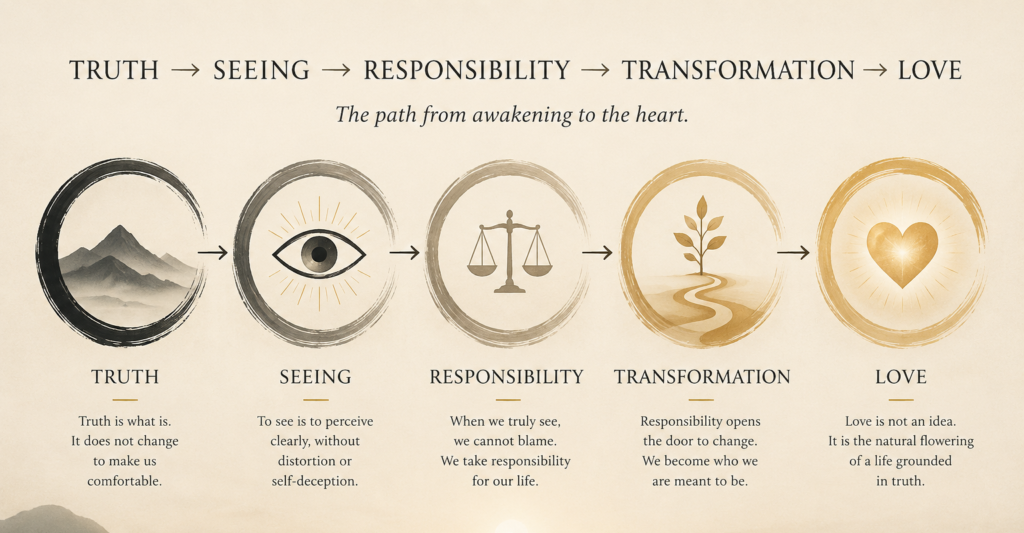
To see ourselves truthfully means encountering the expectations, contradictions, resentments, wounds, defenses, and stories through which we have organized our identity. Spiritual transformation therefore cannot consist only of accumulating beautiful teachings. Eventually, something we believe ourselves to be must be examined.
The ego resists this examination precisely because its survival depends upon maintaining the separate self it has constructed. This is why the old spiritual injunction to “die before you die” becomes more than metaphor. What dies is not the human being but the unquestioned identification with the individual self as the center of reality.
Pain Is Not Outside the Path
Many people enter spiritual practice hoping to suffer less. Shaykh Burhanuddin offers an uncomfortable correction.
“The only thing I can offer you sincerely is more pain, not less.” —Shaykh Burhanuddin Herrmann
This is not a celebration of suffering. It is a recognition of what serious inner work uncovers.
If we sincerely want truth, we eventually encounter what we have avoided. Relationships must be reconsidered. Old wounds surface. Illusions break. Forgiveness may become necessary. Repentance may become necessary. Parts of our history that were organized around blame or self-protection have to be seen again.
The spiritual path does not necessarily create this material. It makes it more difficult to remain unconscious of it. Pain therefore becomes a form of attention.
As Shaykh Burhanuddin explains, when physical pain appears, attention immediately returns to the body. Emotional pain can perform a similar function: it brings us back toward ourselves. The developmental question is not simply whether we suffer, but how we meet suffering.
Can difficulty be experienced without immediately collapsing into it, resisting it, blaming someone for it, or trying to escape it? Shaykh Burhanuddin describes another possibility: learning to suffer more consciously rather than reactively—to learn from difficulty and become strengthened through the encounter.
From Blame to Responsibility
One of the strongest themes running through the conversation is responsibility. As Shaykh Burhanuddin says, “We are the source of our pain.”
This does not mean that other people cannot harm us, that circumstances do not affect us, or that our histories are irrelevant. Shaykh Burhanuddin explicitly acknowledges conditioning and the things that happen to us. The question is what happens next.
If the source of our inner state is continually located outside ourselves, our capacity to act becomes increasingly limited. Someone else becomes responsible for our anger, unhappiness, disappointment, or sense of worth.
His Uwaysi System describes this distinction through the memorable language of multiplayer and single-player modes. In multiplayer mode, responsibility is continually distributed outward: the parent, partner, colleague, stranger, circumstance, or world becomes responsible for what is happening within us. Single-player mode asks something more difficult: What is happening in me?
Relationships then become part of the practice itself. Intimate partners become helpers, revealing aspects of ourselves we might otherwise avoid. Family members and close colleagues become mirrors. Even strangers who irritate us in traffic, a bakery, or a bank become triggers through which previously unseen reactions become visible.
Ordinary life becomes the field of inner work.
The Body Cannot Be Cheated
This movement toward truth is not purely psychological or philosophical. The body participates in knowing. As Shaykh Burhanuddin says, “The body cannot be cheated.”
The mind can construct convincing explanations about what we believe, whom we love, what we want, or why we behave as we do. The body often reveals something before the explanation is complete. There may be contraction or openness, attraction or resistance, ease or tension.
For Shaykh Burhanuddin, this gives the body a sacred position. It is not merely something carried around by the mind. It is part of the perceptual field through which truth can become recognizable.
That observation also places this conversation close to one of the central concerns of Inner Life: the difference between understanding something conceptually and developing the capacity to perceive it directly.
A person can understand an entire spiritual philosophy without that understanding becoming embodied. The body makes that discrepancy harder to hide.
The Heart Does Not Push
If the mind tends toward control, Shaykh Burhanuddin describes the heart very differently.
The heart does not attempt to dominate circumstances. It recognizes timing. It listens. It does not imagine itself to be the controller of the universe but seeks to synchronize with what is occurring.
“The heart does not push. The heart has this tenderness. It has this patience.” —Shaykh Burhanuddin Herrmann
This distinction is subtle. Living from the heart does not mean becoming passive or abandoning discernment. Nor does it mean rejecting the mind. It means changing the relationship between them.
The mind remains useful, but it no longer occupies first place. This creates another way of meeting difficulty. When something refuses to happen despite repeated effort, the response need not always be to push harder. Sometimes the resistance itself becomes information.
Perhaps the timing is wrong. Perhaps the capacity has not yet developed. Perhaps what we are attempting is simply not true for us. The heart introduces tenderness into that encounter.
Silence, Zikr, and the Rebalancing of Attention
The conversation moves from philosophy into practice through silence and zikr, the Sufi practice of remembrance.
For Shaykh Burhanuddin, silence is not simply the absence of noise. Inner space contains both silence and what he calls the “soundless sound.” Human experience itself is paradoxical: anger can be present while another dimension within us remains untouched by anger; sadness can be present while something deeper remains capable of joy.
Harmony does not require eliminating one side of experience. It involves developing the capacity to contain both. Zikr works within this process as a practical instrument.
Shaykh Burhanuddin describes it almost medicinally: it can have physiological, emotional, and cognitive effects. Different practices may be used to address different inner conditions, but their larger purpose is the same.
“All tools are there to remove the veils between us and the divine presence.” —Shaykh Burhanuddin Herrmann
Practice, then, is not valuable merely because it produces a particular state. Its purpose is to change the conditions through which reality is perceived.
One Path, Practiced Deeply
Shaykh Burhanuddin’s own life has brought him into contact with teachers and teachings extending beyond Sufism, including figures such as Krishnamurti and Meher Baba. Yet his conclusion is not that practitioners should accumulate traditions. Quite the opposite.
“I would rather suggest anyone that begins to really focus on one path, and to stay there.” —Shaykh Burhanuddin Herrmann
This distinction matters. Exposure to many teachings can broaden understanding, but breadth is not the same as transformation. A practice becomes formative through depth, continuity, and the willingness to allow it to work upon the practitioner.
In Shaykh Burhanuddin’s own life, despite encounters with multiple teachers and traditions, he describes his actual practice as remaining deeply traditional. The point is not how many teachings we can understand. It is what practice has actually transformed.
A Simple Practice: Smile at the Heart
Near the end of the conversation, Shaykh Burhanuddin offers a remarkably simple practice for someone who wants to begin shifting attention from the outward movement of the mind toward the heart.
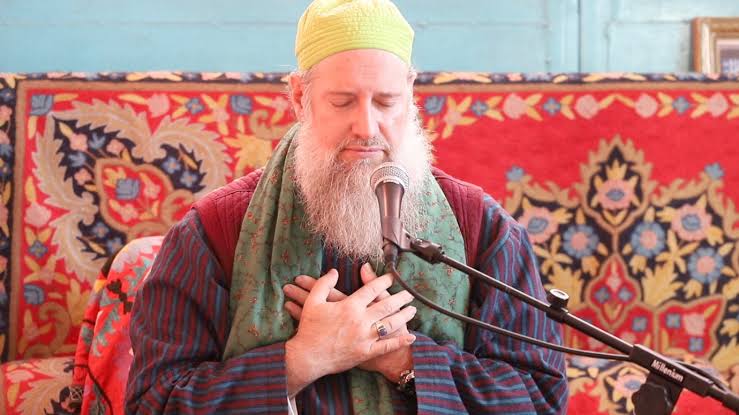
- Place the hands upon the chest.
- Close the eyes.
- Feel the warmth of the hands.
- Bring attention toward the heart.
- And smile at it.
Not sentimentally, but gratefully—recognizing this mysterious organ that has worked continuously in service of life. The practice need not be long.
“If you do it one minute really full, it is in my understanding better than when you sit down half an hour and you just wander around.” —Shaykh Burhanuddin Herrmann
One minute of complete participation can be more transformative than a longer practice performed mechanically. Alongside this, he recommends something even simpler: Say thank you. Again and again. Not only when circumstances are favorable, but as a practice of remembering that life itself—including its difficulty—is not necessarily acting against us.
Gratitude gradually interrupts complaint. Complaint turns attention outward toward what should have been different. Gratitude returns attention to participation in what is actually here.
From Understanding to Transformation
What emerges from this conversation is not a philosophy of escaping ordinary life. It is almost the opposite. The parent, partner, colleague, stranger, disappointment, bodily reaction, moment of anger, painful memory, silence, breath, voice, and beating heart all become material for practice.
The movement is from mind toward heart, blame toward responsibility, reaction toward observation, abstraction toward embodiment, and spiritual ideas toward lived transformation. Truth comes first because without truth there is nothing stable upon which transformation can stand.
Pain becomes meaningful when it returns attention to what has not yet been seen. The body becomes a participant in knowing. Practice becomes the means through which perception itself changes.
And perhaps that is why the path Shaykh Burhanuddin describes cannot finally be reduced to an explanation. It must be practiced. It must be encountered. And ultimately, it must become lived.
About the Guest
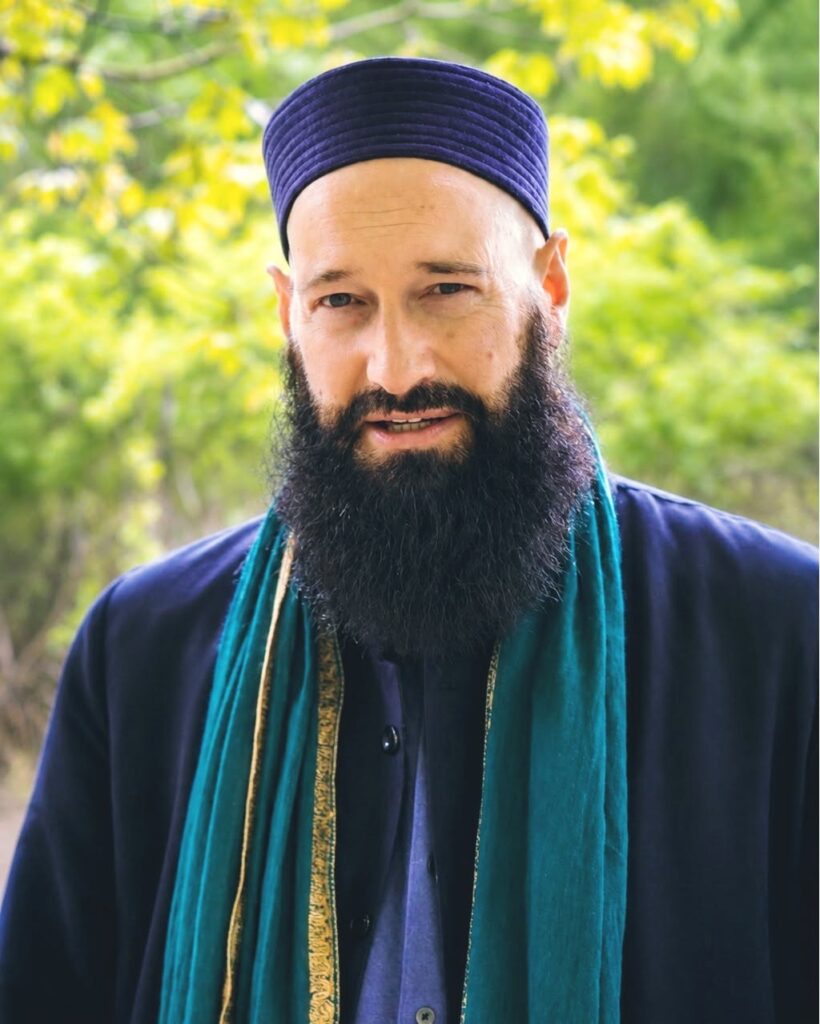
Shaykh Burhanuddin Herrmann is a contemporary Sufi teacher, spiritual guide, author, and musician who received direct transmission within the Naqshbandi Sufi Order. At eighteen, he met Mawlana Shaykh Nazim al-Haqqani ar-Rabbani and subsequently spent thirty-five years close to his teacher, accompanying him internationally and undertaking traditional dervish training that included intensive meditation and prayer, spiritual retreats, disciplined practice, and the integration of spiritual work into everyday life.
For more than three decades, Shaykh Burhanuddin has led spiritual gatherings, teachings, and retreats around the world. His work emphasizes self-observation, responsibility, gratitude, remembrance, the awakening of the heart, and bringing spiritual practice into daily life. He also teaches the Uwaysi System, a method of inner development presented in a universal form for people both within and outside traditional religious paths.
Shaykh Burhanuddin is the author of three books—The Camel on the Roof, The Metropolitan Dervish, and Sufism—and is a musician and founder of the Dervish Orchestra. His teaching brings the traditional discipline of the Sufi path into conversation with the psychological and spiritual challenges of contemporary life.
Continue Exploring