
The Soul Speaks Before We Have Words
Living Truth: Recognition, Practice and Transformation
by Mark V. Wiley
There are moments in life when something is recognized before it is understood.
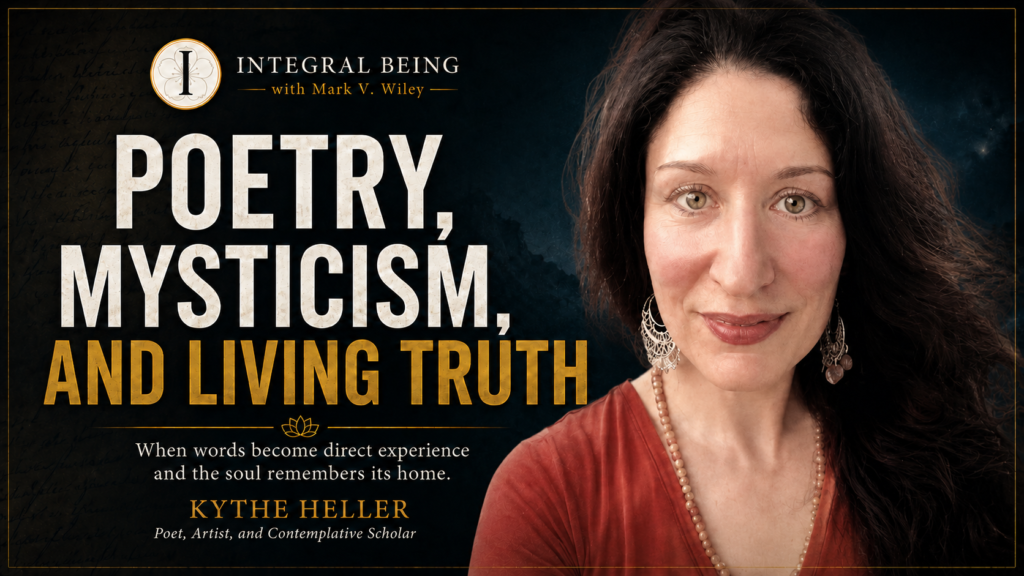
Before there is language, before there is structure, before there is any framework capable of explaining what is happening, there is simply living truth, a kind of knowing. My conversation with Kythe Maryam Heller returned again and again to this idea: that the deepest truths of our lives are often encountered long before we possess the words to describe them.
Many people experience this as children. There is an immediate and unfiltered sensitivity to the world. Meaning seems present within things before we can explain it intellectually. Beauty, wonder, intuition, love, and inward knowing arrive first as experiences and only later become ideas. Something feels real long before it becomes understandable.
Poetry, in this sense, is not merely a literary form. It is recognition. Kythe’s own poems bring this front and center.
What poetry accomplishes at its highest level is not explanation but revelation. It gives language to experiences that already exist within us. It names what we have felt but could not articulate. When that happens, something profound occurs. We no longer feel isolated inside an experience that seemed impossible to communicate. We discover that what appeared uniquely ours belongs to something larger and more universal.
What struck me most was that Kythe did not speak of this recognition as an artistic preference or philosophical inclination. She described it almost as a necessity. Once something has been encountered directly—even briefly—a person cannot fully return to inherited explanations or second-hand understanding. Something within continues searching for the source of that recognition.
“Once something is felt directly, substitutes no longer satisfy.” —Kythe Maryam Heller
The Search Beyond Structure
That early recognition becomes a thread running through an entire life.
It is what drives the search beyond conventional structures, inherited beliefs, and borrowed certainties. Once the soul recognizes something real, it naturally seeks a deeper relationship with that reality.
This search is rarely linear. In Kythe’s story it moved through hardship, dislocation, artistic creation, Buddhist practice, yoga, contemplative disciplines, academic inquiry, and eventually Sufism. Yet none of these appeared as identities to adopt or systems to collect. Each became a stage of refinement—a way of removing obstacles to direct experience rather than replacing it with another layer of concepts.
This distinction feels increasingly important in a culture that often mistakes spiritual activity for spiritual transformation. Practices are not ends in themselves. They are not badges of belonging or performances of identity. They prepare the ground. They stabilize attention, regulate the body and mind, refine perception, and create the conditions in which deeper encounters become possible.

But they cannot replace the encounter itself.
“Practices prepare the ground, but they do not replace the encounter.” —Kythe Maryam Heller
One of the most compelling dimensions of the conversation was the way embodiment continually appeared beneath the philosophical language. Breath. Posture. Sensation. Attention. Yoga not as performance, but as surrender. Meditation not as identity, but as purification. Practice not as accumulation, but as reorganization.
The body participates in awakening. Over time, what begins as method can become a way of being.
The Soul Moves Through What Is Needed
This insight also reframes how we understand spiritual traditions themselves.
From the outside, traditions appear separate. They possess different languages, rituals, doctrines, and cultural forms. Yet at the level of direct experience, the movement can feel surprisingly continuous. The soul does not always experience these distinctions in the same way the intellect does.
“The soul moves through what is needed, not what is structured.” —Kythe Maryam Heller
There was something deeply honest in the way Kythe described this movement. Not triumphantly. Not ideologically. Simply as a process of being guided. Certain practices stabilized the mind. Others deepened embodiment. Others revealed the limitations of self-directed seeking itself. What emerged was not a collection of conclusions but a gradual unveiling.
This perspective challenges the modern tendency to define ourselves through labels and affiliations. It suggests that the deepest movement of transformation is not toward a spiritual identity but toward increasing intimacy with reality itself.
Suffering and the Fire of Transformation
Another powerful thread running through the conversation was the relationship between suffering and transformation.
Modern culture tends to view suffering exclusively as damage, interruption, or pathology. Certainly suffering can wound, distort, and overwhelm. Yet there are moments when hardship reveals dimensions of human experience that comfort never could.
Kythe’s story of a young girl carrying immense suffering alongside extraordinary grace becomes symbolic of this possibility. The suffering did not erase her humanity. In some mysterious way, it revealed something deeper within it.
“Suffering can reveal what comfort cannot.”
—Kythe Maryam Heller
This is not an argument for seeking suffering or romanticizing pain. Rather, it is a recognition that difficult experiences sometimes strip away illusion. They reveal tenderness, resilience, compassion, humility, and presence that might otherwise remain hidden.
The image of the phoenix appears repeatedly throughout Kythe’s work because it expresses this paradox so well. Transformation is not merely self-improvement. It is not the accumulation of skills, achievements, or experiences. Genuine transformation often requires the dissolution of what can no longer remain.
Something burns. And something truer emerges.

of what can endure the fire.
“Suffering can reveal what comfort cannot.” —Kythe Maryam Heller
This is not an argument for seeking suffering or romanticizing pain. Rather, it is a recognition that difficult experiences sometimes strip away illusion. They reveal tenderness, resilience, compassion, humility, and presence that might otherwise remain hidden.
The image of the phoenix appears repeatedly throughout Kythe’s work because it expresses this paradox so well. Transformation is not merely self-improvement. It is not the accumulation of skills, achievements, or experiences. Genuine transformation often requires the dissolution of what can no longer remain.
Something burns. And something truer emerges.
“Transformation is not addition. It is burning and renewal.” —Kythe Maryam Heller
Beyond Knowledge
One of the clearest themes throughout the conversation was the distinction between understanding and realization.
Academic study, philosophy, theology, psychology, and spiritual systems can all point toward truth. Yet eventually they encounter a limit. They can describe transformation, but they cannot produce it. They can explain awakening, but they cannot substitute for awakening itself.
This distinction feels especially relevant today. Never before have people had such unprecedented access to information. We can study virtually every contemplative tradition, psychological system, or mystical teaching from our phones. Yet information alone does not change perception.
The deeper question is not whether we understand a teaching conceptually.
It is whether it changes the way we experience reality.
“Understanding is limited until it becomes lived.” —Kythe Maryam Heller
This may be why so many traditions gradually lose their vitality. The forms remain while the living experience fades. Ritual survives, but transformation disappears. Structure continues, but contact is lost.
“Tradition without experience becomes empty form.” —Kythe Maryam Heller
What is missing is not knowledge. It is living realization.
Living Transmission
This is also why the role of a teacher remains so important across spiritual, contemplative, artistic, and martial traditions. Not because authority itself possesses value, and not because obedience produces wisdom, but because realization is contagious.
At a certain point, every seeker encounters the limits of self-reference. We begin to realize that we are still interpreting reality through the lens of our own conditioning, assumptions, and habits of perception. No matter how sincere our efforts may be, we remain confined within the boundaries of what we already know. The system gradually becomes closed upon itself.
To move beyond those limitations requires relationship. It requires contact with someone who embodies a deeper realization and whose presence reveals possibilities we cannot yet see for ourselves.
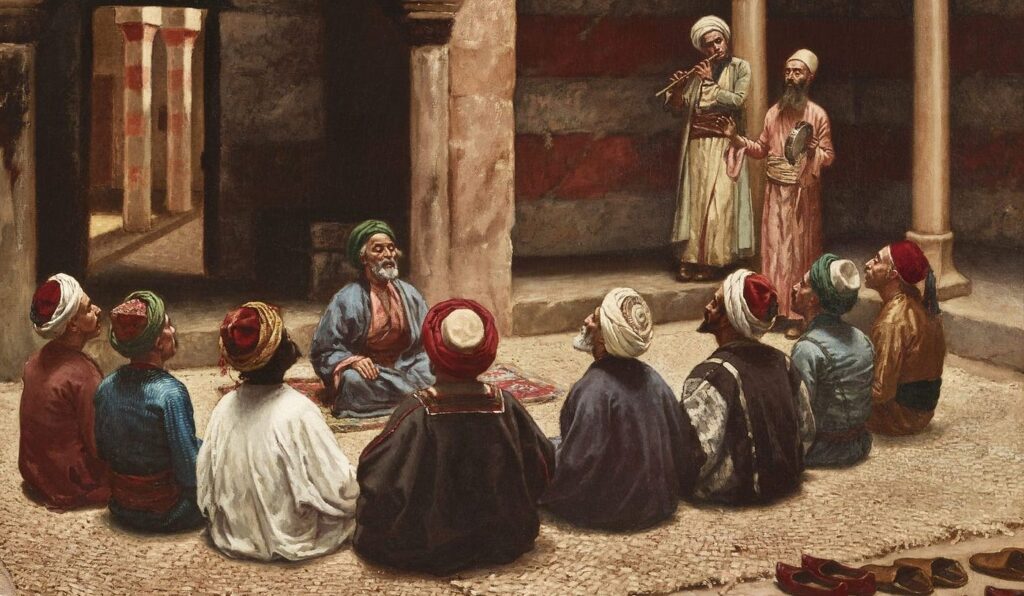
“A teacher is not authority, but living transmission.” —Kythe Maryam Heller
This insight extends far beyond spirituality. It applies equally to martial arts, contemplative disciplines, healing traditions, and artistic practice. Techniques alone are never enough, and information alone is never enough. Something deeper must be embodied, transmitted, and recognized through direct contact. Without that living transmission, traditions slowly become collections of forms and methods, preserving their structure while losing their vitality.
Art as Participation
This understanding transforms the meaning of art itself. In Kythe’s view, art is not fundamentally a form of self-expression. It is a form of participation.
“Art is not expression. It is participation in truth.” —Kythe Maryam Heller
The artist is no longer someone manufacturing meaning, but someone learning to listen deeply enough to receive it. Creativity becomes an act of receptivity rather than assertion. Artistic practice and spiritual practice begin to converge because both require attention, humility, surrender, and the willingness to be transformed by what is encountered.
Seen in this way, art becomes a form of praise. It is not merely the production of something new, but the honoring and revealing of something that already exists. The artist participates in reality rather than attempting to dominate it.
Perhaps this is why certain conversations remain with us long after they end. Not because they provide definitive answers, but because they awaken recognition. Something within us remembers itself, and for a moment the distance between art, suffering, practice, devotion, and truth begins to disappear.
And perhaps that is the deepest thread running through this entire conversation. The most important truths in our lives are rarely invented; they are uncovered. Before philosophy, before theology, before poetry, and before practice, there is often a moment of direct recognition. Something in us knows before we know how to explain it.
The soul speaks first.
The rest of life becomes the attempt to listen.
Watch the full conversation with Kythe Maryam Heller below
Continue Exploring
The Inner Life Model
How body, breath, attention, and perception organize into lived experience.
The Practice Field
What emerges when perception, awareness, and embodied capacities begin functioning together.
Integrated Modular Training (IMT)
How capacities develop, integrate, and become stable traits rather than temporary experiences.
Integral Being
Conversations exploring transformation, embodiment, and the cultivation of the human being.
Continue Exploring Transformation & Inner Development