
The Human Being as an Unfinished Project
Reflections on Consciousness, Transformation, and Human Possibility
by Mark V. Wiley
Have we reached the limit of our human potential?
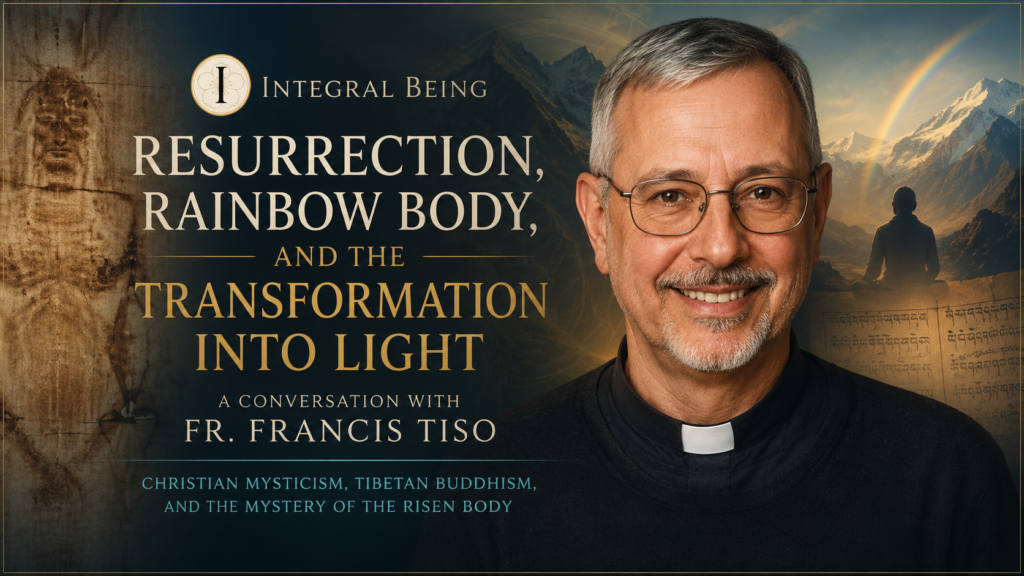
During my conversation with Father Francis Tiso, a question emerged that extended far beyond Christianity, Tibetan Buddhism, resurrection, or rainbow body—the topics of our conversation. Beneath the discussion of saints, mystics, luminous bodies, contemplative traditions, and extraordinary accounts lay a deeper inquiry—one that has appeared repeatedly throughout many of the conversations hosted on Inner Life.
What if the human being is not finished?
Modern culture often assumes that human beings are largely understood. We know our biology. We understand psychology. We have sophisticated models of behavior, cognition, and social organization. Yet across centuries and cultures, contemplative traditions have continued to suggest that human beings possess capacities that remain largely unrealized. Their languages differ. Their metaphysics differ. Their practices differ. Yet they repeatedly point toward the possibility that consciousness can develop beyond its ordinary condition.
Whether one studies Christian mysticism, Daoist cultivation, Sufism, Integral Yoga, Buddhism, or embodied traditions, a similar intuition emerges. Human life may not end where ordinary awareness begins.
“The question is not whether traditions are identical, but whether they are pointing toward underexplored capacities within the human organism.” —Fr. Francis V. Tiso
The Question Beneath the Miracles
Extraordinary stories tend to attract attention. Reports of resurrection, rainbow body, luminous saints, mystical visions, and transformed beings naturally provoke fascination, skepticism, belief, or debate. Yet these phenomena may distract us from the deeper question they are attempting to illuminate.
Father Tiso’s inquiry is not ultimately about proving miracles. Rather, it is about understanding why remarkably similar accounts continue to emerge across traditions separated by geography, language, and theology. Why do cultures that developed independently preserve stories of illumination, transformation, expanded awareness, and extraordinary realization? Why do descriptions of light, transfiguration, awakening, and profound inner change appear so consistently throughout human history?
The modern tendency is to place these stories into one of two categories. They are either accepted as literal supernatural events or dismissed as mythology and religious imagination. Yet there is a third possibility. Perhaps these traditions are preserving observations about dimensions of human development that modern civilization has not yet fully understood.
The value of these accounts may not lie in convincing us that extraordinary events occurred. Their value may lie in challenging our assumptions about what a human being is capable of becoming.
Humanity Is Not Complete
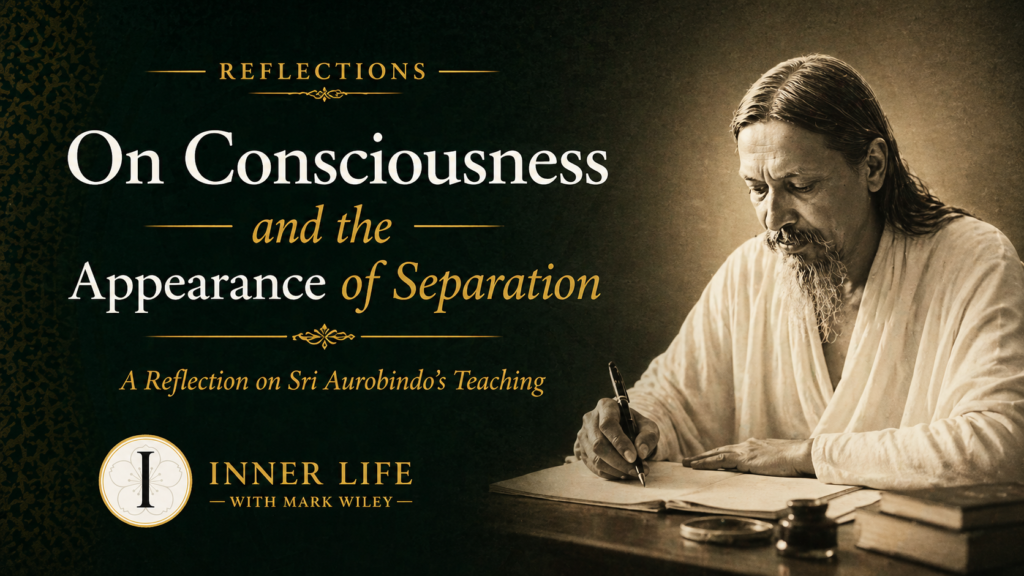
The idea that human development is unfinished appears repeatedly across traditions. It is one of the central themes underlying the work of Sri Aurobindo, whose vision of consciousness rejects the notion that the present human condition represents the final stage of evolution.
“Humanity is not complete.” —Sri Aurobindo
For Aurobindo, evolution is not merely biological. It is also conscious. Human beings are transitional creatures, participating in an ongoing developmental process that extends beyond intellect, belief, and conventional identity. What we call ordinary awareness may be less an endpoint than a midpoint.
This perspective resonates strongly with Father Tiso’s reflections. The mystery of resurrection or rainbow body becomes less a question about isolated miracles and more a question about unrealized possibilities within human life. Whether such accounts are ultimately understood literally, symbolically, or through frameworks not yet available to us, they point toward the same fundamental intuition: the human organism may possess capacities that remain dormant under ordinary conditions.
This does not require belief. It requires openness. The question is not whether extraordinary transformation is guaranteed. The question is whether our current understanding of consciousness is complete.
Transformation Is Not Self-Improvement
One of the most important themes emerging from the wisdom traditions is the distinction between transformation and self-improvement. Modern culture is saturated with strategies for becoming more successful, more productive, more efficient, and more optimized. Spirituality often becomes absorbed into this same framework. Yet genuine contemplative traditions point elsewhere.
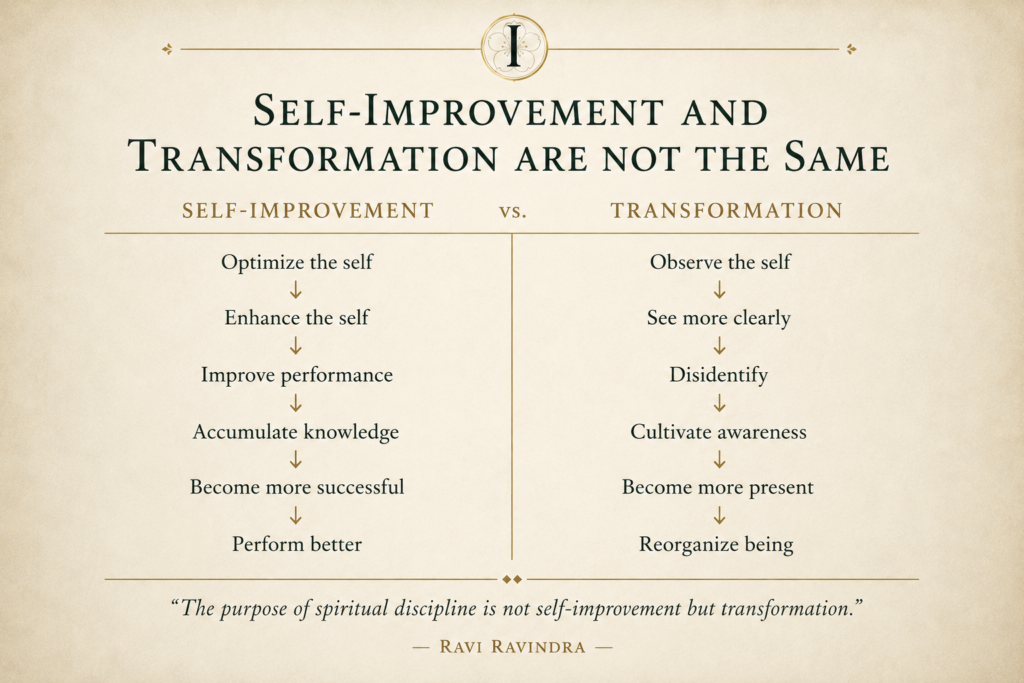
One seeks to enhance the self; the other seeks to see more clearly and reorganize being.
This distinction changes everything. Self-improvement seeks to strengthen the existing self. Transformation questions whether the self we habitually defend is the deepest expression of who we are. Improvement accumulates. Transformation reorganizes. Improvement works within existing assumptions. Transformation reveals that many of those assumptions may be incomplete.
Ravi Ravindra repeatedly returns to this insight. The aim of practice is not to become a more sophisticated version of our conditioning. It is to encounter reality more directly. Such encounters often require a shift in perception rather than the acquisition of additional knowledge.
In this sense, transformation is not the enhancement of identity. It is the gradual loosening of identification itself.
Practice Before Phenomena
One of the most overlooked aspects of extraordinary spiritual accounts is that the individuals associated with them rarely pursued extraordinary experiences. Saints, yogis, monks, contemplatives, and mystics devoted themselves to practice. Their lives were shaped by discipline, attention, prayer, meditation, ethical refinement, service, and sustained self-observation.
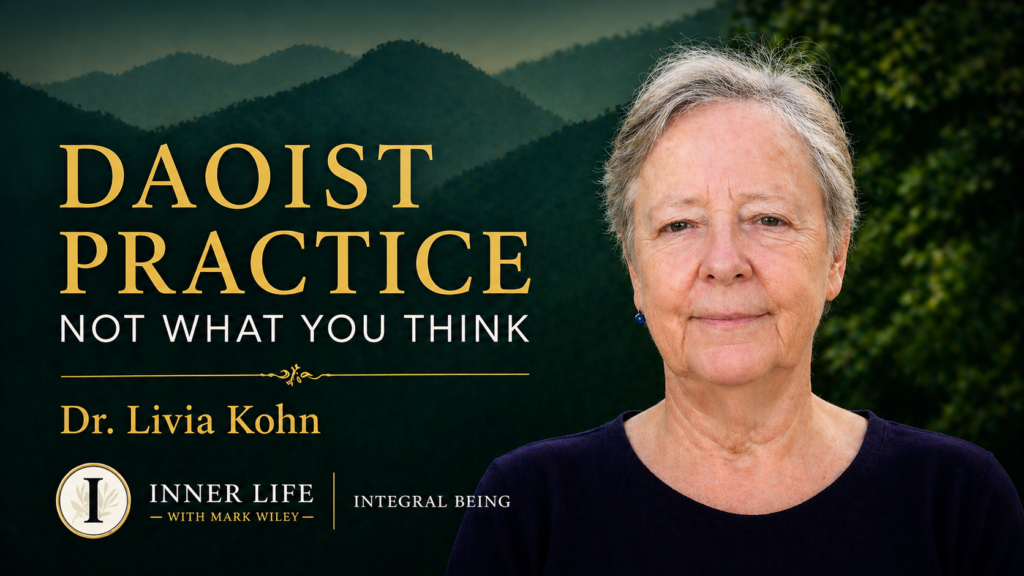
The phenomenon was never the goal. The path IS the goal. Dr. Livia Kohn expresses this beautifully through the Daoist understanding of cultivation.
“The experience happens. It’s not something you can plan. But you can make yourself prone to it.”
—Dr. Livia Kohn
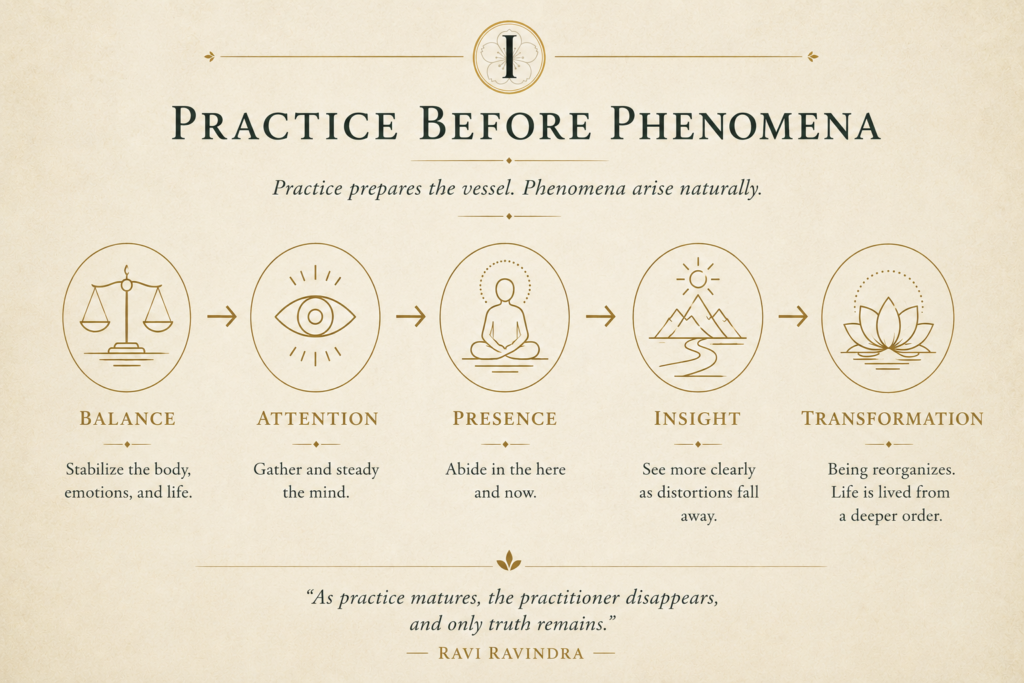
This reverses much of modern spirituality. Rather than chasing experiences, Daoist cultivation prepares the conditions through which deeper realization may emerge naturally. The emphasis shifts from acquisition to refinement.
Dr. Baffour Jan offers a complementary perspective.
“Transformation does not begin in the mind. It begins in balance.” —Dr. Baffour Jan
Before insight, there is regulation. Before realization, there is coherence. Before expanded awareness, there is the restoration of balance within the body, breath, nervous system, and perception.
Tai Chi Sifu Stuart Alve Olson echoes the same principle from the perspective of Taoist and martial cultivation.
“The body reveals what the mind cannot conceptualize.” —Sifu Stuart Alve Olson
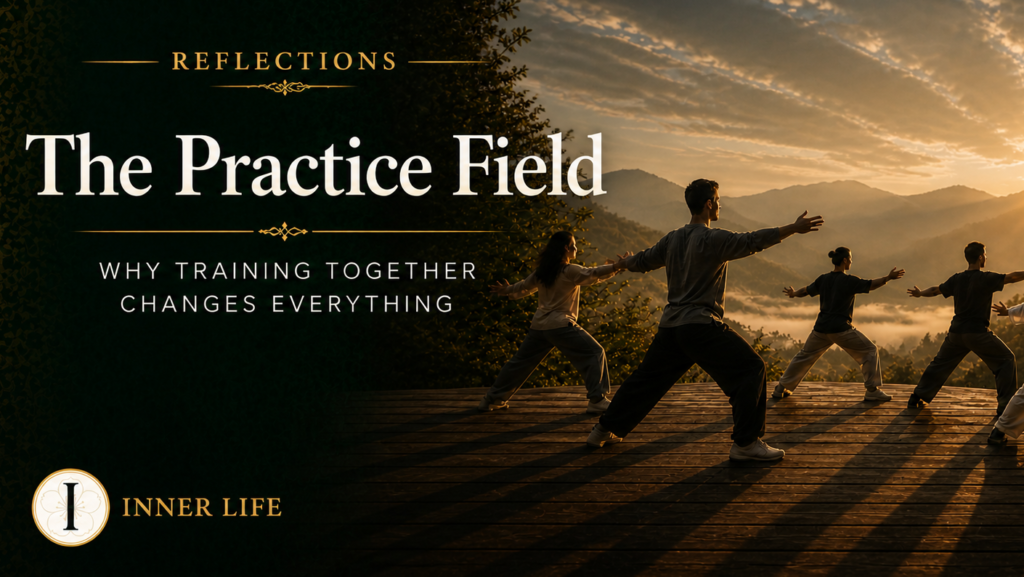
Across traditions, the pattern remains remarkably consistent. Lasting transformation emerges through participation in a disciplined way of life. It is embodied before it is understood. It is practiced before it is explained.
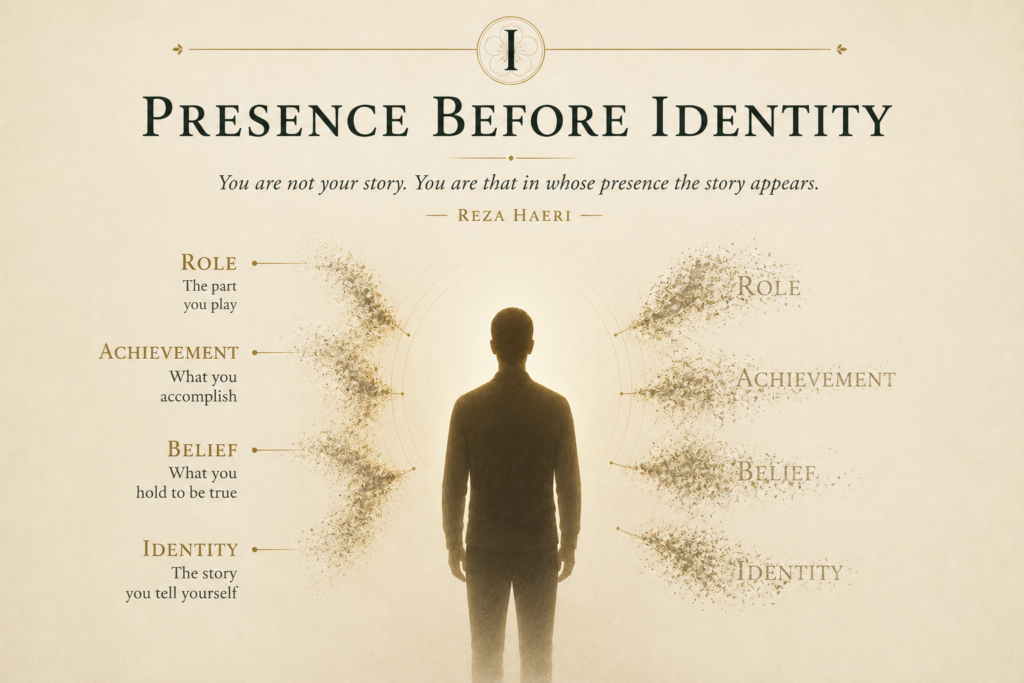
Presence Before Identity
Many spiritual traditions begin by asking who we are. Eventually they begin asking what remains when our familiar answers dissolve.
Shaykh Fadhlalla Haeri repeatedly returns to the simplicity of presence. Rather than constructing new identities, accumulating spiritual achievements, or seeking special status, his teaching points toward recognition.
“Presence, presence, presence—reconnects you to the source.” —Shaykh Fadhlalla Haeri
This movement from accumulation toward recognition appears throughout the contemplative traditions. What is sought is often described as already present, obscured not by distance but by identification.
Dr. David Parrish approaches a similar realization through the distinction between awareness and personality. Personality consists of conditioning, habits, preferences, memories, and narratives. Awareness is the background within which all of these arise. The crucial insight is that awakening and integration are not the same process. Seeing clearly is one thing. Living from that clarity is another.
This distinction is important because it prevents spiritual realization from becoming another abstraction. Insight alone does not transform a life. Transformation becomes real only when awareness enters relationship, work, emotion, responsibility, and daily living.
The task is not escape. It is embodiment.
The Human Being as an Open Question
Perhaps the greatest gift offered by the contemplative traditions is not certainty but humility. They remind us that our current understanding of human nature may be provisional. What appears obvious today may eventually reveal itself as incomplete.
The saints, mystics, contemplatives, sages, and realized beings preserved in these traditions may not be important because they performed extraordinary feats. They may be important because they challenge the limits of what we assume is possible.
The traditions disagree about theology. They disagree about cosmology. They disagree about doctrine and method. Yet many converge around a remarkably similar observation. Human beings are capable of greater awareness, deeper integration, expanded perception, and more profound transformation than ordinary life typically reveals.
Whether one speaks of awakening, realization, enlightenment, sanctification, liberation, presence, or transformation, the invitation remains fundamentally the same. Attend more deeply. Practice sincerely. Refine perception. Become available to what is already present.
The enduring significance of these traditions may not lie in the stories they preserve but in the questions they refuse to abandon.
- What if consciousness can develop further than we imagine?
- What if transformation is more real than self-improvement?
- What if human life contains possibilities that remain largely unexplored?
- And what if the most important response is neither belief nor disbelief, but the willingness to participate in the inquiry ourselves?
The human being remains, in many ways, an unfinished project.
What Inner Life Is Exploring
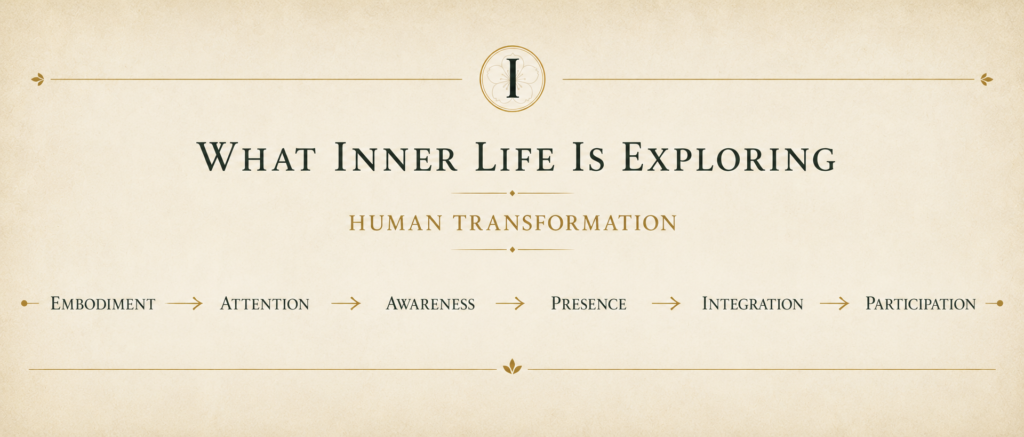
Across the conversations, reflections, practices, and field notes of Inner Life, a common pattern continues to emerge. The traditions differ in language, symbolism, and method, yet they repeatedly point toward the possibility of human transformation through disciplined engagement with life.
Some traditions begin with meditation. Others begin with movement. Some begin with contemplation, prayer, martial discipline, service, self-inquiry, or the cultivation of attention. Yet beneath these differences lies a shared developmental intuition: consciousness can mature, perception can refine, and the human organism can become more integrated, responsive, and aware.
This recognition forms the foundation of the Inner Life model.
Inner Life is not organized around belief, ideology, or a particular spiritual tradition. It is organized around the observation that transformation appears to follow recognizable developmental principles regardless of the path through which it is approached. The body can be trained. Attention can be refined. Awareness can deepen. Identity can become less rigid. Perception can become more direct. Human experience can become more integrated.
Whether one studies Daoist cultivation, Christian contemplation, Sufism, Integral Yoga, Buddhist practice, psychology, or embodied disciplines, the same essential question remains: What changes through sustained practice?
The purpose of Inner Life is not to provide definitive answers to that question. It is to explore the territory where those answers may be discovered through experience.
“Different traditions illuminate different aspects of the journey, yet each points toward the same possibility: greater presence, awareness, integration, and participation in life.” —Mark V. Wiley
The conversations gathered within Inner Life are therefore not separate subjects. They are different windows looking into the same field of human development. What appears at first to be many paths gradually reveals itself as a shared inquiry into consciousness, embodiment, transformation, and the unfolding possibilities of human life.
Continue Exploring