
The Inner Life Regulation Model
Understanding the Three Conditions of Human Development
Reading the Condition of the Human System
Every living system continuously moves toward or away from greater integration.
The Inner Life Regulation Model offers a practical way of recognizing that movement through three recurring conditions: Excess, Stagnation, and Deficiency (ESD).
These are not diagnoses or fixed personality traits. They are observable patterns that appear in the body, attention, emotion, relationships, work, leadership, and everyday life.
Learning to recognize these conditions allows us to respond intelligently rather than mechanically.
Immediately we’ve expanded the audience.
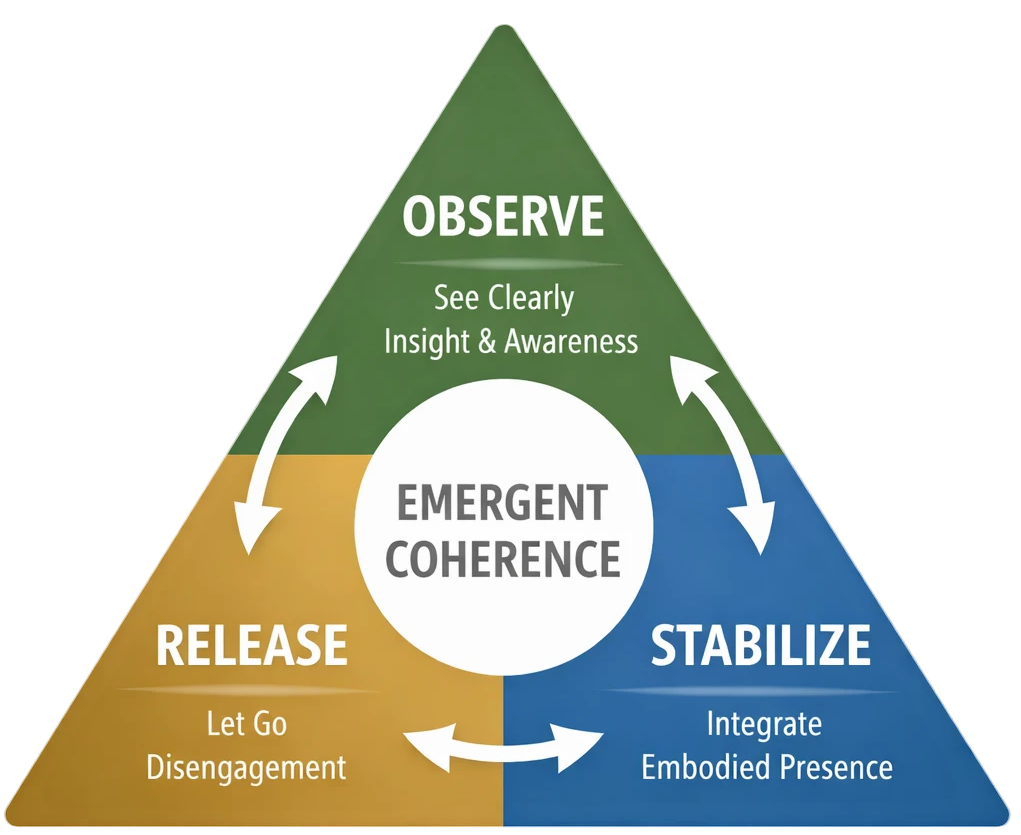
These conditions are not separate. They interact continuously. Excess can lead to stagnation. Stagnation can mask deficiency. Deficiency can result in compensatory excess. The system is always moving between them. Together these three conditions form the basis of the ESD Framework. Rather than asking whether a person is succeeding or failing, the model asks a more useful question: What condition is the system expressing right now?
A Deeper Layer: Identification
The Inner Life Regulation Model operates on two levels. First, how imbalance appears in the system—through excess, stagnation, and deficiency. At a deeper level, however, these patterns are not only experienced—they are often identified with.
If we consider classical frameworks such as the Yoga Sutras of Patanjali, a further distinction becomes clear: disturbance is not only a matter of imbalance, but of misidentification—the tendency for awareness to become entangled with what it observes. From this perspective, each condition can be understood across two layers:
Energetic / Functional
- Excess → overdrive, agitation
- Stagnation → blockage, dullness
- Deficiency → weakness, instability
Identification
- “I am this thought”
- “I am this reaction”
- “I am this state”
This distinction is subtle but critical. It is not simply that imbalance arises, but that it is taken to be self. When this occurs, the system is no longer only imbalanced—it is entangled.
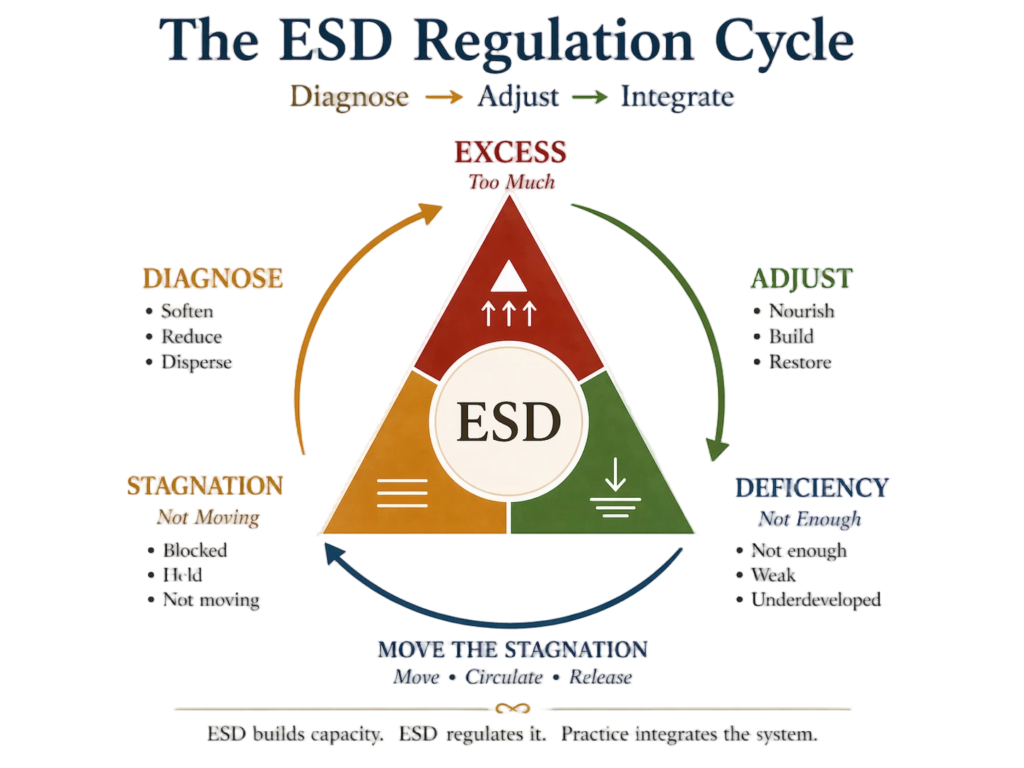
Seen this way, ESD does not only describe condition. It reveals how perception and identity become fused within that condition—and how, through practice, that fusion can begin to loosen. Where identification remains, underlying patterns persist. As identification loosens, those patterns begin to resolve at their root.
Intelligent Regulation
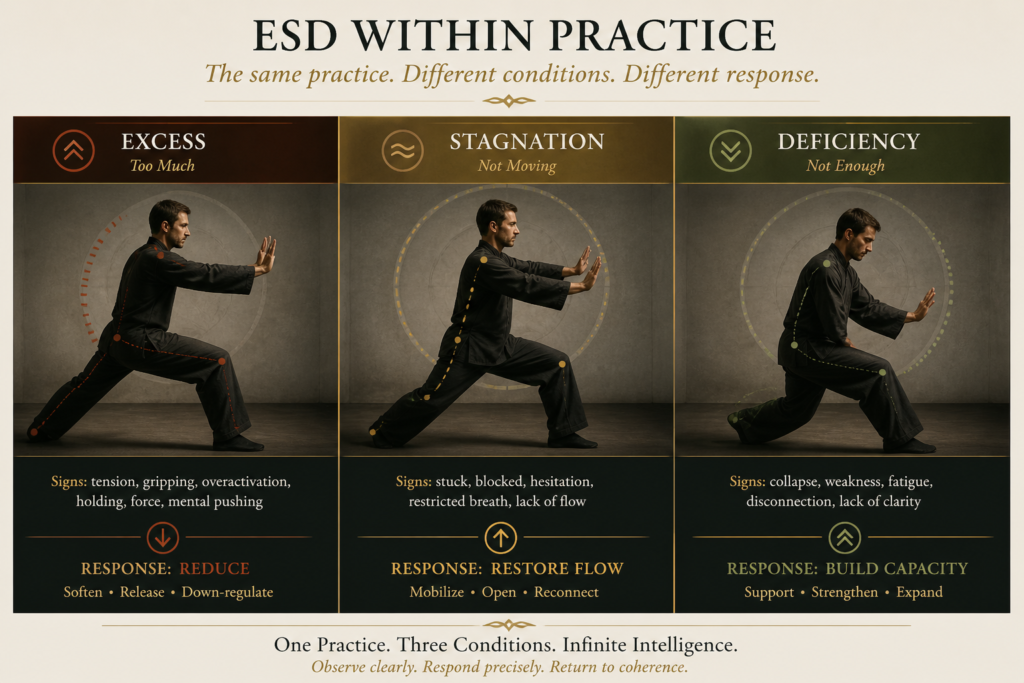
The Inner Life Regulation Model insists that each condition calls for a different response.
Excess must be reduced. Not by suppression, but by softening what is unnecessary. Effort decreases. Tension releases. What is over-applied is allowed to settle.
Stagnation must be moved. Not by force, but by restoring flow. Breath circulates. Movement returns. What is held begins to open.
Deficiency must be built. Not by compensation, but through development. Strength is trained. Attention stabilizes over time. Structure becomes reliable.
These are not techniques in themselves. They are principles that guide how techniques are applied.
A Universal Pattern
These patterns are not limited to practice. You can observe them in everyday life. These patterns are not limited to physical practice. They appear across all domains of human experience.
- In the body, excess appears as tension or inflammation, stagnation as restriction or poor circulation, and deficiency as weakness or fatigue.
- In the mind, excess appears as agitation or overthinking, stagnation as dullness or avoidance, and deficiency as lack of focus or instability.
- In action, excess appears as force without sensitivity, stagnation as hesitation or freezing, and deficiency as lack of structure or coordination.
In emotion, excess appears as overwhelm or reactivity, stagnation as suppression or withdrawal, and deficiency as numbness or lack of connection.
Across all domains, the pattern remains the same. What changes is not the structure of imbalance, but how it expresses. Whether we examine an individual, a family, a team, or an organization, the same three conditions repeatedly emerge.
ESD and Embodied Development
Within Inner Life, Regulation Model does not stand alone.
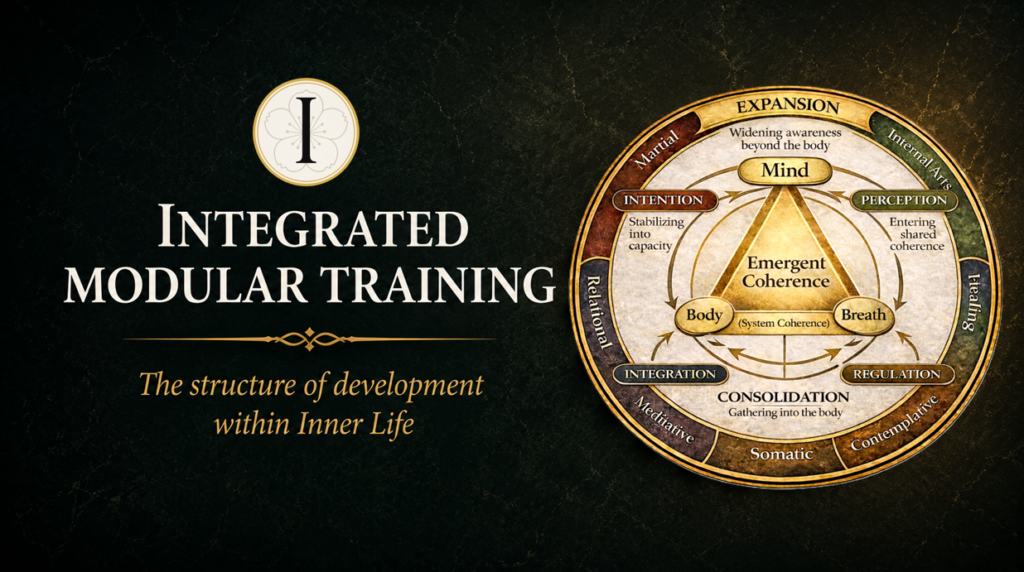
Integrated Modular Training (IMT) describes what is being developed—stability, continuity, clarity, and integration. ESD describes how that development is regulated.
As capacity increases, imbalance appears. Stability can become rigidity. Continuity can break. Clarity can dull. Integration can fragment under pressure.
ESD allows this to be recognized and corrected in real time.
- IMT builds capacity.
- ESD regulates it.
- Practice integrates both.
Together, they form a continuous feedback loop: development, imbalance, recognition, adjustment, and reorganization.
Stable Isn’t Finished
As this shift stabilizes, perception becomes more direct. Imbalance is sensed early, and adjustment becomes natural. Yet even here, another distinction becomes important.
Periods of clarity and coherence can arise while deeper patterns remain. The system may feel stable, perception may be clear, and reactivity may be reduced—but certain tendencies may still exist in latent form.
Classical systems such as those described by Patanjali refer to these as underlying impressions—patterns that have not yet been fully resolved.
Within the ESD model, this can be understood as the difference between:
- Immediate balance (what is present now)
- Latent conditioning (what has not yet been expressed)
This distinction prevents confusion between temporary coherence and deeper transformation. Over time, as practice continues, these underlying patterns are not suppressed, but gradually lose their force. What once reappeared no longer does. What once required management no longer arises.
In this way, practice does not only regulate imbalance—it refines the system at progressively deeper levels, until stability is no longer conditional.
This marks a shift—from thinking about practice to sensing condition directly.
Beyond Training
This perception does not remain confined to formal training. It informs how one eats, moves, rests, and responds to stress. The same patterns appear across domains. The same principles apply.
Eventually the model is no longer something we apply. It becomes the way we perceive ourselves, other people, and the changing conditions of life.
It is the language of imbalance as it appears in real time—simple, direct, and continuous. Through recognizing it, practice becomes not a fixed method, but a responsive process of ongoing refinement.
ESD becomes more than a model. It becomes a way of reading the system—not as theory, but as direct experience. It reflects how the system is failing—or learning—to regulate opposing forces within a living process.
[The Inner Life Regulation Model was expanded from a model of pulse diagnosis in Traditional Chinese Medicine.]
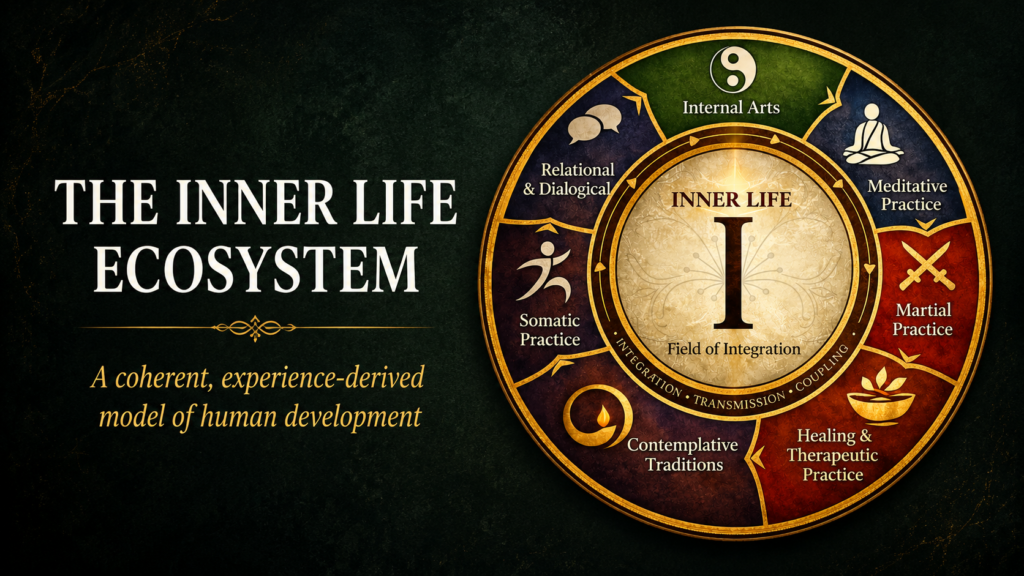
The Inner Life System describes the developmental process through which embodied human capacities are cultivated, refined, stabilized, and expressed.
The Inner Life Regulation Model explains how development is continually assessed and refined.
Together they form one integrated system for embodied human development.
Explore the Inner Life Framework