A Practice Is Different Than Practicing
Why a Practice Is Different Than Practicing—and Why Real Development Extends Beyond the Training Session
by Mark V. Wiley
There is an important distinction that is easy to overlook. A practice is different than practicing, and understanding that difference changes how we approach real development.
Most of us think of practice as something we do. We meditate before work. We perform a qigong exercise. We attend a yoga class. We train in martial arts. We journal, pray, or spend time in contemplation. These activities all matter. They can calm the mind, strengthen the body, deepen attention, and open us to new possibilities. But there is another meaning of Practice that is often missed.
“Practicing” is something we do. A practice is different than practicing because practicing fills time, while “a practice” gradually reshapes the person. Over time, a practice becomes more than a collection of exercises or techniques. It becomes the way we meet life itself. At first, the distinction seems subtle. In time, it changes everything.
“Practicing fills time. A Practice gradually reshapes the person.” —Mark V. Wiley
Training Sessions Are Only the Beginning
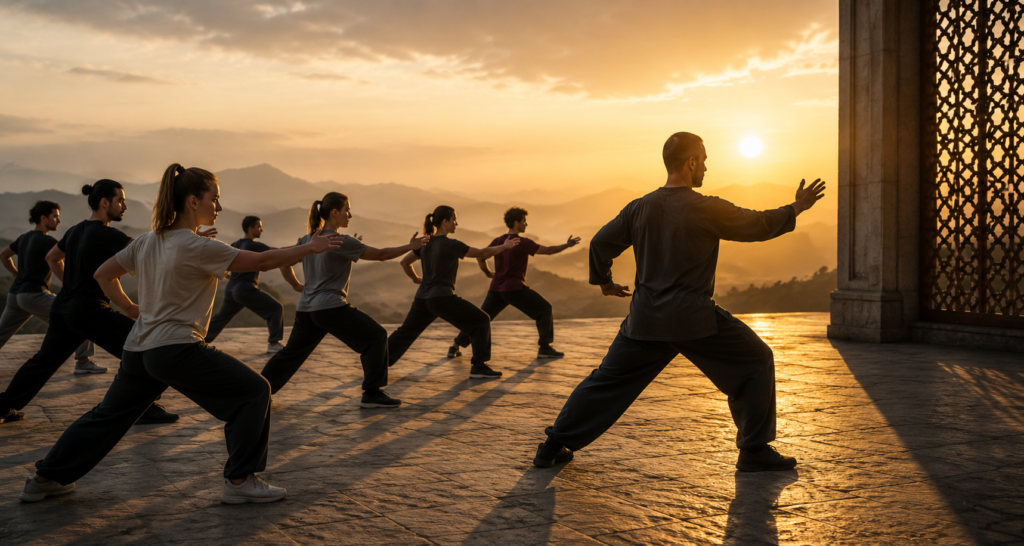
Every authentic path begins with dedicated periods of training. Without them, nothing deeper can develop. We learn techniques, repeat movements, return to the breath, observe our thoughts, and cultivate stability through repetition. These sessions matter because they create the conditions for development.
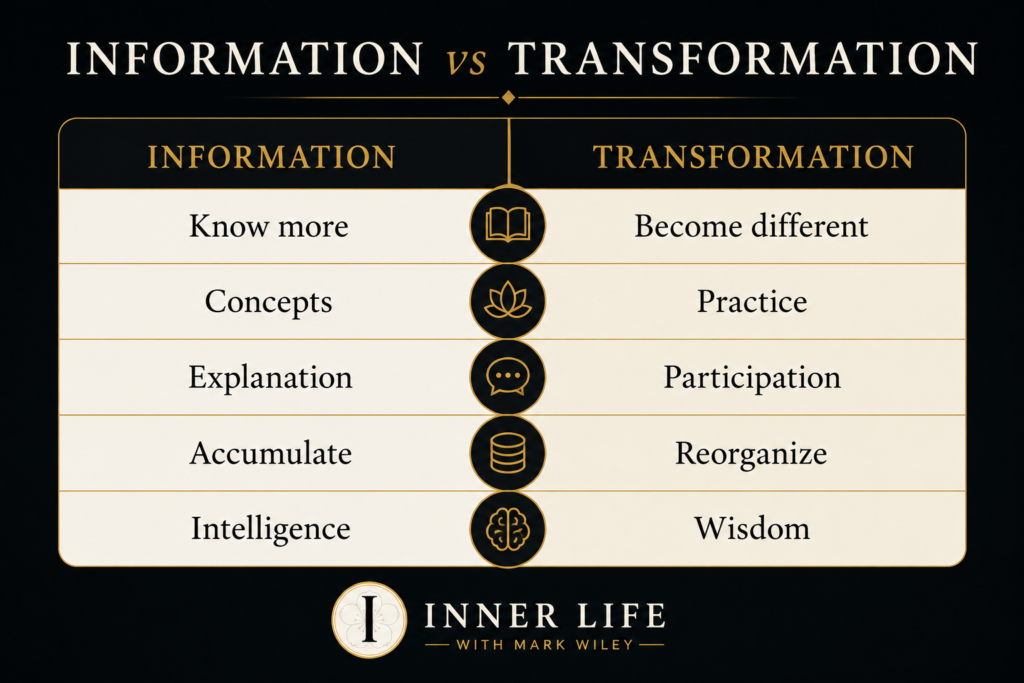
But sessions alone do not necessarily transform us. A person can repeat the same exercises for years and still breathe the same way under stress, react the same way during conflict, and become distracted by the same habits of attention. The techniques may improve. The person may not.
This is why time spent practicing is not the same thing as development. The more important question is not simply whether we practice, but whether our practice is gradually changing how we live.
What Remains After Practice?
Across mature contemplative, healing, and martial traditions, development was never measured solely by what happened during formal training. It was measured by what remained after the session ended.
Does your breathing stay steady when life becomes difficult? Can attention remain collected when conditions become uncertain? Does the body maintain its organization under pressure? Do you recover more quickly after frustration or disappointment? Does awareness return more naturally throughout the day?
These questions reveal something deeper than technical skill. They reveal whether practice has begun extending beyond the training session and into ordinary life.
“The true measure of practice is not what happens during the session, but what remains after it.”
—Mark V. Wiley
When Practice Becomes a Way of Living
This is where practicing gradually becomes a way of life. Over time, it matures into a Practice.
The purpose of a Practice is not simply to perform techniques well. It is to cultivate the conditions through which the whole person begins to change. Over time, breathing becomes less fragmented, attention more continuous, recovery steadier, perception clearer, and our responses less reactive and more intentional.
The change is usually so gradual that we barely notice it. It unfolds quietly through thousands of ordinary moments in which body, breath, and attention are repeatedly brought back into relationship with one another.
Eventually, practice no longer belongs only to a meditation cushion, a training hall, or a period of quiet reflection. Standing in line, walking through a parking lot, listening during a conversation, meeting uncertainty, and responding to conflict all become opportunities to continue the same Practice.
The session has ended. The Practice has not.
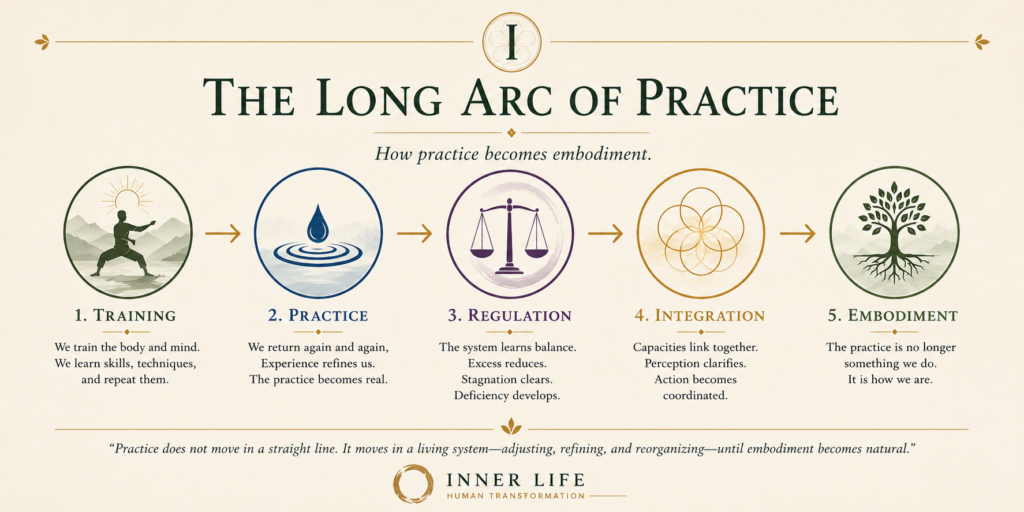
The Long Arc of Practice
This is why consistency matters more than intensity. A Practice is not built through occasional moments of extraordinary effort. It is built through repeated moments of intelligent participation. It is less concerned with perfect sessions than with cultivating an increasingly stable way of meeting experience itself.
The goal of Inner Life is not to accumulate methods or memorable experiences, nor is it to become proficient in an ever-growing collection of techniques. The goal is to cultivate a Practice that gradually reshapes how we perceive, participate in, and respond to life.
How that transformation actually unfolds—and how body, breath, attention, and awareness gradually reorganize into a more integrated way of being—is a deeper question.
It is one we will explore next.
“Practicing begins the journey. A Practice becomes the path.” —Mark V. Wiley
Research on deliberate practice has likewise shown that long-term development depends on repeated, intentional engagement over time rather than isolated performances.
The deepest practices eventually become shared practices. We discover that transformation is not only supported by individual discipline, but also by participating in a field where attention, inquiry, and presence are cultivated together.
Continue Exploring