
Embodied Transformation
Why Insight Alone Does Not Transform Us
by Mark V. Wiley
We often imagine that one profound realization will permanently change us. A retreat. A breakthrough meditation. A mystical glimpse. A moment when everything suddenly becomes clear. Yet many people eventually discover something surprising. They return home… and they are still themselves. The same habits. The same reactions. The same fears. The same patterns of thought.
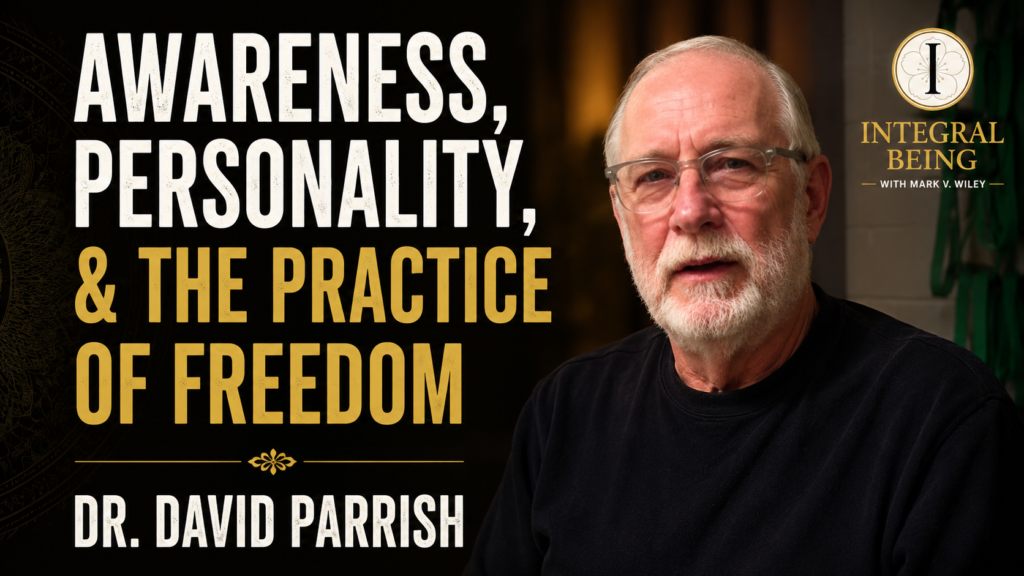
My conversation with psychologist and non-dual teacher Dr. David Parrish explored why this happens. What emerged was not a criticism of awakening, but a deeper understanding of what awakening is actually for. Insight may reveal something fundamental about who we are, but it is only the beginning of transformation—not its completion.
Awakening Reveals. Integration Transforms.
Much of contemporary spirituality places enormous emphasis on awakening experiences. We seek moments that dissolve ordinary perception and reveal a deeper ground of awareness. Those moments can be genuine, powerful, and life-changing. But they do not automatically reorganize a lifetime of conditioning.
Parrish speaks candidly about discovering this in his own life. After profound experiences of awareness, he believed he had found lasting freedom. Then intense anxiety unexpectedly arose. Rather than disproving his realization, it exposed something he had overlooked: he had unconsciously rejected the personality and the body instead of learning how awareness could be lived through them.
“The personality is inherently unstable.” —Dr. David Parrish
That insight quietly changes the entire conversation around spiritual practice.
The goal is not to escape the personality. Nor is it to identify exclusively with awareness while treating the body, emotions, or conditioning as somehow less real. Genuine development begins when awareness gradually reorganizes the whole human system rather than attempting to bypass it.
Seeing Is Different From Becoming
One of the most practical insights from my conversation with David Parrish is also one of the simplest. Anything we can observe—our thoughts, emotions, habits, fears, memories, even the self-image we have carefully constructed—cannot be the observer itself. The moment we recognize this directly, a new possibility appears. Thoughts no longer have to become beliefs. Emotions no longer have to become actions. Conditioning no longer has to dictate behavior. Awareness introduces a different relationship with experience. It does not remove difficulty from life, but it changes how difficulty is met.
“If you can see it, you don’t have to be it.” —Dr. David Parrish
This distinction has quietly surfaced throughout many of the Integral Being conversations. Whether speaking with contemplatives, martial artists, psychologists, meditation teachers, or philosophers, the pattern is remarkably consistent. Insight reveals possibility, but possibility alone does not transform a human being. Only sustained practice develops the capacities through which insight becomes embodied. Seeing opens the door. Living from what has been seen is another matter entirely.
Practice Is Where Insight Becomes Real
This is why meditation occupies such an important place in Parrish’s teaching. Meditation is not presented as an escape from life, nor as a method for collecting unusual experiences. It is the repeated practice of returning attention to awareness until awareness gradually becomes the stable reference point from which life is lived. Over time, this simple act begins to reorganize the entire human system.
Parrish also emphasizes something beautifully practical: resting as awareness for brief moments throughout the day. These small returns accumulate. They calm the nervous system, soften habitual reactions, and gradually widen the space between impulse and response. As this continues, what once required deliberate effort slowly becomes the natural way we meet experience.
“The voice in your head is not you thinking.” —Dr. David Parrish
Genuine transformation is usually quieter than we imagine. It rarely announces itself through dramatic experiences. Instead, it becomes visible in how we listen, how we relate, how quickly we recover from reactivity, and how steadily awareness begins to inform the ordinary moments of everyday life.
From Information to Embodiment
One of the reasons Inner Life has gradually evolved beyond interviews alone is that conversations, by themselves, rarely produce lasting transformation. They can reveal important distinctions, challenge long-held assumptions, and offer glimpses of another way of seeing. Reflections allow us to contemplate those insights more deeply, but understanding alone is never the destination. As David Parrish reminds us throughout our conversation, insight must eventually become integration. The real work begins when what we understand starts to reorganize how we perceive, respond, and participate in everyday life.
That realization has shaped the direction of the entire Inner Life project. The Practice Field exists to provide a place where ideas become lived exercises rather than remaining interesting concepts. Integrated Modular Training (IMT) provides the developmental structure through which different practices cultivate and progressively integrate stability, continuity, clarity, and integration. The Regulation Model functions as a regulatory framework, helping us recognize excess, stagnation, and deficiency so that practice can respond to the actual condition of the system. The Pathways offer different entrances into this work according to where each person finds themselves. Together, these form a living ecosystem intended to help readers move naturally from information, to practice, to embodiment.
Knowledge can inspire us. Practice begins to reorganize us. Over time, embodiment changes not simply what we know, but how we participate in life. This movement from insight to lived capacity is central to what I mean by embodiment. For a fuller explanation, see What Embodiment Actually Means.
Becoming More Fully Human
Perhaps the deepest misunderstanding of spiritual life is the belief that awakening somehow removes us from being human. Dr. Parrish points in another direction. Awareness does not ask us to abandon the personality, reject the body, or escape the ordinary circumstances of life. Instead, it invites us to inhabit them more consciously, allowing awareness to gradually reshape the way the personality expresses itself within the world.
“Awakening is not an escape from your life. It is a change in how your life is lived.” —Dr. David Parrish
The personality remains. The body remains. Relationships remain. Responsibilities remain. What changes is not the fact of our humanity, but the ground from which it is lived. We become less governed by unconscious conditioning and more available to respond from awareness itself. In that sense, transformation is not an escape from ordinary life but a gradual reorganization of our participation within it.
Perhaps that is what genuine human development has always pointed toward. Not leaving life behind, but learning to inhabit it more fully. Insight opens the door, practice carries us forward, and embodiment is what remains when understanding has become the quiet architecture of everyday living.
Watch the Conversation with Dr. David Parrish
Continue Exploring