
What Does Qi Feel Like?
When Qi Stops Being an Idea
by Mark V. Wiley
There is a moment in practice when something you have been told, something you have repeated, and something you may even have believed stops being an idea and becomes something you can actually feel. My conversation with Fabrice Piché kept returning to that threshold. Not to qi as theory, nor to the extraordinary claims that have surrounded qigong for generations, but to the quieter question that matters to a practitioner: What does qi actually feel like?
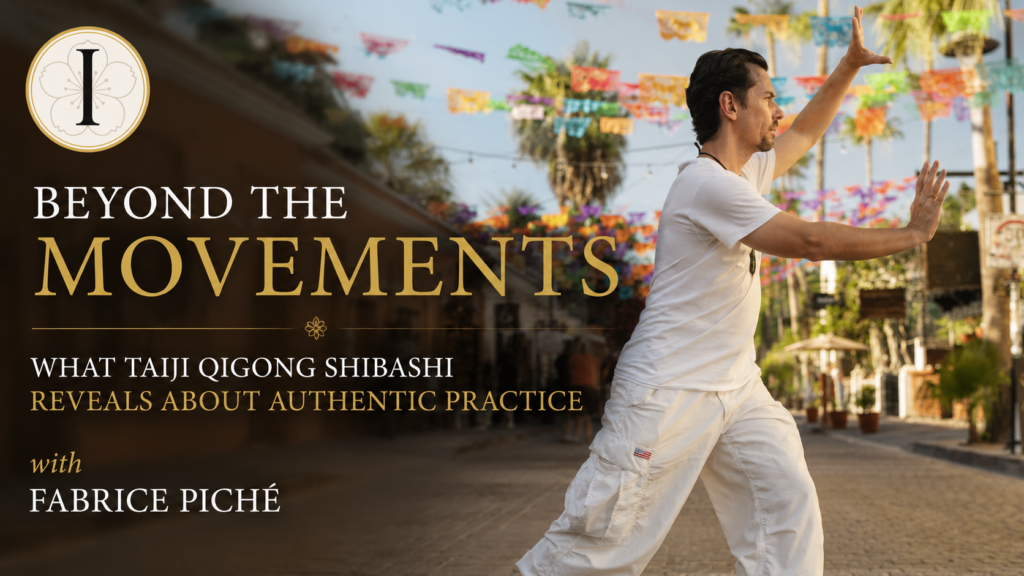
For Fabrice, one of the earliest experiences came through a simple exercise with the palms facing one another. The space between the hands began to feel different—denser, almost like the resistance between two magnets. For others, he explained, the first sensations may appear as warmth, tingling, or a subtle change in pressure. What matters initially is not deciding exactly what these sensations are or constructing an explanation for them. Something previously known only through instruction and language has become perceptible. An idea has entered experience.
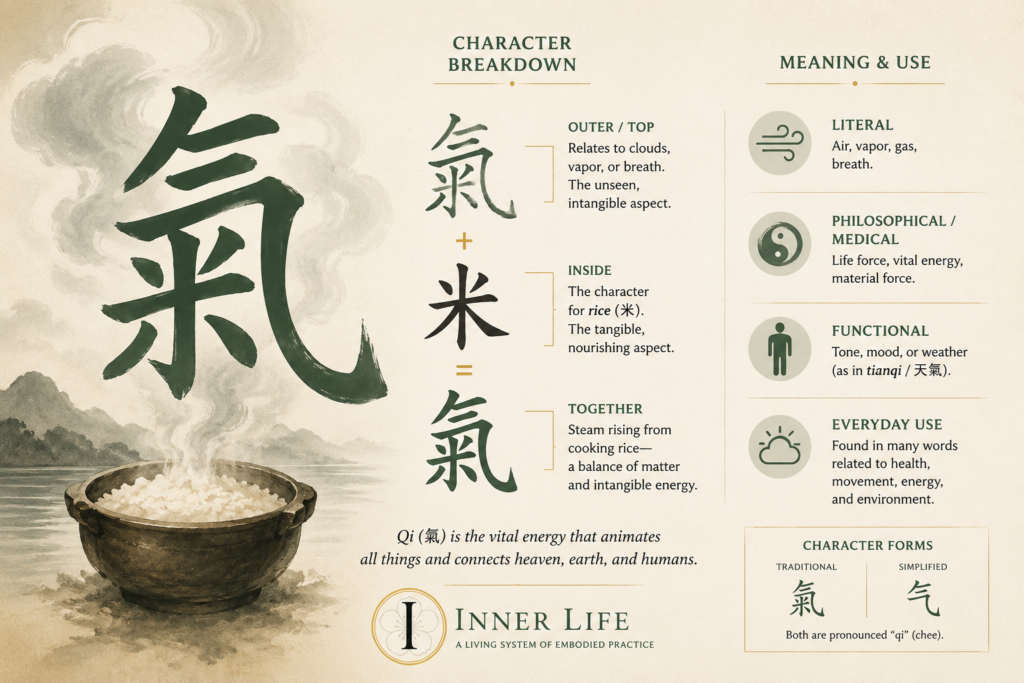
We speak easily about qi. It is translated as energy or vital essence, described through the language of Chinese medicine, associated with martial arts and healing, and sometimes surrounded by claims that make it seem mysterious or inaccessible. Fabrice offered another useful way of thinking about it, drawn from Professor Lin Housheng: qi as an information transmitter, mediating between the physical structure of the body and the various dimensions of mind and consciousness. But even that remains a framework for understanding something that practice ultimately asks us to encounter directly.
“At some point, explanation has to give way to perception.” —Mark V. Wiley
That movement—from something we have been told about, to something we begin to perceive for ourselves—is where the deeper question begins. When does an idea become an experience?
The First Door Is Sensation
Fabrice described one of his earliest experiences of qi in a way that will be familiar to many people who have practiced qigong. With the palms facing one another, he began to notice that the space between them did not feel quite the same. There was density, warmth, tingling, or something resembling the resistance between two magnets. The significance is not that we immediately know how to explain the sensation. The significance is that something previously discussed only as an idea has become perceptible.
That is an important threshold in any embodied practice. Before it, we are working largely from instruction: put the hands here, breathe this way, relax the shoulders, shift the weight, move slowly. We are trying to reproduce what we have been shown. Then perception begins to participate. We notice that one movement feels different from another, that the body feels different before and after practice, that one position produces tension while another allows continuity, or that something changes when breath, attention, structure, and movement become coordinated.
“The practice has begun teaching us from within.” —Mark V. Wiley
Simplicity Can Hide the Work
One of the strongest themes in my conversation with Fabrice concerned the deceptive simplicity of Taiji Qigong Shibashi. The movements are accessible, and that accessibility was part of their purpose. Professor Lin developed a system that ordinary people could practice and from which they could receive benefit without needing years of specialized training. Yet accessibility and shallowness are not the same thing.
This distinction extends far beyond qigong. I have seen it repeatedly in martial arts and other forms of embodied practice. Once we can reproduce the visible sequence, there is a temptation to believe we know the practice. We know where the hands go, we remember the order, and we can perform the form. Yet choreography is only the outer container. The deeper practice concerns what is happening within the movement: how the body organizes itself, where unnecessary tension appears, how weight is transferred, how breathing changes, where attention goes, whether movement is fragmented or continuous, and eventually what becomes perceptible that could not previously be perceived.
“A simple movement can contain years of practice.” —Fabrice Piché
As Fabrice observed, people often see the simplicity of Shibashi, receive some benefit, and stop there without recognizing the deeper engineering behind the movements. That is a pattern found in many practices: the outer form is learned quickly, while the principles that give the form meaning may take years to embody. Simplicity may actually require more attention rather than less because there is less choreography available to distract us from ourselves.
When Boredom Becomes a Doorway
Fabrice made an observation during our conversation that I found especially important. Once a movement has been learned well enough that we no longer need to think continually about what comes next, boredom can appear. For many practitioners, that is precisely when they begin looking for something new: another exercise, another form, another method, another teacher, another level.
Yet what we call boredom may actually indicate that an important stage of practice has finally become possible. The mind no longer needs all of its attention to remember the choreography, so awareness can begin turning inward. Instead of asking, What comes next? we begin noticing, What is happening now?
“What we call boredom may be the moment practice finally becomes deep enough for us to observe.” —Fabrice Piché
The same movement repeated five times does not actually feel the same five times. The body is changing continuously. Tension releases, balance reorganizes, breathing changes, sensation shifts, and attention becomes clearer or wanders away. Over time, repetition stops being repetition and becomes observation. This is one of the places where qigong begins to move beyond exercise and toward embodied meditation.
From Imagining to Perceiving
Many qigong systems use imagery. We imagine holding a ball, moving through water, separating clouds, or gathering something between the hands. At first, such imagery gives the mind somewhere to rest. Rather than allowing attention to scatter, the image organizes it around the movement.
Fabrice described an important progression, however. Eventually the image becomes less necessary because the sensations themselves become more interesting than the imagined picture. You no longer need to imagine density because you are investigating density. You no longer need to imagine flow because you are noticing continuity. You no longer need to tell yourself to become aware of the body because awareness has begun settling into it.
The direction of practice has changed. This reversal is fundamental. It marks the difference between performing according to an instruction and developing the capacity to perceive directly.
“We began by placing an idea onto the body. Now we are allowing the body to reveal something back to us.” —Mark V. Wiley
Moving Meditation and the Problem of the Cushion
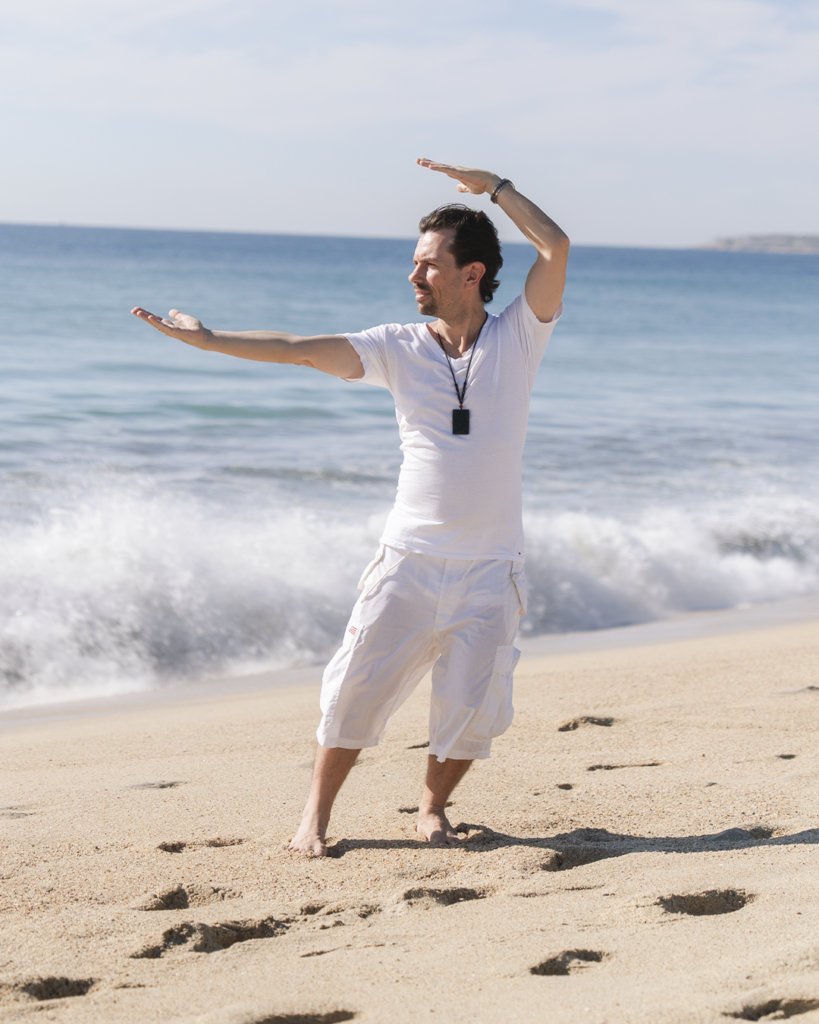
This also helps explain why moving practices can occupy such an important place between formal meditation and ordinary life. It is possible to become very quiet while sitting in a controlled environment. The body is still, external demands are reduced, and attention can withdraw from much of the activity surrounding us. Then we stand up, walk, speak, respond to someone, or encounter a problem, and the quality we experienced during meditation can disappear remarkably quickly.
Fabrice described qigong as a kind of bridge between these conditions. We may not initially enter the same depth of stillness while moving that we can reach while sitting, but we are learning something equally important: how to remain internally attentive while activity is occurring. That distinction matters enormously because inner development cannot exist only under ideal conditions. Whatever we cultivate must eventually survive movement, relationship, uncertainty, interruption, and pressure. Otherwise we have cultivated a state that depends upon removing ourselves from the conditions in which life actually occurs.
Whatever we cultivate in practice must eventually survive contact with life.
Moving meditation begins closing that gap. It asks whether the quiet cultivated in stillness can remain present while the body moves, while attention is distributed, and eventually while life itself becomes more complex. This was one of Fabrice’s strongest observations about qigong: moving practice can help carry the meditative quality developed in stillness into ordinary activity.
What Happens When Practice Disappears
Perhaps the most revealing moment in the conversation came when Fabrice described a period in his own life when he largely stopped practicing. Qigong had been part of his life since adolescence, and feeling qi between his hands had become so familiar that its presence was almost taken for granted. Then, during a difficult period, his personal practice fell away, and eventually he discovered that he could no longer feel what had once seemed obvious.
The sensation between his hands was gone. He even began wondering whether he had imagined it all along. So he returned to something remarkably simple: the first Shibashi set, practiced daily. At first, something might appear during practice and disappear again the following day. Gradually, sensations returned. Then other sensations he had almost forgotten began reappearing. Over the following months, the perceptual world that years of practice had cultivated opened again.
“Practice does not merely give us experiences. Practice cultivates capacities.” —Mark V. Wiley
There is something important here that reaches well beyond qi. Stop cultivating a capacity long enough and some part of it can diminish. Return to practice and it may become available again. This is why there is such an important distinction between having practiced something and actually having a practice.
The Body We Learn to Perceive
Long-term embodied practice changes more than our ability to perform movements. It changes what we are capable of noticing. The beginner may experience the body primarily through broad categories such as tension, relaxation, pain, effort, and fatigue. With sustained attention, those categories begin differentiating. We perceive smaller changes in pressure, balance, temperature, muscular holding, breathing, internal movement, emotional activation, and the relationship between intention and physical response.

Whether we describe some of those experiences as qi depends partly upon the framework through which we have learned to understand them. But the deeper principle does not depend upon terminology.
“What we repeatedly attend to becomes increasingly available to perception.” —Mark V. Wiley
This is one reason genuine practice can make the body seem more alive. The body did not suddenly acquire an interior life. We became capable of perceiving more of the life that was already occurring. In that sense, the training is not simply adding something to us. It is refining the instrument through which experience itself is known.
The Difference Between Knowing and Knowing
There are therefore at least two very different ways of knowing something like qi. One is conceptual. We can define it, discuss Jing, Qi, and Shen, describe meridians, dantian, circulation, intention, and the relationship between Chinese medicine and qigong. We can read classical texts and modern interpretations, compare frameworks, and become increasingly articulate about what the traditions say.
All of that can be useful. But another kind of knowing begins when we become quiet enough to perceive. This knowing is slower. It cannot be acquired by reading faster, accumulated by collecting more techniques, or convincingly borrowed from someone else’s experience.
“The teacher can point. The system can organize the conditions. But eventually the practitioner has to become capable of noticing what is actually happening.” —Mark V. Wiley
That is where practice becomes personal. It is also where the body stops being merely the object performing the practice and begins becoming one of our teachers.
When Qi Stops Being an Idea
Perhaps the most important thing about feeling qi is therefore not the sensation itself. It is the transition the sensation represents. Something once known only through language has entered experience, and once that happens the relationship between practitioner and practice changes. We are no longer practicing solely because someone told us what should happen. We have begun developing our own internal reference points.
The same transition occurs throughout serious practice. We hear about relaxation until we discover what releasing unnecessary tension actually feels like. We hear about rooting until the body begins organizing itself differently against the ground. We hear about awareness until awareness becomes something more immediate than thinking about being aware. We hear about integration until movement, breath, attention, and intention stop behaving like separate instructions.
Again and again, the path moves from concept → practice → perception → embodiment.
The words are useful, and the teachings are necessary, but eventually something has to happen in us. Perhaps that is the deeper lesson behind my conversation with Fabrice:
“Practice becomes transformative when what we understand begins changing what we are capable of experiencing.” —Fabrice Piché
Continue Exploring