
Embodied Meditation:
Why the Body Must Awaken First
What Will Johnson Reveals About Embodied Meditation
by Mark V. Wiley
Sit perfectly still. Do not move. Watch your breath.
For many people, that is the entire definition of meditation. Yet what if this instruction, repeated across meditation halls, mindfulness classes, yoga studios, and modern meditation apps, unintentionally teaches us to disconnect from the very body through which awareness is meant to awaken?
The body is frequently treated as something to quiet, minimize, control, or eventually transcend. Breath becomes an object of concentration. Awareness narrows toward the mind. Movement is discouraged, while stillness becomes associated with discipline, composure, and spiritual seriousness.
Over time, many practitioners unconsciously learn to meditate through control. The body tightens, breath becomes shallow, sensation recedes into the background, and attention moves upward into the head while the rest of the organism becomes increasingly muted. Even practices intended to awaken awareness can subtly reinforce disconnection from the body itself.
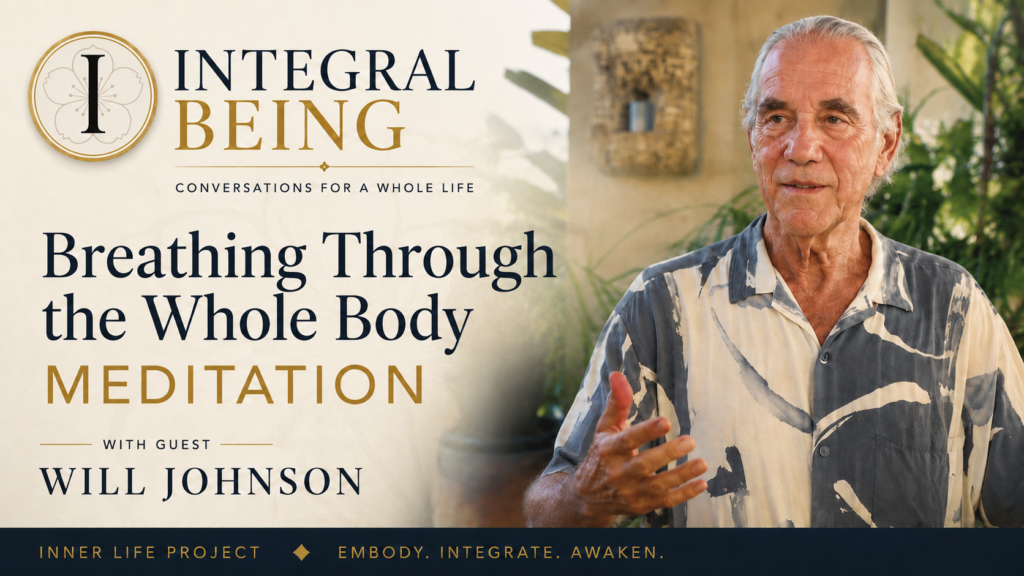
This became one of the central themes in my Integral Being conversation with Will Johnson. Again and again, Johnson returned to a radically different possibility: meditation not as withdrawal from the body, but as awakening through the body. Breath, posture, gravity, sensation, movement, and visual perception are not secondary concerns within his approach. They are foundational.
At one point in our discussion, Johnson recalled a Zen story. A student asks the teacher Joshu, “What is meditation?” Joshu gestures toward the meditation hall and replies:
“It’s not meditation. It’s alive.” —Will Johnson
That line stayed with me long after the conversation ended because it cuts directly to the heart of what much of modern contemplative culture has lost.
One reason the conversation resonated so deeply is that it reflects a central principle explored throughout the Inner Life Model: transformation is not something that happens to the mind while the body waits patiently nearby. Transformation emerges through the integration of body, breath, attention, perception, and awareness into one functioning whole.
The Problem With “Garden Statue” Meditation
Johnson jokingly refers to rigid meditation culture as “garden statue” meditation, but beneath the humor is a serious critique of how many people learn to practice. Meditation becomes associated with suppressing movement, controlling breath, enduring discomfort, holding posture rigidly, narrowing awareness, and remaining externally composed.
The result is that practitioners may slowly learn to brace themselves against life while calling it awareness.
Johnson describes how this can create chronic tension throughout the body. Breath becomes increasingly shallow, the diaphragm loses freedom, the spine stiffens, and awareness disconnects from sensation. A person may appear calm externally while remaining deeply contracted inside.
Yet the body was never designed to function this way. Breath naturally moves through the organism. The spine subtly responds to inhalation and exhalation. Sensation shifts continuously, while the body expands, releases, balances, and adjusts from moment to moment… Life moves.

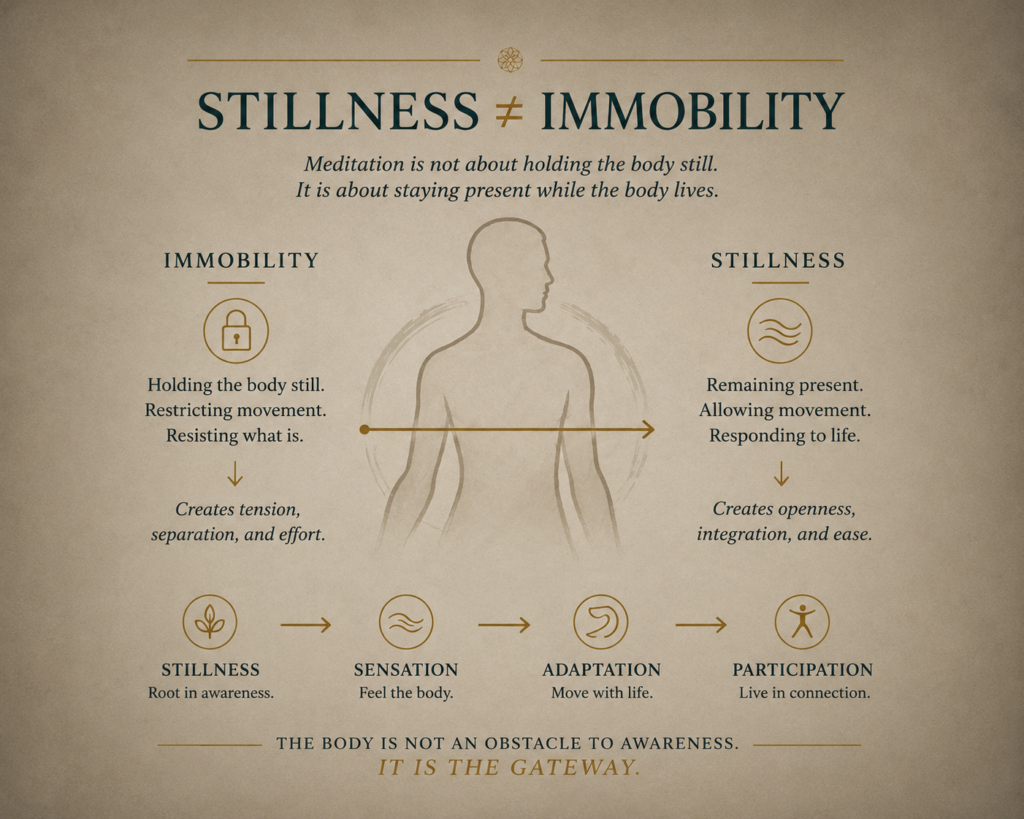
Stillness itself is not the problem. The problem is confusing stillness with rigidity. There is a profound difference between a body that has become quiet through release and one that has become frozen through effort. Living stillness remains responsive. It breathes, adapts, senses, and participates.
One of the most important references Johnson returns to is an instruction from early Buddhist teaching:
“As you breathe in, breathe in through the whole body.” —Will Johnson
For Johnson, this changes everything. Breath is no longer confined to the nostrils, chest, or mental observation of respiration. The entire body becomes involved in awareness. Meditation stops being primarily cognitive and becomes profoundly somatic.
This is not merely another breathing technique. It represents a fundamentally different relationship to meditation and embodiment.
The Opening Became the Whole Dharma
One of the most insightful moments in the conversation came when Johnson reflected on the development of mindfulness in the modern West. He observed that many practitioners became trapped in the introductory stages of meditation without realizing it.
“The opening became the whole Dharma.” —Will Johnson
It is a remarkably precise statement.
The early stages of mindfulness practice—calming attention, stabilizing awareness, and observing the breath—are important. They interrupt compulsive thinking and create the possibility of presence. But somewhere along the way, preliminary methods often became mistaken for the entirety of contemplative life.
The doorway became the destination.
Every authentic tradition begins with introductory practices. These methods stabilize attention, quiet habitual thought, and prepare the practitioner for deeper work. Problems arise when practices intended to cultivate attention become mistaken for awakening itself.
This distinction is also central to the Six Foundational Practices of Inner Life. The aim is not simply to produce temporary calm, bodily sensation, or altered states. Practice gradually develops the capacities through which awareness can remain embodied, integrated, and responsive under changing conditions.
Johnson’s work points toward what becomes possible after the doorway of basic mindfulness has opened. Awareness must eventually move beyond detached observation and enter into direct embodied experience. Breathing becomes fuller, muscular holding softens, the spine begins to move, gravity is felt more clearly, sensation becomes vivid, and perception opens beyond the narrow field of mental concentration.
The body itself begins to awaken.
The result is not less stillness, but a different quality of stillness altogether—a living stillness that breathes, responds, and remains connected to the intelligence of the whole organism.
Relaxing on the Inhale
One of the simplest statements Johnson made during our conversation unexpectedly became one of the most profound. He said:
“Start relaxing on the inhale.” —Will Johnson
The reason this struck me so strongly is that many people instinctively do the opposite. Inhalation is often accompanied by subtle bracing. The chest lifts, the neck tightens, the diaphragm restricts, and the body resists gravity rather than surrendering into it.
Even relaxation becomes effortful.
I immediately experimented with this during my own practice. Like many people, I discovered that I had unconsciously learned to hold myself together while inhaling, as though breathing required effort rather than surrender.

Allowing relaxation to begin with the inhale changed the quality of breathing almost immediately. The breath no longer felt like something I produced. It became something I participated in.
Johnson describes a process in which the body softens downward into gravity at the onset of inhalation. Rather than pulling the breath upward through effort, the practitioner releases into support. The body yields downward, and because it is no longer bracing against gravity, the breath begins filling and expanding the organism naturally.
The inhale no longer feels defensive or forced. The spine subtly moves, posture becomes dynamic rather than fixed, sensation awakens, and awareness spreads throughout the body. Meditation stops being something imposed upon the body and becomes something emerging through it.
This distinction matters because contemplative practice often becomes overly concerned with adding more techniques, instructions, and structures. Johnson repeatedly points toward the opposite movement: removing interference so the body’s natural intelligence can re-emerge.
Embodiment Is Participation
One idea kept returning throughout the conversation without always being stated directly: embodiment is participation.
The body is not simply the location where meditation happens. It is the means through which we participate in gravity, breathing, movement, relationship, perception, and ultimately life itself. As embodiment deepens, practice becomes less about standing outside experience and observing it from a distance. It becomes a more intimate participation in the processes through which experience is continually arising.
This is why embodiment cannot be reduced to bodily awareness alone. A person may be highly aware of tension, pain, or breath while still remaining fragmented. Awareness may begin the process, but embodiment concerns what that awareness changes: how the whole system becomes organized and how that organization shapes our participation in life. I explore this distinction more fully in What Embodiment Actually Means.
Body, breath, attention, perception, and awareness begin functioning together.
This same developmental logic appears throughout Integrated Modular Training, where stillness gradually becomes movement, movement becomes adaptability, and adaptability becomes responsiveness. Awareness must learn to travel through changing conditions rather than remaining confined to a single posture, sensation, or meditative state.
Embodiment is therefore not a fixed achievement. It is an increasingly integrated capacity to remain present, responsive, and participatory within life.
Permission to Let Go
At one point, I asked Johnson directly how people actually learn to let go. His answer was immediate:
“I’m giving people permission to let go.” —Will Johnson
That response stayed with me because it reframed teaching itself. Not authority. Not spiritual performance. Not mastery. Permission.
Permission to soften, breathe, move, and stop trying to appear meditative. Permission to stop managing every sensation, posture adjustment, or spontaneous movement. Permission to trust the intelligence of the body again.
Johnson describes modern culture as “somatophobic”—disconnected from the body and uncomfortable with sensation, vulnerability, and direct embodied presence. From childhood onward, many of us are taught to sit still, suppress discomfort, ignore sensation, remain productive, and live primarily from the neck upward. Those habits become so ordinary that we begin mistaking them for adulthood itself.
Meditation, in its deepest sense, may reverse that conditioning. Not by rejecting awareness, but by reconnecting awareness with the living body.
This is one reason we explore these principles experientially within the Practice Field. Intellectual understanding can clarify what embodiment means, but understanding alone does not dissolve the habitual tension, guarding, and fragmentation held within the body. Those patterns must be encountered directly through practice.
Permission is not passivity. Letting go does not mean collapsing, losing structure, or abandoning discernment. It means releasing unnecessary interference so a more coherent form of organization can emerge.
The Body as Gateway

One of the most important recognitions emerging from the conversation is that awakening is not merely conceptual or philosophical. It is profoundly somatic.
Johnson describes how breath, posture, gravity, sensation, movement, and visual awareness interact to alter consciousness directly. As tension softens and breathing deepens, perception itself begins to change.
The practitioner no longer feels isolated inside the head.
Awareness expands into what Johnson describes as the “larger body” of experience. The visual field opens. Sensation becomes vivid. Boundaries soften. Identity loosens some of its habitual rigidity.
This leads naturally into visual field awareness, sky gazing, spontaneous movement, relational perception, partner gazing, and surrender into sensation. These are not random supplementary methods. Each loosens the assumption that awareness exists as a separate observer located somewhere behind the eyes.
Again and again, the body appears not as an obstacle to realization, but as the doorway through which realization becomes lived.
“Fortunate are those who have learned how to soften their rigidities.” —Will Johnson
The phrase is powerful because rigidity is not merely muscular. We become rigid in posture, perception, identity, belief, emotion, and our relationship to experience. As these rigidities soften, awareness becomes less confined by the structures through which we habitually organize reality.
The body does not merely accompany this process. It reveals and participates in it.
Aliveness as Practice
What stayed with me most after speaking with Will Johnson was not a single method, but a recognition.
Real practice does not deaden us. It does not make us more rigid, less sensitive, or increasingly disconnected from life. Genuine contemplative work moves in the opposite direction. It increases sensitivity, responsiveness, openness, adaptability, and participation in experience itself.
This may explain why so many people feel drawn today toward somatic practice, breathwork, internal martial arts, contemplative movement, and body-based approaches to awareness. Something in us recognizes that consciousness cannot fully unfold while the body remains excluded from the process.
Johnson’s work points toward a contemplative path in which breath, posture, sensation, gravity, movement, and perception all become dimensions of awakening itself. They are not preliminary concerns to be left behind once “real” meditation begins. They are the living conditions through which meditation becomes embodied.
Within the Inner Life Regulation Model, breathing through the whole body is not viewed as an isolated breathing exercise. It represents the progressive integration of body, breath, attention, perception, and awareness into a coherent mode of embodied participation.
Perhaps that is the deepest lesson I took away from our conversation. Meditation is not measured by how motionless we become, but by how fully alive we become. The question is not whether we can hold still long enough to silence the mind. The question is whether body, breath, attention, perception, and awareness can become so deeply integrated that life itself begins to awaken through us.
Continue Exploring