Attention, Consciousness, and the Mystery of Transformation
with Dr. Ravi Ravindra
Science, spirituality, self-study, and the journey from self-improvement to awakening
In this Integral Being conversation, Ravi Ravindra explores consciousness,
self-study, attention, and spiritual transformation.
The Question Beneath Every Spiritual Path
Many people begin a spiritual practice hoping to become calmer, happier, wiser, or more fulfilled. These motivations are natural and often necessary. They provide the initial impulse to meditate, pray, study, or undertake disciplined inner work. Yet throughout this conversation, Ravi Ravindra points toward a deeper possibility. Authentic spiritual practice, he argues, is not primarily concerned with self-improvement. Its true purpose is transformation.
Again and again, he returns to a question that has accompanied him since childhood: What am I? Not as an abstract philosophical puzzle or an intellectual exercise, but as the seed question underlying every serious spiritual journey. We did not create ourselves. We did not choose our birth, our family, our body, our capacities, or the countless conditions that shape our lives. To recognize this is not a limitation. It is the beginning of humility.
For Ravindra, spiritual inquiry begins when we become willing to examine the mystery of our own existence. The great traditions may use different languages, symbols, and practices, yet they all point toward the same fundamental challenge: to understand what a human being truly is and what a human being might become.
“The purpose of spiritual discipline is not self-improvement but transformation.” —Ravi Ravindra
From Attention to Awareness
One of the most illuminating themes explored in the conversation is Ravindra’s distinction between attention, awareness, and consciousness. While these words are often used interchangeably, he suggests that they point toward different dimensions of experience.
Attention is usually experienced as something personal. We direct our attention. We focus. We concentrate. Awareness introduces another quality altogether. It involves receptivity rather than control. Consciousness extends further still, suggesting participation in something larger than the individual mind. The distinctions may seem subtle, yet they fundamentally alter the orientation of practice.
“Attention becomes valuable because it creates the conditions through which deeper awareness may emerge.” —Ravi Ravindra
Seen in this light, spiritual development becomes less about mastering experience and more about becoming available to it. Across the world’s contemplative traditions, a similar movement appears repeatedly: from thinking to seeing, from conception to perception, from effort to receptivity, and from self-concern to participation. Rather than accumulating spiritual ideas, the practitioner gradually learns how to receive.
Attention remains important, but not because concentration is itself sacred. Attention matters because sustained attention creates the conditions through which deeper awareness may emerge. It prepares the ground for perception that is not entirely directed by the habitual mind.
The Body as an Instrument of Consciousness
A recurring theme throughout Ravindra’s work is the recognition that transformation is embodied. Spiritual realization is not something that occurs apart from the body. Breath, posture, sensation, movement, relaxation, and physical presence all influence the quality of awareness available to us.
This insight is hardly limited to a single tradition. It appears throughout yoga, Zen, Taoist cultivation, contemplative Christianity, and the teachings of Gurdjieff. Each recognizes that the body is not an obstacle to spiritual life but one of its essential instruments.
In this context, relaxation takes on a deeper meaning. It is not merely a technique for reducing stress. Rather, it represents freedom from the chronic tensions generated by fear, ambition, self-assertion, and identification. The more contracted the organism becomes, the less receptive it remains. The more relaxed and present it becomes, the more capable it is of receiving subtler levels of perception.
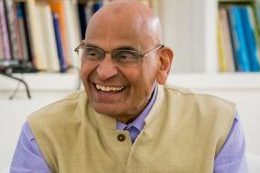
“The more relaxed and present we become, the more capable we are of receiving finer levels of perception.” —Ravi Ravindra
Meditation therefore becomes something larger than a method. It becomes a way of preparing oneself to encounter realities that cannot be reached through thought alone.
Self-Study and the Encounter With the Shadow
Perhaps the strongest theme running through the conversation is the necessity of self-study. Nearly every serious contemplative tradition emphasizes self-knowledge, self-observation, or self-study as an indispensable aspect of inner development. Yet genuine self-study is rarely comfortable.
To observe oneself honestly is to encounter fear, vanity, insecurity, ambition, self-importance, contradiction, and self-deception. It is to discover that both higher and lower possibilities exist within every human being. The contemplative path does not begin with idealized images of enlightenment. It begins with seeing clearly what is already present.
Quoting the great Sufi poet Rumi, Ravindra offers a striking reminder:
“If you have not yet seen the devil, go look in the mirror.” —Ravi Ravindra
The statement is not an invitation to self-condemnation. It is an invitation to clarity. The obstacle must first be seen before it can be understood. Whether traditions speak of Satan, Mara, ego, or the nafs, they are often pointing toward the same reality: the forces that obstruct awakening are not merely external. They are also within us.
For this reason, Ravindra emphasizes the importance of undertaking serious inner work in the company of fellow seekers. The journey becomes less frightening when we realize that the human condition is shared.
Beyond Knowledge
As both a physicist and contemplative practitioner, Ravi Ravindra occupies a rare position. He deeply respects science while simultaneously recognizing its limitations. Scientific knowledge can describe, measure, predict, and analyze, yet many of the most important dimensions of human experience remain beyond conceptual understanding.
The Buddha struggled to describe nirvana. Christ spoke of the kingdom of heaven through metaphor and parable. Mystics across traditions repeatedly turned to poetry, paradox, and silence because ordinary language proved inadequate to express what they encountered.
“When you discover something, you will be astonished.” —Ravi Ravindra
The problem is not knowledge itself. The problem arises when we become trapped by what we know. The mind naturally seeks certainty, conclusions, and fixed interpretations. The contemplative path cultivates another capacity altogether: the ability to remain open within mystery.
Ravindra suggests that genuine discovery is accompanied by astonishment. One of the signs of authentic spiritual insight is not certainty but wonder. The deeper one travels, the more extraordinary existence begins to appear.
Becoming Available to What Already Is
One of the most profound insights emerging from this conversation is that spiritual practice is not fundamentally about acquiring something new. It is about becoming capable of what is already present.
“Practice becomes less about becoming extraordinary and more about becoming present.” —Ravi Ravindra
The search for God, truth, awakening, or realization often begins as a personal effort. Yet over time, something changes. The practitioner becomes less concerned with achievement and more concerned with receptivity. Less concerned with arrival and more available to participation. Practice gradually shifts from a project of becoming extraordinary to a process of becoming present.
“What would it mean not merely to think differently—but to become different?” —Ravi Ravindra
Within the broader vision of Integral Being, this conversation points toward a foundational question. It is not simply whether we can think differently, believe differently, or accumulate more spiritual knowledge. The deeper question is whether we can undergo a transformation in the quality of our being itself.
About the Guest
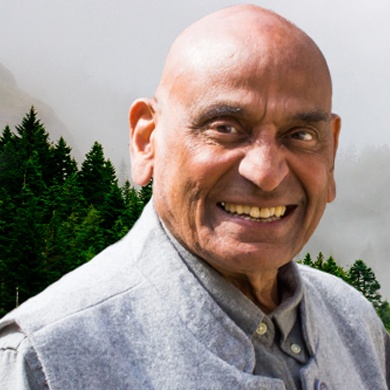
Dr. Ravi Ravindra is an internationally respected physicist, philosopher, author, and spiritual teacher whose work bridges science, religion, and contemplative practice. A longtime Professor of Physics, Philosophy, and Comparative Religion at Dalhousie University in Canada, he has also held fellowships at Princeton University, Columbia University, and the Institute for Advanced Study. His work explores the relationship between scientific understanding, spiritual wisdom, and the transformation of human consciousness.
Deeply influenced by Yoga, Zen Buddhism, G. I. Gurdjieff, J. Krishnamurti, and the mystical traditions of both Christianity and India, Ravindra has spent decades investigating questions of consciousness, self-knowledge, attention, and awakening. Through his books, lectures, and teaching, he invites seekers to move beyond self-improvement toward a more direct encounter with reality itself.
Continue Exploring