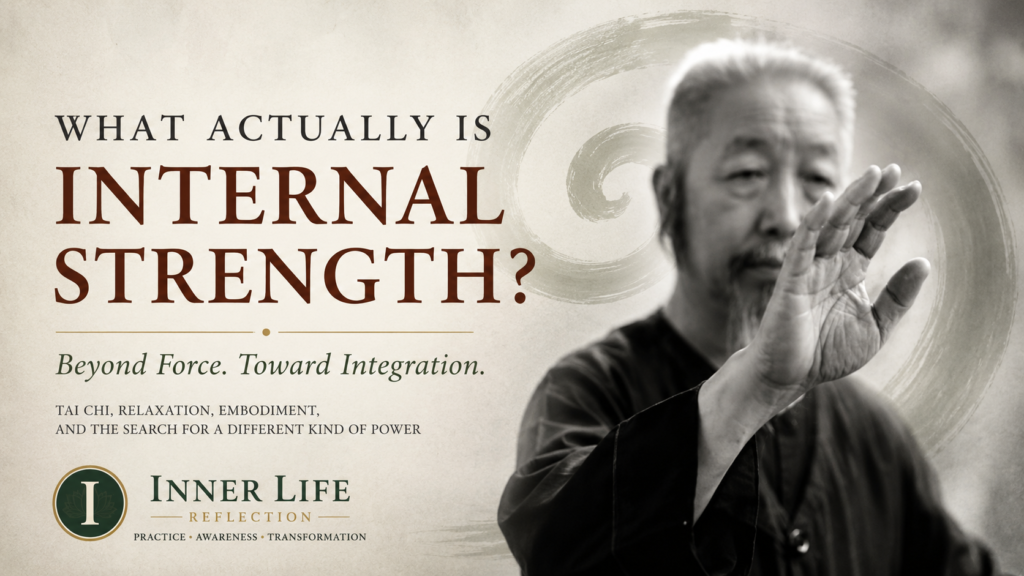
What Actually Is Internal Strength?
Tai Chi, Relaxation, Embodiment, and the Search for a Different Kind of Power
by Mark V. Wiley
Among practitioners of Tai Chi, Qigong, Bagua, Xingyi, Aikido, and other internal arts, few subjects generate more discussion than internal strength. Most people have heard the term. Many claim to possess it. Yet ask ten experienced practitioners to define it, and you are likely to receive ten different answers.
Some describe internal strength as efficient body mechanics. Others describe it as whole-body power, connective tissue force, structural alignment, or the expression of Qi. Some insist it is entirely physical. Others regard it as energetic or even mystical.
Yet beneath the debate lies a more fundamental question.
What if internal strength is not primarily about power at all?
In my recent conversation with Tai Chi teacher, author, and physicist Dr. Robert Chuckrow, a different perspective emerged. Rather than beginning with force, Chuckrow begins with relaxation. Rather than asking how to become stronger, he asks what happens when unnecessary tension is removed. Rather than focusing on what we can make the body do, he invites us to explore what the body may already know how to do.
This shift changes the conversation entirely.
The Discovery That We Are Not Fully Embodied
One of the first observations Dr. Robert Chuckrow makes is both simple and profound. When students begin practicing Tai Chi, they quickly discover that they are not as relaxed, coordinated, or embodied as they imagined. Many uncover layers of tension they did not know they were carrying. Others realize that their balance is less stable than they assumed. Even simple movements reveal patterns of restriction, compensation, and disconnection that have accumulated through years of habit.
This insight extends far beyond martial arts. Most of us move through life without paying much attention to how we move, breathe, stand, or relate to our own bodies. We live primarily through thought. The body becomes something we use rather than something we inhabit. Practice begins to reverse that relationship. Before Tai Chi teaches movement, it teaches awareness. Before it develops power, it develops sensitivity. Before it reveals what is possible, it reveals what is already present.
“Most people discover that they’re not really in their bodies.” —Dr. Robert Chuckrow
That realization may be uncomfortable, but it is also the beginning of transformation. Without a transformation there can be no development or expression of internal strength.
Relaxation Is Not What Most People Think
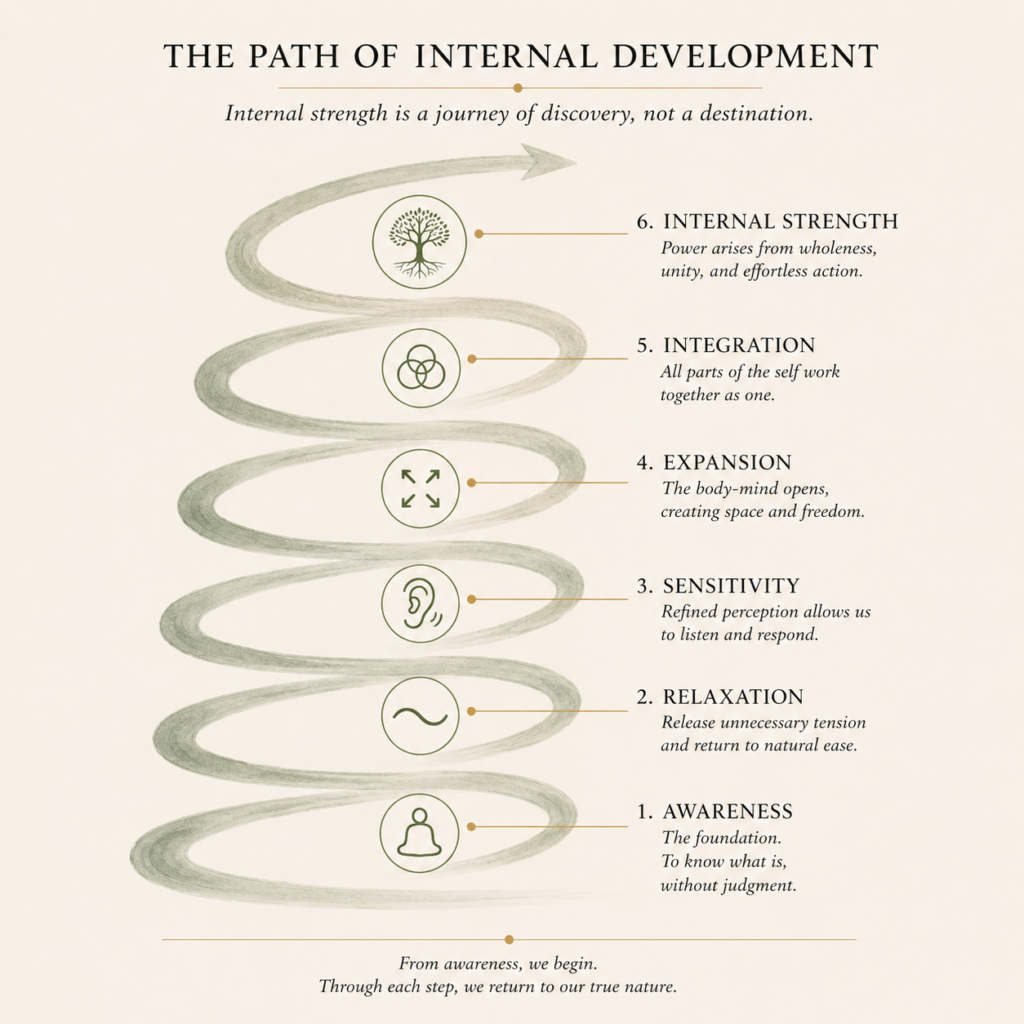
In many Tai Chi schools, students are told to relax. Unfortunately, the instruction is often misunderstood. Relaxation is commonly interpreted as reducing muscular tension or becoming softer. While this may be beneficial, Chuckrow suggests that something much deeper is taking place. For him, relaxation is not simply a matter of loosening the body. It involves releasing what he calls contractive strength.
This distinction is important because most human movement relies on muscular contraction. We pull, push, brace, tighten, and exert effort. We use force to create movement, and over time this becomes our default way of organizing ourselves. Yet the deeper traditions of Tai Chi suggest another possibility.
“The problem is that if you release contractive strength completely, you shouldn’t be able to move—unless there is another kind of strength.” —Dr. Robert Chuckrow
That statement points toward one of the central mysteries of the internal arts. If movement is no longer being driven primarily by contraction, what takes its place?
The Search for a Different Kind of Power
This is where the conversation becomes especially interesting. When discussing the refined power of Tai Chi and internal arts, many refer to it as neijin or internal strength. Chuckrow, however, describes what he calls expansive strength. Rather than organizing movement through pulling and contracting, expansive strength creates a feeling of extension, openness, continuity, and support throughout the body. Whether one agrees with his explanations or not, the experiential question remains fascinating: What happens when movement is organized through expansion rather than contraction? What happens when the joints are no longer bound by excess effort? What happens when the body remains open rather than braced, and movement emerges through continuity rather than force?
These questions are worth exploring because they challenge assumptions that extend far beyond martial arts. Modern culture often equates power with effort—more force, more tension, more intensity. The internal arts suggest that another form of power may exist, one rooted not in domination but in organization; not in forcefulness but in integration; not in effort but in relationship.
Perhaps this is why internal strength remains so difficult to define. It is not merely something we do. It is a different way of being.
The Choreography Is Not the Practice
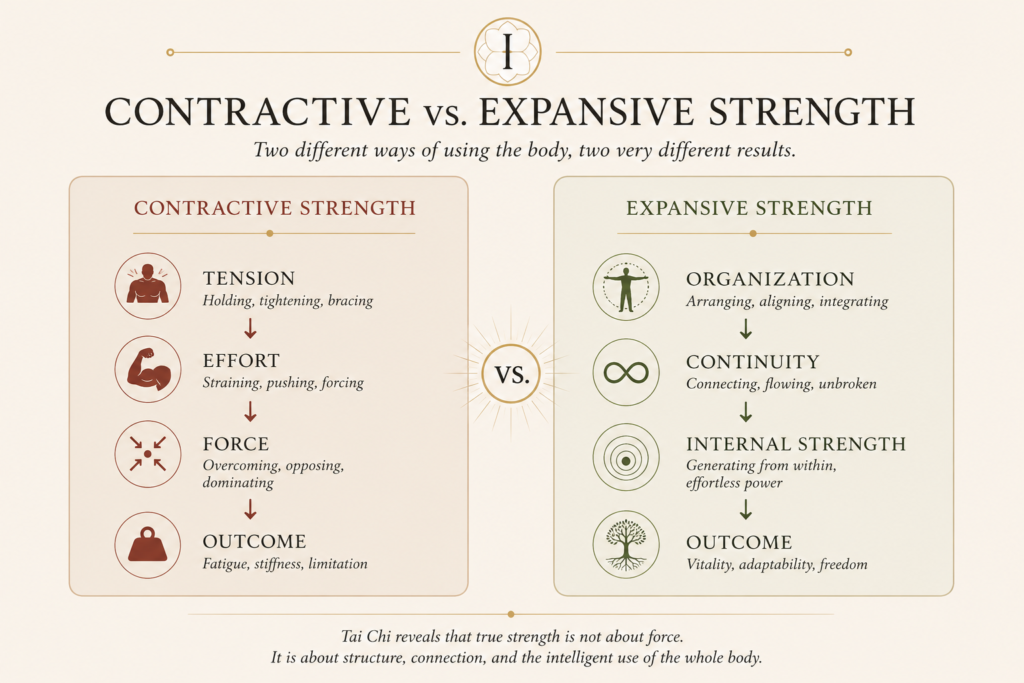
One of the most valuable insights from the conversation concerns the relationship between form and awareness. Most beginners naturally focus on choreography. They try to remember where the hands go, how the feet move, and what comes next. This is unavoidable. Every practice requires a structure.
Yet eventually the choreography itself can become a trap. The practitioner becomes preoccupied with positions rather than principles. Attention shifts toward performance instead of experience. Chuckrow offers a powerful observation:
“If you’re thinking about where the hand is supposed to go, you’re already out of the moment.” —Dr. Robert Chuckrow
The statement sounds less like martial arts instruction and more like a meditation teaching. The moment we become occupied with where we are going next, we stop experiencing what is happening now. We leave the present in pursuit of a future position. The irony is that many practitioners spend years trying to perfect forms while missing the very quality the forms were designed to cultivate: Presence.
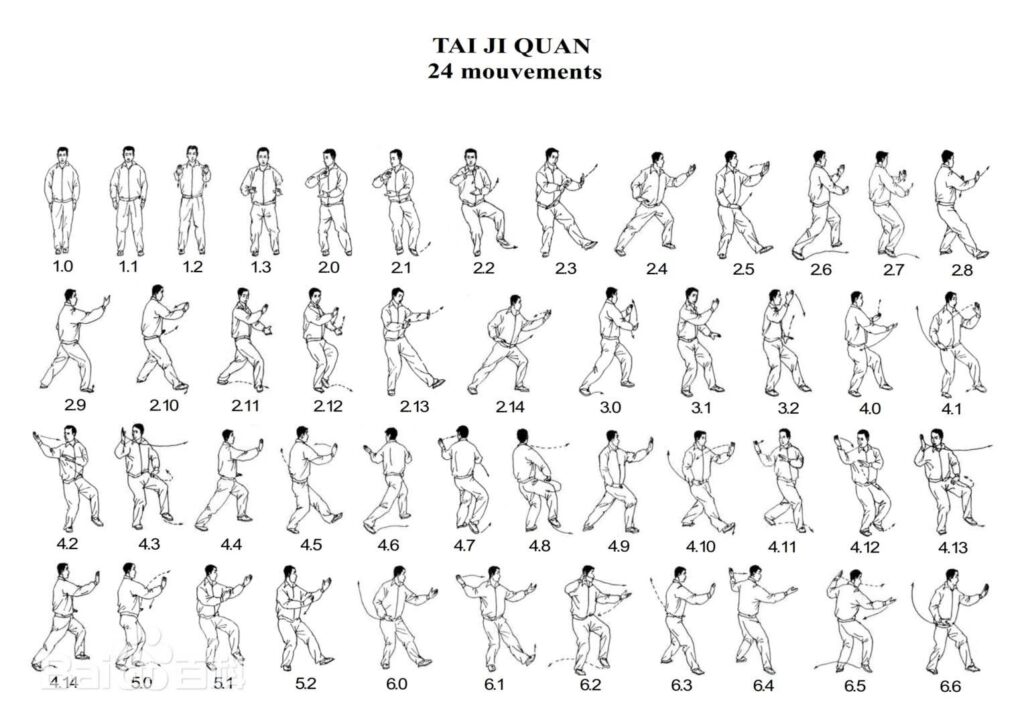
Most students initially experience Tai Chi as a sequence of postures and movements. While forms are valuable training tools, Dr. Chuckrow suggests that genuine practice begins when attention shifts from remembering choreography to cultivating awareness, relaxation, sensitivity, and continuity.
From Control to Participation
Perhaps the deepest lesson in the conversation concerns our relationship with the body itself. Most of us approach practice through control. We try to make movement happen, force positions, push for results, and impose our ideas onto the body. The assumption is that improvement comes through greater effort and greater control.
Chuckrow repeatedly returns to a different approach. Instead of forcing movement, he speaks of allowing movement. Instead of imposing positions, he speaks of observing principles. Instead of controlling the body, he speaks of listening to it. This perspective reflects an ancient insight found in contemplative traditions throughout the world: transformation often begins not when we gain greater control, but when we stop interfering.
The body possesses forms of intelligence that cannot be accessed through force. They reveal themselves gradually through attention, sensitivity, patience, and participation. Over time, the practitioner becomes less a commander directing the body and more an observer learning from it—less a controller and more a participant in an unfolding process of discovery.
Sensitivity Before Strength
In push hands training, practitioners often become preoccupied with winning. Yet Chuckrow argues that the deeper purpose is learning. The more force we apply, the less sensitive we become. Excess tension reduces perception, and excess effort limits responsiveness. What appears to be strength can often become an obstacle to understanding.
True development arises through refinement rather than domination. As sensitivity increases, practitioners begin to perceive subtleties that are invisible when they rely primarily on force. Timing becomes clearer, balance becomes more apparent, and responsiveness becomes more natural.
The same principle applies beyond martial arts. Relationships improve through listening rather than control. Learning develops through curiosity rather than certainty. Awareness expands through observation rather than force. In this sense, sensitivity is not the opposite of strength. It may be the foundation upon which genuine strength — internal strength — is built.
A Lifelong Exploration
After more than five decades of practice, Dr. Robert Chuckrow still describes himself as a student. That may be the most important lesson of all. Tai Chi endures because it cannot be exhausted. Beneath every technique lies another layer of understanding. Beneath every skill lies another level of refinement. Beneath every answer lies another question waiting to be explored.
Watch the Integral Being conversation with Dr. Robert Chuckrow here.
Somewhere along the way, the question itself begins to change. We start by asking what internal strength is. Eventually, we begin asking what kind of human being emerges when relaxation, awareness, sensitivity, and presence become the foundation of how we move through life. The answer is unlikely to be found in a single technique, a single insight, or even a single lifetime of practice. It is a question that continues to unfold as long as we remain willing to explore it.
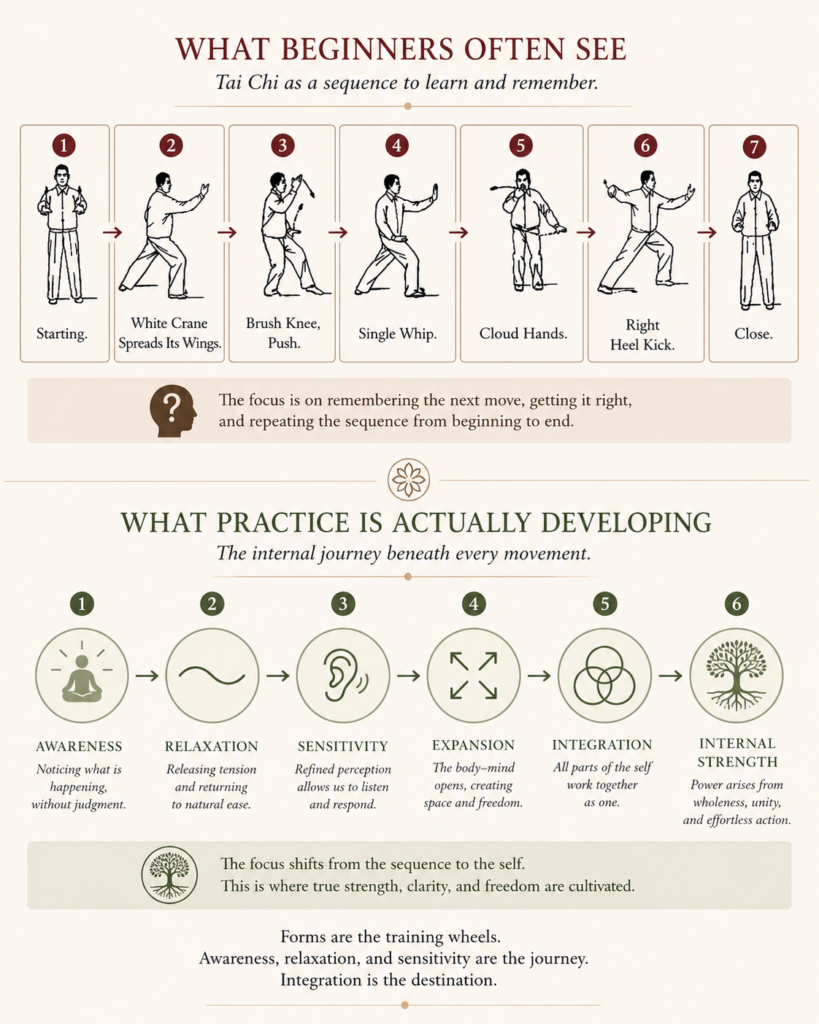
sensitivity, integration, and internal strength.
“What begins as an exploration of movement gradually becomes an exploration of embodiment. Embodiment deepens into awareness, and awareness gradually matures into participation. The practice becomes less about acquiring techniques and more about discovering new ways of relating to ourselves, others, and the world around us.” —Mark V. Wiley
Watch the Integral Being conversation with Dr. Robert Chuck below.
Continue Exploring
The Inner Life Model
How body, breath, attention, and perception organize into lived experience.
The Practice Field
What emerges when perception, awareness, and embodied capacities begin functioning together.
Integrated Modular Training (IMT)
How capacities develop, integrate, and become stable traits rather than temporary experiences.
Integral Being
Conversations exploring transformation, embodiment, and the cultivation of the human being.
Explore Tai Chi, Embodiment & Internal Development