Freemasonry as Inner Work
with Brian T. Mattocks
Symbols, Embodied Practice, and the Work Upon Oneself
Freemasonry is often approached through its history, rituals, degrees, symbols, and enduring aura of secrecy. Yet Freemasonry and inner work have a much deeper relationship than these outward forms might suggest. The tools and structures of the Masonic tradition were intended not merely to be understood, but to be used.
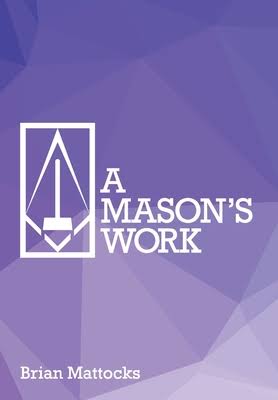
In this Integral Being conversation, Brian T. Mattocks explores Freemasonry and inner work as a practical framework for inner work. Drawing upon the ideas developed in his book A Mason’s Work, he describes a tradition in which the tools once used to shape stone become instruments for examining perception, behavior, character, and the way we participate in life.
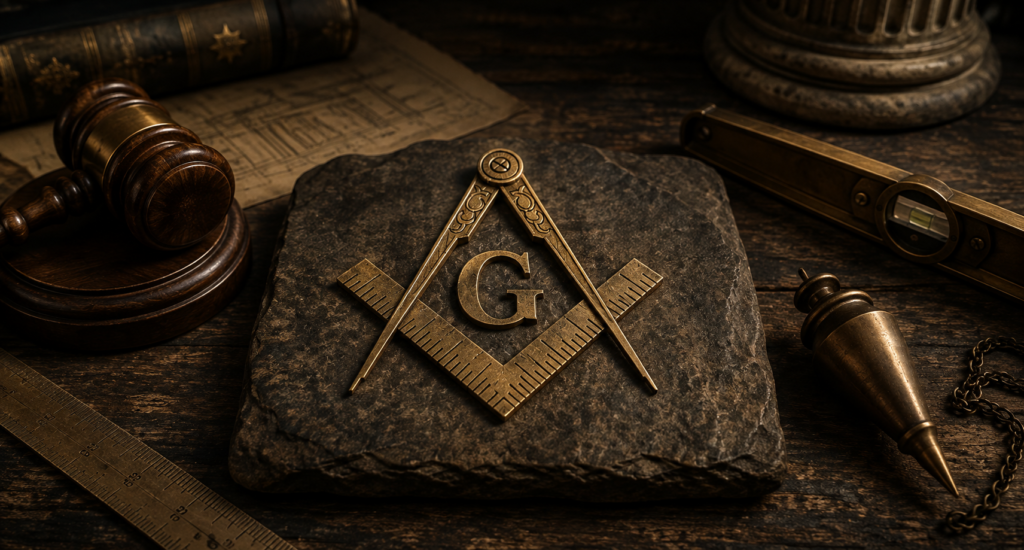
The movement is subtle but important. The gavel is no longer simply a hammer, the level is no longer merely an instrument for construction, and the plumb is no longer simply a way of determining whether something stands upright. Each can become a way of looking at ourselves, and when a symbol begins changing how we perceive and respond to experience, it is no longer merely a symbol. It has become a practice.
From Operative Masonry to Inner Work
Freemasonry developed historically from the world of tradesmen and builders. The operative mason worked directly with material: cutting stone, measuring angles, establishing level, testing vertical alignment, and removing what did not belong.
As Masonry became increasingly “speculative,” those same physical tools acquired psychological and philosophical meaning. A tool for shaping stone could become a way of thinking about the shaping of character. Brian describes the gavel as a particularly simple example: a mason uses a hammer to remove rough edges from stone, while speculatively the same image can invite the question, What are the rough edges in my own behavior that need to be worked upon?
This is where Freemasonry becomes especially interesting from an Inner Life perspective. The physical action becomes an organizing metaphor, but it need not remain an abstraction. The symbol can be brought back into life through behavior, moving from operation, to reflection, to lived expression.
“The tool begins in the hand, moves into the mind, and returns through the way we live.” —Brian T. Mattocks
That movement is at the heart of the conversation. The work is not simply to know what a symbol means, but to discover whether that meaning can actually influence perception, choice, and conduct.
When Symbols Become Instruments
We commonly think of symbols as things that represent something else. But Brian presents Masonic symbols as something closer to instruments of perception: ways of organizing attention toward a particular dimension of what is occurring.
The 24-inch gauge, for example, originated as a practical measuring tool. Within Masonry it becomes a way of contemplating the allocation of one’s time. The square can raise questions about the alignment of one’s conduct, while the compass can illuminate boundaries, proportion, and the extent to which we attempt to control what lies beyond ourselves.
The symbol therefore becomes useful not because it contains a secret answer, but because it gives us another way to examine the problem. Instead of remaining trapped inside our immediate reaction, we gain a perspective from which to look at it.
Brian describes this as a way of taking our thinking out of our heads and placing it, figuratively, on the table. Different tools and Masonic roles offer different perspectives from which the same situation can be examined.
A useful symbol does not replace perception. It reorganizes attention.
This distinction matters because knowledge about a symbol is not the same as knowing how to use it. One can study the square, compass, level, plumb, or gavel for years without allowing any of them to change a single response in daily life. The transition occurs when symbolism becomes operational.
“The symbols themselves actually create a ton of cognitive breathing room.” —Brian T. Mattocks
The Knock: Learning to Notice What Comes First
One of the most interesting parts of the conversation concerns what Brian calls the knock. Within his operative protocol, the knock is the first indication that something requires attention. It may be anxiety tightening the chest, anger moving through the hands, an impulse to flee, a vague uneasiness, or simply the recognition that something within us has shifted.
Brian relates this to interoception, our capacity to perceive signals arising from within the body. Before we construct an explanation, defend ourselves, attack someone, withdraw, or begin telling ourselves a story about what has happened, the organism has already responded.
There has been a knock, and the practice begins by noticing it.
From there, Brian describes a process of awareness, reflection, analysis, and action. What am I experiencing? What may be generating it? From what perspective am I viewing the situation? Which response is actually appropriate?
This creates something essential to nearly every transformative discipline: space between stimulus and response. Instead of reaction immediately becoming behavior, awareness enters the sequence, and once awareness enters, other possibilities become available.
Is Freemasonry an Embodied Practice?
Brian makes an important distinction in the conversation. Freemasonry is not an embodied discipline in the same sense as martial arts, qigong, yoga, or other practices that deliberately reorganize the body through repeated physical training. Its methods are comparatively cognitive, symbolic, relational, and behavioral.
Yet this raises a deeper question: What do we mean by embodiment? If a practice alters how we perceive experience, changes our relationship to emotional reactivity, increases our capacity to pause before acting, and gradually reshapes the way we engage other people, then something has moved beyond intellectual understanding.
It has entered life.
“It has the capacity to strengthen and lengthen the distance between emotional reactivity and cognitive process.” —Brian T. Mattocks
Brian describes the possibility of increasing the distance between emotional reactivity and cognitive response. Through repeated examination, symbolic perspectives become increasingly available when they are needed. What initially required deliberate thought may eventually begin to inform behavior more naturally.
Embodiment begins when what we practice changes the organization of how we meet life. A teaching has then crossed an important threshold. We are no longer merely remembering it; we are beginning to live from it.
The Lodge as a Practice Field
Transformation also does not happen entirely inside the individual. Throughout the conversation, Brian emphasizes the importance of the lodge as a community of trust, feedback, accountability, and mutual development.
A person may study symbolic tools alone, but other people expose dimensions of us that solitary reflection cannot easily reveal. Someone irritates us, someone challenges our assumptions, someone notices a pattern in our behavior that we cannot see ourselves, or someone cares enough to tell us what we would rather not hear.
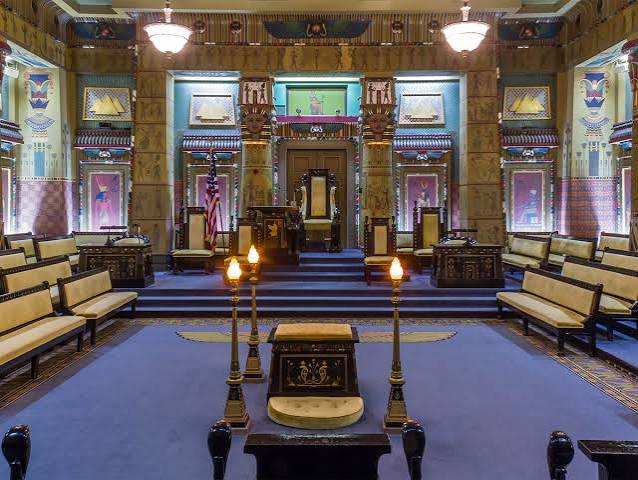
This is one of the functions of what wisdom traditions sometimes call the sangha and what Inner Life describes as the practice field: an environment in which development is intensified through participation with others.
The people around us become part of the practice. Brian makes the provocative observation that we may sometimes learn more from those who rub us the wrong way than from those who simply reflect ourselves back to us. Difference becomes friction, and friction can polish. This is why genuine community is more than belonging. It is developmental.
“I learn more from the folks that rub me the wrong way than from mirrors and reflections.” —Brian T. Mattocks
The Level, the Plumb, and the Measure of a Life
When asked which Masonic symbol might be especially valuable even to someone outside Freemasonry, Brian turns to the level. The level reminds us of a fundamental equality: every human life is moving toward the same end, and death becomes the great leveler.
This is not offered as morbidity, but as perspective. Against the scale of an entire life, how important is the irritation of a mistaken coffee order? How much weight should an insult receive? What deserves our energy, attention, resentment, or love?
Remembering the limited span of a life can recalibrate the significance we give to the events occurring within it.
Brian then adds the plumb, the tool that establishes true vertical alignment. Psychologically, it becomes the question of whether we have discovered a center from which we can stand upright. What do we actually believe? What matters enough that we will not simply bend with every social pressure or passing emotion?
The two symbols complement one another. The level asks us to remember the proportion of a life, while the plumb asks us to discover how we intend to stand within it.
From the Trappings of Practice to Transformation
One of the broader themes running through the conversation reaches well beyond Freemasonry. Every tradition can become performative.
We can acquire the clothing, language, books, memberships, rituals, certifications, and outward identity of a practice without submitting ourselves to the transformation that practice demands. The trappings are comparatively easy; the inner work is not.
Brian repeatedly returns to the importance of turning symbolic understanding back toward behavior. A tradition becomes transformative only when its teachings are used to examine the very places we would often prefer not to examine: the uncomfortable reaction, the habitual defense, the desire for approval, the attempt to control, the story we continually tell ourselves, and the rough edge we would rather leave untouched.
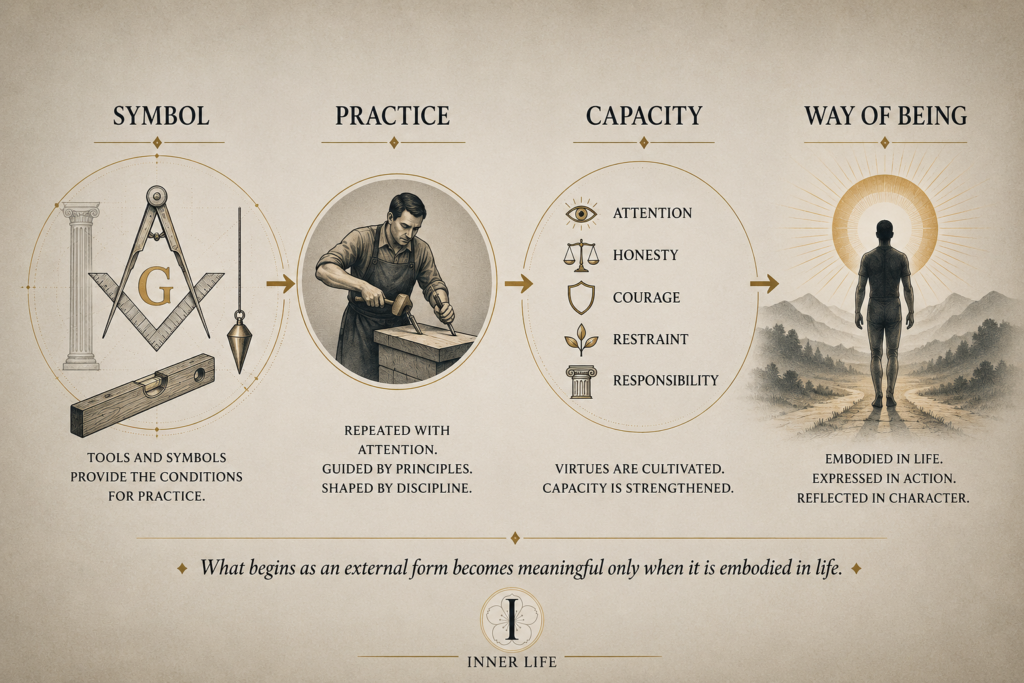
This is where a symbolic tool once used upon stone becomes an instrument of self-examination. The point is not to possess the tool, but to become skillful enough to use it without harming ourselves or others.
“Even the right tool used unskillfully causes damage.” —Brian T. Mattocks
Courage and Honesty
Near the end of the conversation, the question becomes very simple: if another person cannot transform us, what does inner work ultimately require from the individual? Brian’s answer is equally simple: courage and honesty.
Honesty is required because the person we can most easily deceive is ourselves. Courage is required because the places that most need examination are often the places we most resist entering.
We need honesty to recognize what is actually happening, and we need courage to remain present long enough to work with what we find. Together, these qualities make self-examination possible.
“The inner work for everyone—Mason, non-Mason—requires two things: courage and honesty.” —Brian T. Mattocks
Perhaps this is where Freemasonry’s metaphor of building becomes most useful. The human being is not a finished structure; we remain under construction.
The work is therefore not toward some single moment in which we finally declare ourselves transformed. It is an ongoing process of refinement—learning to notice more clearly, examine more carefully, respond more skillfully, and gradually bring our actions into greater alignment with what we understand.
The tools may come from Masonry, martial arts, contemplative traditions, psychotherapy, or another path entirely. The essential question remains the same:
Are we collecting the tools, or are we allowing them to work upon us?
About the Guest
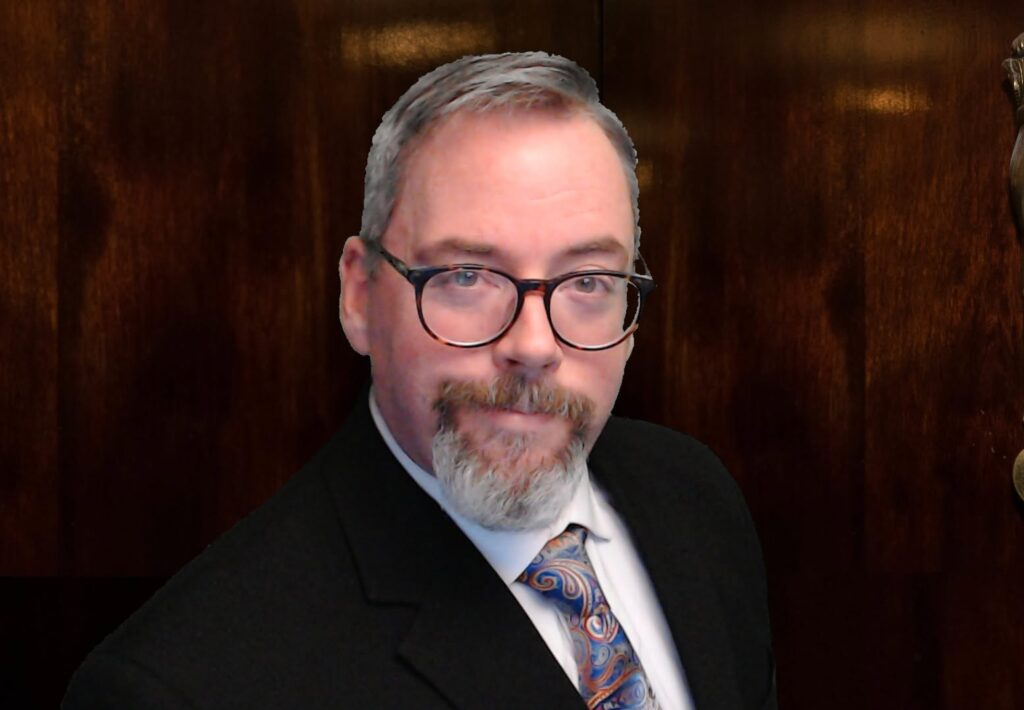
Brian T. Mattocks is a Freemason, author, and podcast host whose work explores Freemasonry as a living practice of personal development and inner transformation. Based in Havertown, Pennsylvania, he has served three times as Worshipful Master of Cassia Mt. Horeb Lodge No. 273, F&AM, under the Grand Lodge of Pennsylvania, and currently serves as Vice Chair of the Pennsylvania Academy of Masonic Knowledge.
Mattocks is the author of A Mason’s Work, which grew from years of experience in lodge rooms, at podiums, and in one-to-one conversations with Masons seeking to move beyond the symbols and rituals of Freemasonry toward their practical application. At the center of his work is a simple conviction: the tools of Freemasonry were never meant merely to be admired; they were meant to be used.
Continue Exploring