
The Life We Enter
Reflections on Faith, Practice, and Participation
by Mark V. Wiley
There is a difference between believing in a spiritual path and entering it as a lived spiritual practice.
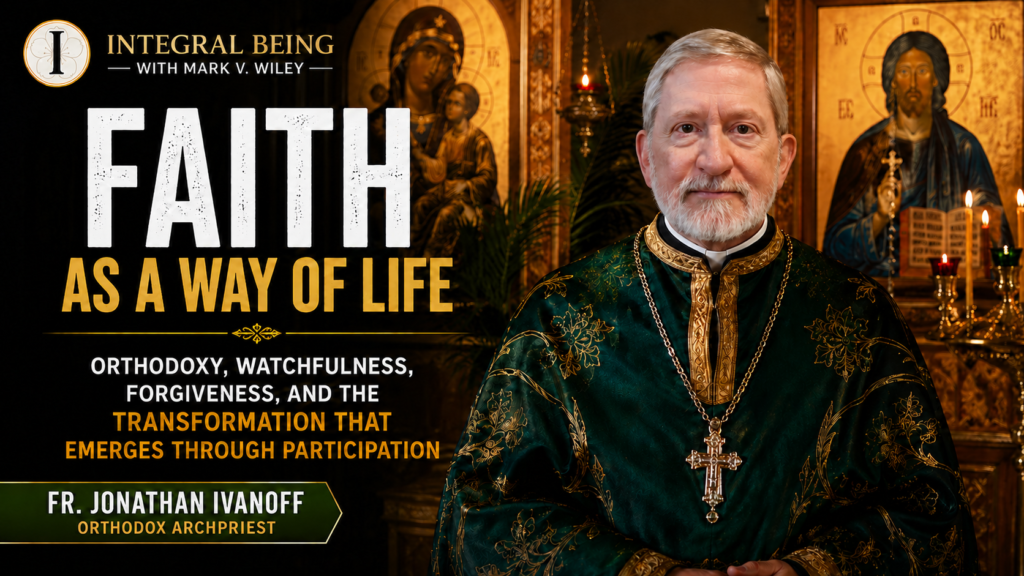
My conversation with Father Jonathan Ivanoff began with Orthodox Christianity—its history, beliefs, worship, scriptures, and traditions—but underneath these subjects another question gradually emerged: What happens when a teaching is no longer something we merely understand, but something we actually live?
Father Jonathan repeatedly returned to the idea that Orthodoxy is not simply a collection of propositions to which a person gives intellectual assent. Belief is expected to become prayer, fasting, worship, forgiveness, conduct, and a particular orientation toward life. As he explained, one must eventually “embrace that way as a way of life.” The teaching is not simply learned. It is entered.
That distinction extends well beyond religion. A teaching observed from the outside remains information. A teaching entered through practice begins to shape perception, behavior, attention, and eventually the person who is practicing. This is where belief becomes participation.
When Belief Becomes a Way of Life
Modern culture places enormous emphasis on understanding. We gather information, compare viewpoints, analyze claims, and decide what we think about them. There is value in this, but there are dimensions of human life that cannot be fully known from that position.
No amount of reading about meditation produces the experience of sitting quietly with one’s own mind. No description of martial practice can give someone balance, timing, sensitivity, or composure under pressure. And no explanation of a living spiritual tradition can reproduce what happens when its disciplines begin organizing the rhythm of a person’s days.
Father Jonathan describes spiritual practice in Orthodox life in precisely these terms. Prayer, fasting, worship, forgiveness, and other disciplines are not accessories surrounding belief. They are among the means through which belief becomes lived. This suggests an important distinction: we can know about a path without yet knowing the path. The second kind of knowing requires participation.
“It’s a way of life.” —Fr Jonathan Ivanoff
Practice Organizes Attention
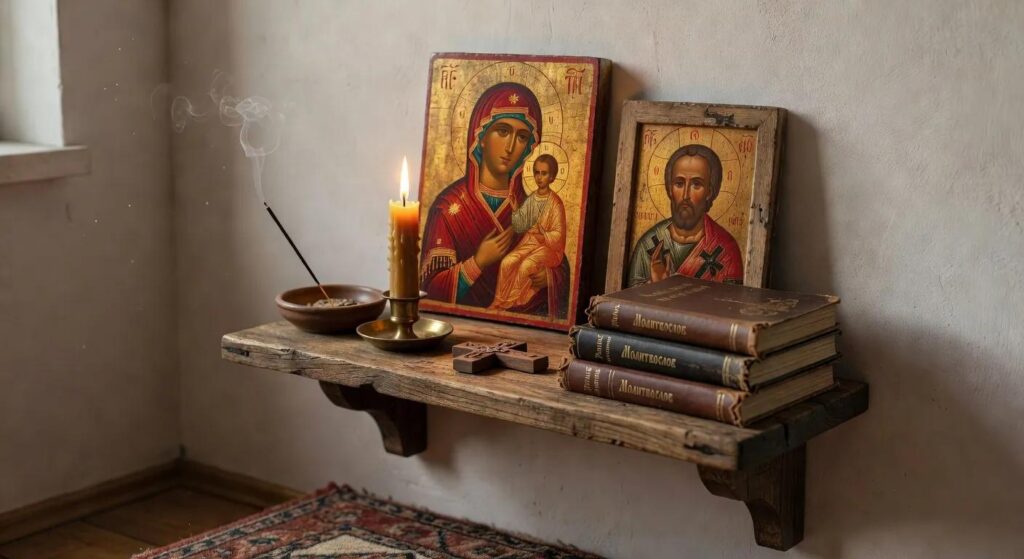
One of the most interesting portions of our conversation concerned the sensory environment of Orthodox worship: icons, candles, incense, chanting, ritual movement, and the prayer corner traditionally maintained within the home. It would be easy to regard these things as religious decoration. Father Jonathan described them differently. They are tools for attention.
He explained that the smell of incense, the glow of candles, the presence of icons, the words of prayer, and the physical act of standing before them can help “move the world…out of range” for a time so the practitioner can focus on what matters. Prayer, fasting, almsgiving, and participation in divine services all function within this larger structure of recollection and orientation.
This principle is not unique to Orthodoxy. Every serious practice creates conditions that support a particular quality of attention.
A meditation room becomes different from the room in which we watch television. A training hall becomes different from an ordinary floor. A prayer rug, cushion, altar, icon, bell, incense burner, or simply a particular place in one’s home can gradually acquire significance through repeated use. The objects themselves are not the transformation. They help establish the conditions in which transformation can be cultivated.
Watchfulness as a Practiced Life
Father Jonathan’s discussion of watchfulness brought this even further. Watchfulness is sometimes translated into contemporary language as mindfulness or self-observation. But in the Orthodox context he described, it carries a stronger demand: remain vigilant. Do not become so absorbed in the world that you forget what your life is oriented toward.
He described watchfulness as a continual readiness: “We have to watch. We have to not get caught up in the world. We have to be ready.” He then connected that vigilance to what he called “a practiced life.” Watchfulness, then, is not merely noticing thoughts. It is remembering how one intends to live.
That becomes much more difficult if practice exists only occasionally. A person who remembers once a week must continually reconstruct the orientation. A person whose day contains repeated acts of prayer, recollection, restraint, forgiveness, and worship is continually returning to it.
Practice creates continuity. Over time, what initially requires deliberate effort may begin to become a disposition. The practice starts reorganizing the practitioner.
“Watchfulness means just watch and be ready.” —Fr Jonathan Ivanoff
Forgiveness Is Not an Idea
The conversation about forgiveness made this especially concrete.
Most people agree that forgiveness is admirable. Agreement, however, is easy when nothing is at stake. The practice begins when we have actually been hurt. Father Jonathan spoke about how readily human beings justify resentment: “I have a right to be mad. I have a right to be upset. I have a right to carry a grudge.” His response was direct: from within the Christian path he describes, forgiveness confronts that self-justification rather than confirming it.
This makes forgiveness something more demanding than a moral opinion. It becomes a practice through which a person encounters attachment to injury, anger, identity, and the need to be right. The teaching becomes real precisely where it becomes difficult.
We discover the depth of patience when impatience arises. We discover equanimity when circumstances disturb us. We discover compassion when another person becomes difficult to love. And we discover forgiveness when there is actually something to forgive. Practice reveals the distance between the person we imagine ourselves to be and the person we are capable of being in the moment.
The Body Participates
Another striking aspect of Orthodox spiritual practice is how thoroughly the body participates.
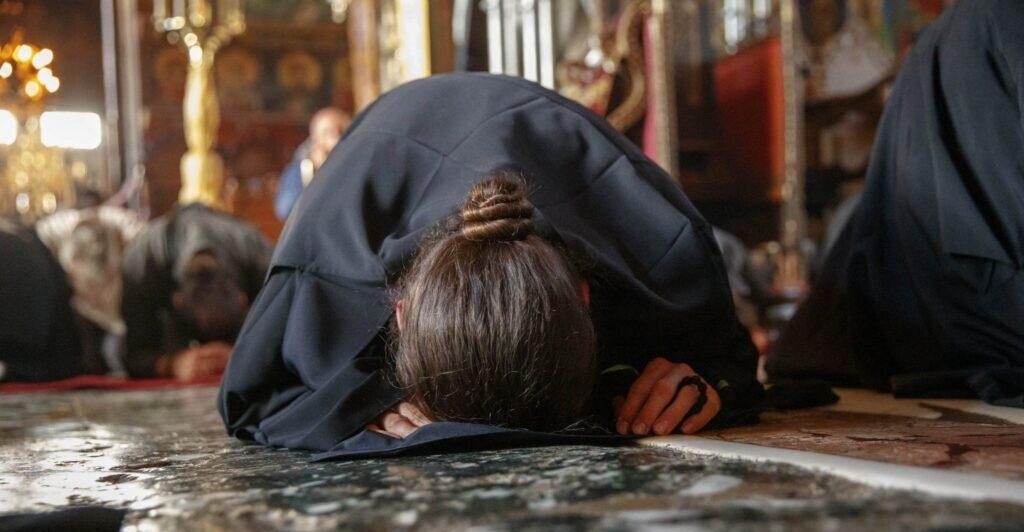
Father Jonathan described standing, kneeling, bowing, making prostrations, crossing oneself, smelling incense, seeing icons, fasting, and receiving the Eucharist. Prayer, as he put it simply, “involves the body.” The body is not simply carrying a mind around while the “spiritual” work happens somewhere inside it. The body participates in the practice.
“Prayer involves the body.” —Fr Jonathan Ivanoff
This matters because repeated physical actions influence attention and behavior differently from ideas alone. A person can think about humility while remaining physically unchanged. Bowing is different. A person can admire discipline while remaining comfortable. Fasting or repeatedly rising from a full prostration introduces another kind of encounter. The teaching is no longer merely conceptual. Something is being asked of the whole person.
From the perspective of Inner Life, this is one of the most compelling aspects of the conversation. Across very different traditions, transformative practices repeatedly recruit more than thought. Breath, posture, movement, sensation, attention, environment, relationship, and repetition become part of the process.
The human being learns through participation.
From Repetition to Formation
At one point in our conversation Father Jonathan made an observation that reaches beyond its immediate religious context. He described how repeated behavior becomes habit, and how habit can eventually become something more deeply ingrained in a person’s nature. This may be one of the simplest descriptions of cultivation.
What we repeatedly do does not merely produce an isolated experience. It gradually establishes tendencies. Attention practiced repeatedly becomes easier to recover. Distraction repeatedly indulged becomes easier to enter. Resentment rehearsed becomes easier to maintain. Forgiveness practiced becomes more available.
The same principle operates in movement, meditation, prayer, relationships, and across the broader process of human development and integration. Practice is therefore never entirely neutral. We are continually cultivating something. The question is whether we are cultivating it deliberately.
The Life We Enter
What remained with me after speaking with Father Jonathan was not primarily an argument for or against a particular theology. It was the image of a human life organized around practice.
Prayer at particular times. Fasting. Worship. Watchfulness. Forgiveness. Bodily participation. Sacred spaces within ordinary environments. Repeated acts that continually remind the practitioner what matters and where attention is meant to return. Seen this way, a tradition is more than a collection of teachings. It is an environment of formation. And perhaps this is why genuine traditions cannot be completely understood from the outside.
We can study their history. We can examine their doctrines. We can compare their ideas. We can even admire their practices. But eventually observation reaches its limit. To discover what a practice actually does, something must be practiced. To discover what a way of life reveals, something of that life must be entered
The deepest understanding does not always precede experience. Sometimes it is what experience gradually makes possible. A tradition becomes transformative when it organizes life around spiritual practice. That is where its teachings move from something we understand to something we embody.
And that is profoundly Inner Life.
Continue Exploring