Watching the Movie of the World
Witnessing Awareness and the Work of the Heart
by Mark V. Wiley
Long before I had any language for contemplative practice, nonduality, or witnessing awareness, I occasionally experienced moments that made me question my ordinary relationship to the world around me.
When the World Suddenly Felt Different
I remember walking the hallways of my school as a teenager, surrounded by other students moving between classes, talking, laughing, carrying books, going about the ordinary business of the day. I was clearly there among them, and yet for a moment I had the unmistakable feeling that although I was in that hallway, I was somehow not entirely of it.
It was difficult to describe. It felt almost like entering a kind of virtual reality—as though I had suddenly found myself among a different time, place, and group of people. Everything was familiar, yet somehow I was standing apart from the familiarity of it.
I didn’t understand the experience, and I certainly didn’t have a framework for interpreting it. But the feeling stayed with me. It would be at least another decade before something similar happened again.
This time I was sparring in eskrima, Filipino-style stick fighting with an opponent. The exchange was fast, blunt, and intense. There was no opportunity for abstract reflection. The body had to perceive and respond immediately. Then, unexpectedly, my relationship to the experience changed.
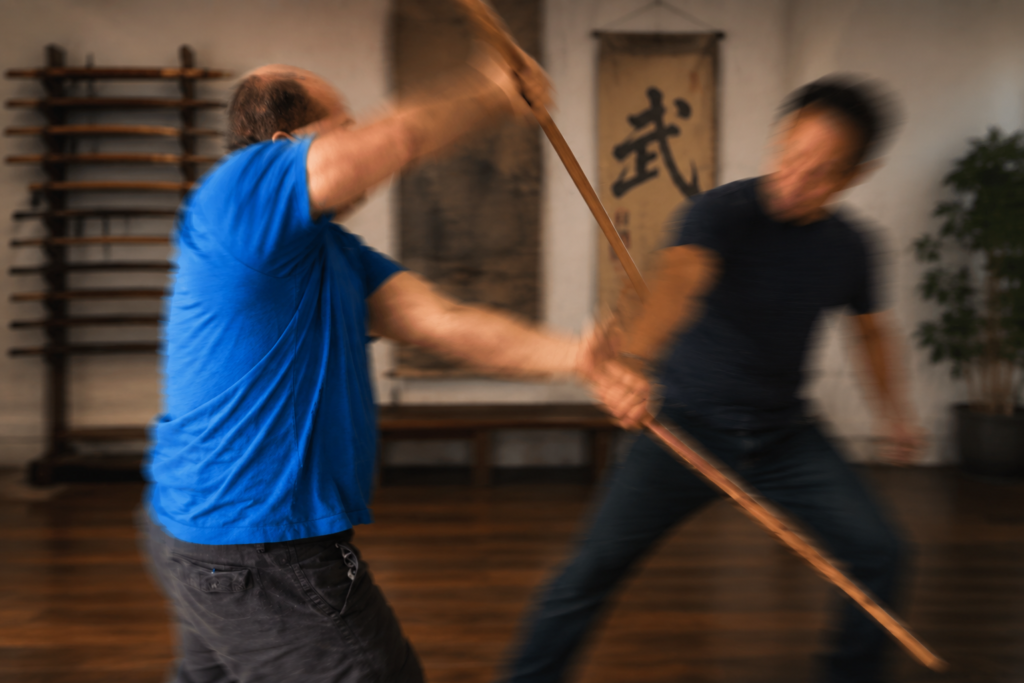
For a brief period, it felt almost as though I were watching myself from slightly behind. The exchange continued. My body continued moving and responding. The sticks continued striking and countering. Yet the emotional intensity and stress that normally accompanied such an exchange seemed strangely absent.
I was participating fully in what was happening, but at the same time I seemed to be witnessing it. his was different from what I had experienced as flow. In flow, the sense of self can recede as one becomes absorbed in the activity. Here, something else seemed to occur: the apparent locus of awareness shifted, as though the action continued while awareness witnessed it from somewhere slightly removed.
I don’t offer either of these experiences as evidence of some special state or attainment. They were simply moments that disturbed, however briefly, the ordinary assumption that the person experiencing life and the awareness of that experience are necessarily the same thing.
When Understanding Becomes Intellectual
Over the decades that followed, I encountered many ways of understanding this question through Eastern, Western, and Middle Eastern contemplative and spiritual traditions. I read about the witness, the observer, awareness, surrender, nonduality, remembrance, and the distinction between what we experience and that which knows the experience.
These traditions gave me language for something I had once experienced without language. But language creates its own problem.
I can become so interested in the ideas—the philosophies, metaphysics, traditions, distinctions, and explanations—that something originally encountered through direct experience becomes intellectual again. The living question becomes a concept. Something once felt becomes something understood.
And understanding something is not the same as living it.
That is partly why a recent conversation affected me in such a simple way.
Watching the Movie of the World
A few days ago I had the opportunity to speak with the Naqshbandi Sufi teacher Shaykh Burhanuddin Herrmann. Later that evening, I watched a recorded talk he had given to his students during a period when many people were feeling anxious about world events.
Listening to it, I was struck by the simplicity and clarity of a metaphor he used to describe the human situation. There was nothing particularly complicated about it. In fact, perhaps that was precisely why it reached me.
After decades of encountering sophisticated ways of thinking about awareness and our relationship to experience, his simple image seemed to bypass the intellectual structures I had accumulated around the question. It brought me back, however briefly, to something immediate.
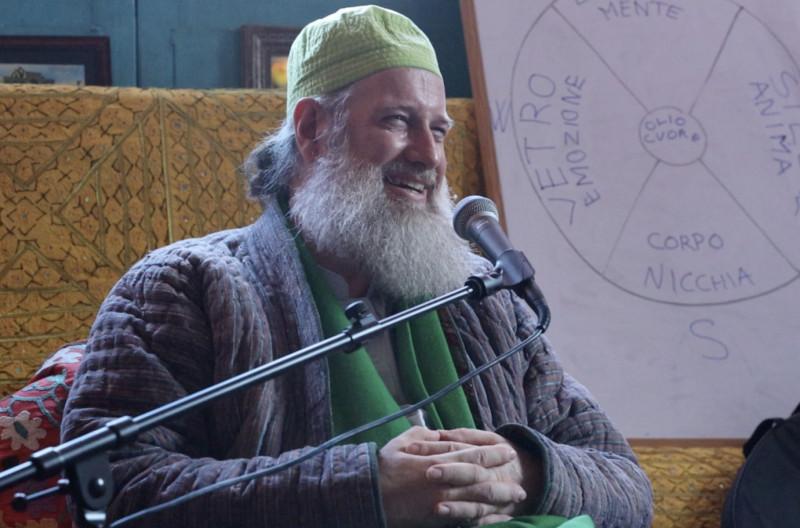
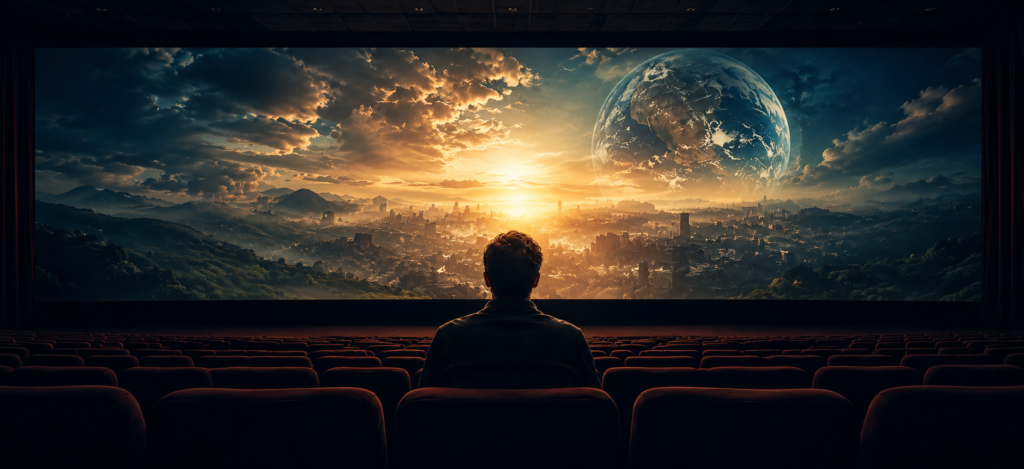
“Think of it like a movie. When you watch a movie in the cinema you feel with the actor. You want him to go left or right—but he goes where the story goes. He is not listening to you.” —Shaykh Burhanuddin
The image is deceptively simple.
Most of us live as if we are directing the film of our lives—and often the film of the world itself. When events move in ways we cannot control, anxiety naturally follows. We feel as though something has gone wrong, as though the story has taken a turn it was never supposed to take.
But the deeper suggestion in the Shaykh’s metaphor is that the problem may not lie in the unfolding of events. It lies in our assumption that we are directing them.
History rarely bends itself to the wishes of individuals. Nations move through cycles. Economies rise and fall. Conflicts appear and disappear according to forces that lie far beyond the horizon of personal understanding.
As the Shaykh explained:
“The one who wakes up while watching the movie is not so affected.” —Shaykh Burhanuddin
The events on the screen continue. The storms of history continue. But our relationship to them can change.
The metaphor resonated with me in another, more personal way. Over the past decade, I have spent time working in film. I wrote and produced a feature film, produced several others, and appeared as an actor in a handful of productions. Anyone who has spent time on a film set learns quickly that what the audience eventually experiences is very different from what those involved in making the film can see.
Actors bring life to their roles. Directors shape pacing and tone. Unexpected moments arise. But from outside the experience of the audience, the story is already moving according to an arc the audience cannot see.
For the person watching the film, however, every moment appears uncertain. We become absorbed in each scene. We hope. We fear. We anticipate. Every turn in the story seems momentous because we cannot see where the larger arc is taking us.
Life often feels much the same. We experience it from inside the unfolding story. We watch events with deep emotional involvement, convinced that everything depends upon the next turn. Yet the film of history may be moving along deeper currents we cannot see.
The question, then, is not whether the movie will continue to play.
The question is whether we remain lost in the drama—or awaken while watching it.
Different Traditions, a Common Turn
This possibility appears in strikingly different forms across contemplative traditions. They do not necessarily make the same metaphysical claims, and we should resist collapsing their differences. Yet each, in its own way, asks us to reconsider our ordinary identification with what is happening.
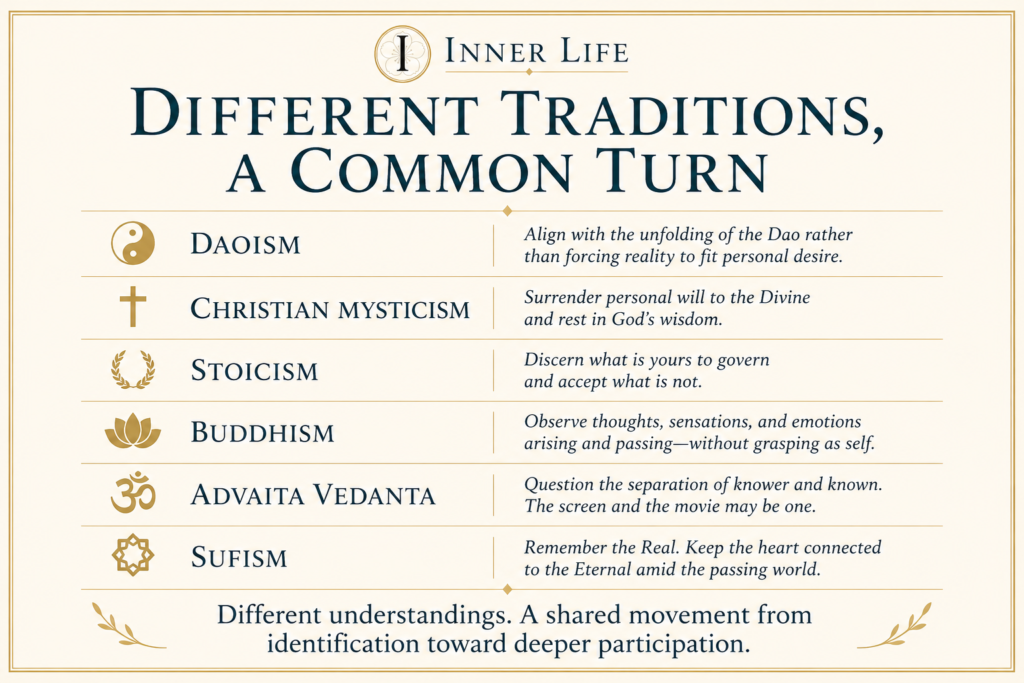
In Daoism, the sage does not attempt to force reality into conformity with personal desire. The cultivation is one of alignment—learning to move with the Dao rather than continually imposing oneself against the unfolding of things.
Christian mysticism approaches the question through surrender. Personal will gradually yields to divine will, not necessarily as passivity, but as a different orientation toward what cannot be controlled.
Stoicism makes a practical distinction between what lies within our power and what does not. Our actions, judgments, and responses remain ours to cultivate, even when the larger movement of circumstances does not obey our wishes.
Buddhist contemplative traditions approach similar experiential territory through careful observation. Thoughts, sensations, emotions, and perceptions arise and pass. As they are observed more clearly, the tendency to grasp each experience as “me” or “mine” can begin to loosen.
Importantly, Buddhism also cautions against simply moving our identification from the contents of experience to some permanent observer standing behind them. This marks an important distinction from certain ways of interpreting the witnessing Self in other traditions.
Advaita Vedanta approaches the question from another direction. Its teachers ask us to investigate the distinction between the one who is aware and everything that appears within awareness.
We see the body. We experience sensations. We notice emotions. We observe thoughts arising and passing. We see, hear, touch, taste, and smell the world around us. All of these appear within experience—and all can, in some sense, be observed.
This gives rise to a deceptively simple inquiry:
If something can be observed, is it what I fundamentally am—or is it something appearing within awareness?
A thought arises, and we know the thought. An emotion arises, and we know the emotion. A sensation arises in the body, and we know the sensation. Even our familiar sense of ourselves—our memories, preferences, identities, fears, and hopes—can become something we observe.
Here the metaphor of the movie becomes especially revealing.
We normally experience ourselves as a character inside the film, caught in its pleasures, fears, conflicts, and uncertainties. We identify so completely with the character that whatever happens to the character appears to be happening to the whole of what we are.
Advaita invites a different recognition: become aware of the awareness in which the entire experience appears—the screen, so to speak, upon which both the world and our sense of ourselves are being projected.
At first this seems to establish another duality: observer and observed, witness and world, screen and movie. But the nondual inquiry does not end there.
Eventually even the apparent separation between observer and observed is questioned. If everything we experience appears within awareness, where precisely is the boundary between awareness and what appears within it?
The screen and what appears upon it may not be two separate realities.
There is a progression here that the movie metaphor helps illuminate:
At first, we think we are directing the movie. Then we discover that we are watching the movie. Then we begin to recognize how completely we have mistaken ourselves for the character in the movie. Finally, even the distinction between watcher and watched begins to become less certain.
Sufism speaks in a related, though distinctly theistic, language. The passing world is not denied, but the seeker’s orientation toward it changes through remembrance. Rather than becoming entirely absorbed in the movement of appearances, the heart continually turns toward the Real.
Different traditions. Different metaphysics. Different understandings of what, ultimately, the witness—or even the absence of a separate witness—means.
Yet something interesting seems to converge in lived experience: our ordinary identification with every passing thought, emotion, circumstance, and event can loosen. And perhaps that loosening allows another kind of participation to become possible.
The Work of the Heart
In his talk, Shaykh Burhanuddin extended the movie metaphor in a deeply human direction:
“You look at the person next to you and suddenly you feel they look very familiar. And you realize that you and the people around you are what really matter in the cinema—not the movie.” —Shaykh Burhanuddin
This may be the most important turn in the entire metaphor. The point is not to become an indifferent spectator. It is not to decide that the world is unreal and therefore nothing matters. Nor is it to retreat into the position of a detached observer while life happens somewhere else.
The drama of the world continues.
But the awakening of the heart becomes the real work.
Perhaps when we are less captured by the movie, we become more capable of meeting what is actually here: the person beside us, the family that needs our care, the meal that needs preparing, the conversation happening now, the life immediately before us.
The question is no longer simply, What will happen next?
Another question begins to appear:
Who—or what—is watching? And from where am I living this moment?
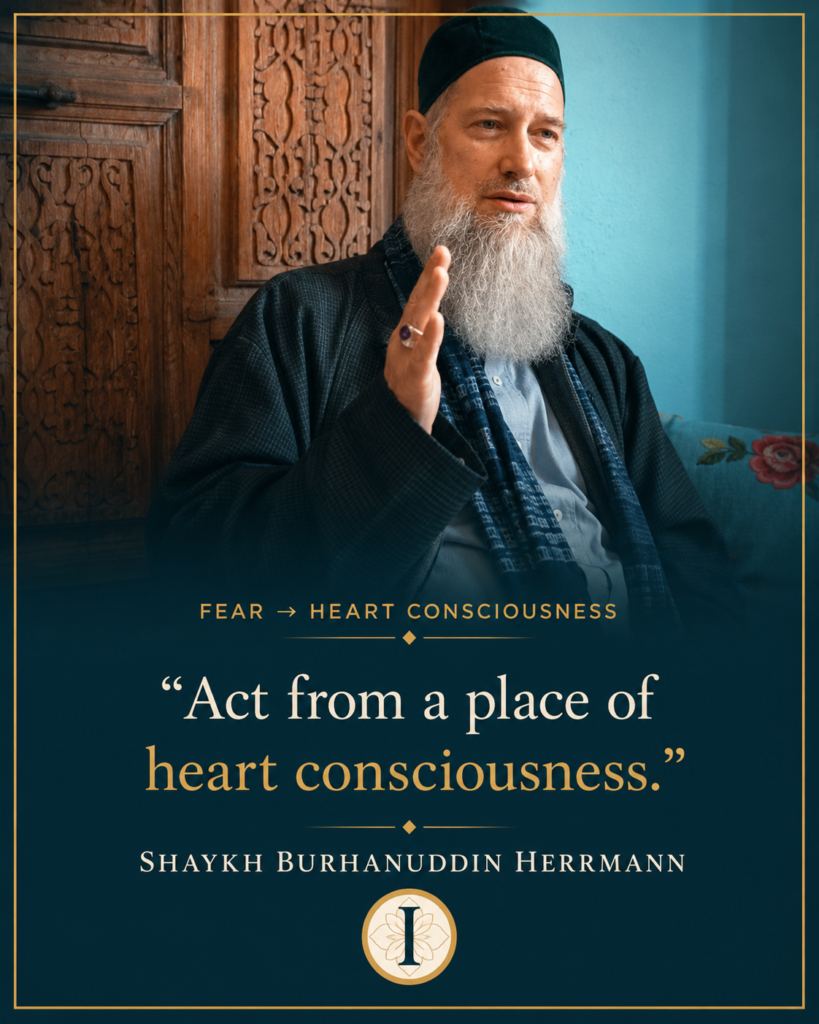
Toward the end of the talk, Shaykh Burhanuddin offered simple guidance: continue your prayers, take life day by day, and do not lose yourself in fear. Even simple acts—sharing food, caring for family, preparing calmly for uncertain times—become meaningful when they arise from steadiness rather than anxiety.
Perhaps this is where these very different traditions converge most meaningfully—not necessarily in doctrine, theology, or metaphysics, but in lived experience. The point is not merely to develop a different idea about reality. It is to discover a different relationship to experience.
The movie of the world will continue to unfold. Storms will come and go. We will continue to think, feel, act, choose, care, suffer, love, and participate in the world around us. But we need not be completely captured by every scene.
The work of the inner life is not to control the story.
It is to wake up while watching it.
About Mark V. Wiley
Mark V. Wiley is a martial artist, author, and researcher with nearly five decades of training across traditional martial arts, internal cultivation systems, healing arts, and contemplative disciplines. He is the founder of Integrated Eskrima, a lineage holder in orthodox Ngo Cho Kun, and the creator of Inner Life — a practice-based system exploring embodied development, integration, and lived transformation.
Continue Exploring