Why You Cannot Control the Breath
How Observation Restores Natural Regulation, Embodiment, and Awareness
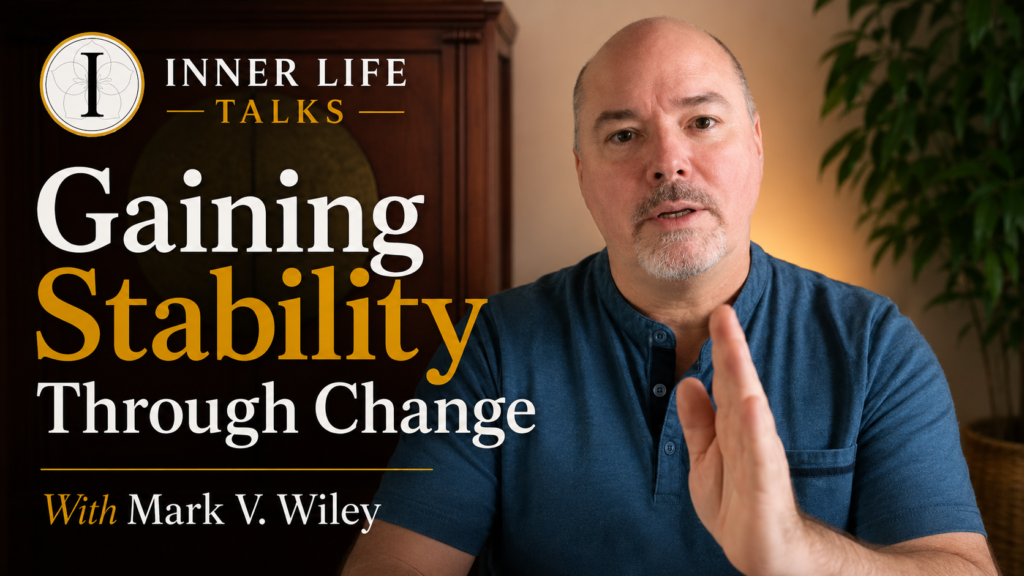
by Mark V. Wiley
Breathing is one of the few human processes that exists between conscious intention and unconscious intelligence. We can influence it for a moment, yet it continues every hour of every day without our participation. This unique relationship makes the breath one of the most accessible doorways into embodied awareness—and one of the easiest places to mistake control for practice.
In this Inner Life Talk, Mark V. Wiley explores why the attempt to control the breath often creates the very tension practitioners hope to eliminate. Rather than offering another breathing technique, he invites us to discover what becomes possible when observation replaces management and awareness replaces effort.
“True regulation is not imposed. It emerges.” —Mark V. Wiley
We Are Taught to Control the Breath
Most systems of meditation, yoga, breathwork, and stress management begin with the same instruction: control the breath.
Breathe more deeply. Slow the rhythm. Lengthen the inhale. Extend the exhale. These practices can certainly influence physiology, and in many situations they are useful. Yet they also introduce something subtle that often goes unnoticed. The moment we begin directing the breath, the mind shifts into management. We become occupied with getting the breath right rather than becoming aware of what is already taking place.
The breath becomes something we are doing instead of something we are witnessing. Although this distinction may seem small, it changes the entire quality of practice. Rather than cultivating presence, we may simply be replacing one activity with another.
The Breath Already Knows How to Breathe
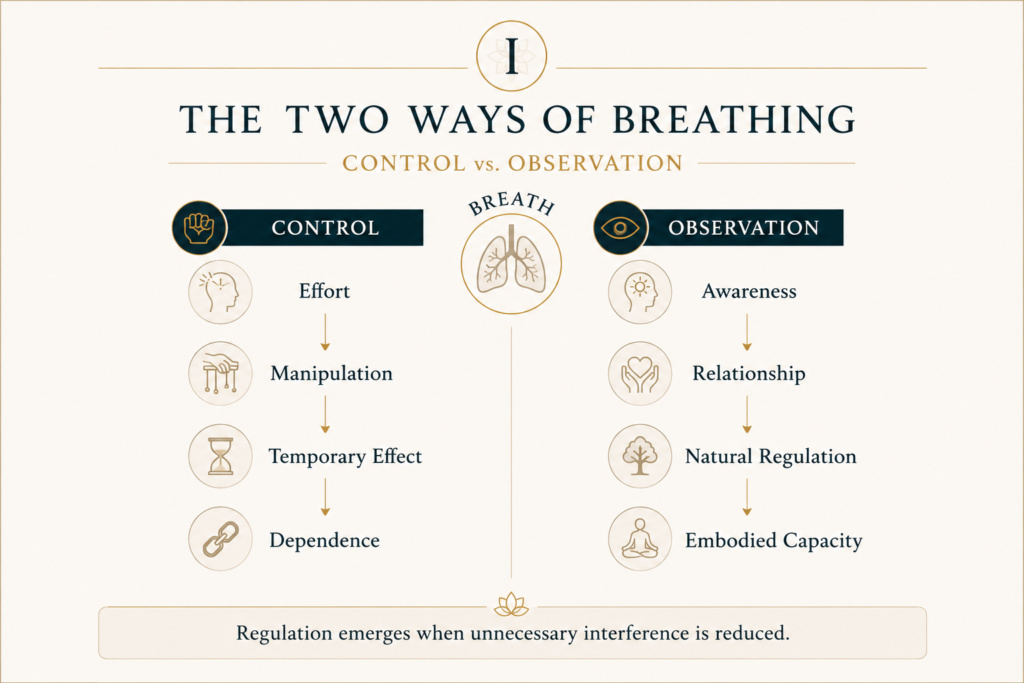
Long before we learned meditation, Tai Chi, or contemplative practice, the breath was already functioning perfectly well. It continues while we sleep, adapts automatically during exercise, responds to emotion, and constantly adjusts itself to the body’s changing needs without requiring conscious direction.
The body possesses an extraordinary capacity for self-organization. Breathing is one expression of that intelligence. When we attempt to control the breath — to supervise every inhalation and exhalation — we may unintentionally interrupt the natural coordination that already exists between breath, posture, movement, sensation, and awareness.
Instead of asking, How should I breathe?, a more revealing question begins to emerge: What happens when I stop interfering?
“The breath is not something you own. It is something that is happening.” —Mark V. Wiley
Observation Changes the System
Observation is often misunderstood as doing nothing. In reality, observation changes the quality of the entire system.
When the breath is simply observed without attempting to improve it, unnecessary effort begins to diminish. Muscular tension softens. Attention becomes less fragmented. The nervous system gradually settles into a more coherent pattern—not because observation forces change, but because it removes the constant interference created by control.
The breath begins to find its own rhythm. The body relaxes naturally. Awareness becomes more continuous because it is no longer divided between experiencing the breath and managing it.
This is one reason the Six Foundational Practices begin with awareness rather than technique. Before practitioners learn to influence the system, they first learn to perceive it. Genuine transformation begins by seeing clearly what is already present.
Regulation Is Different Than Control
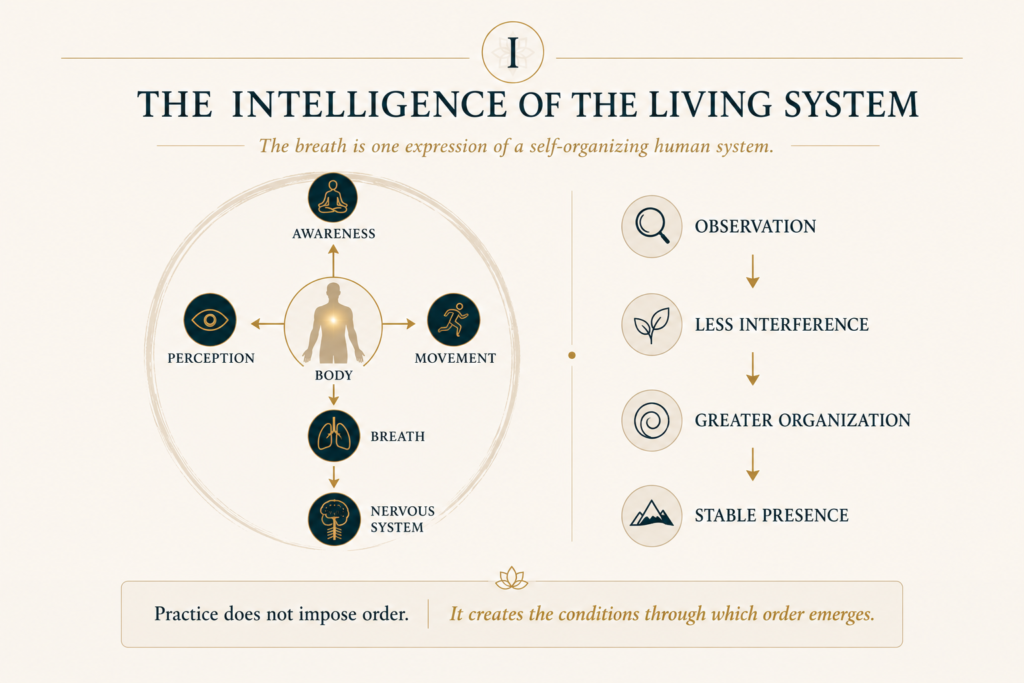
Control depends upon continual effort. Regulation arises from organization. Although these words are often used interchangeably, they describe two very different processes. Control requires constant intervention. Regulation reflects an integrated system functioning according to its own inherent intelligence.
As awareness deepens, breathing often becomes quieter, smoother, and more refined. This is not because an ideal breathing pattern has been imposed, but because the body no longer needs to compensate for unnecessary tension.
The same principle extends far beyond respiration. Posture, movement, emotional stability, perception, and even our relationships become more organized as interference decreases. This is one of the central principles explored throughout the Inner Life Model and embodied practice itself.
“Practice is not about taking control of the system. It is about reducing interference so the system can organize itself.” —Mark V. Wiley
Breath as a Doorway Into Embodiment
The breath is not the destination. It is one of the clearest pathways into embodiment.
By learning to observe rather than to manipulate or control the breath, practitioners gradually discover a more profound shift. Awareness begins moving beyond the thinking mind into direct participation with the living body. Presence becomes less something we attempt to create and more something that naturally emerges as unnecessary effort dissolves.
This is the difference between collecting experiences and cultivating embodiment. Experiences come and go. Embodiment becomes a stable capacity through repeated practice. Over time, temporary moments of calm gradually become lasting qualities of presence. Breath is no longer treated as a technique to perfect but as a living expression of the body’s ongoing intelligence.
“The less we interfere with the breath, the more clearly the body teaches us how deeply it already knows how to live.” —Mark V. Wiley
Continue the Practice
If this conversation resonates with you, continue exploring the principles of embodied awareness through the Six Foundational Practices, What Embodiment Actually Means, What the Body Reveals Over Time, and the Inner Life Model. Together they explore a single question from different perspectives:
How do human beings cultivate greater integration, presence, and participation in life?
Watch & Listen
Watch on YouTube or listen on your favorite podcast platform




Continue Exploring