Embodied Practice and the Structure of Experience
The Developmental Foundations of Inner Life
by Mark V. Wiley
Embodied practice changes the structure of experience in ways that are often subtle at first but profound over time. Modern life places unprecedented demands on human attention. Most people spend their days seated, immersed in information, surrounded by stimulation, and increasingly disconnected from the direct experience of being alive.
Here, embodiment does not simply mean greater awareness of bodily sensation. It refers to the integration of sensing, structure, regulation, and responsiveness into capacities that become increasingly available without deliberate effort. See What Embodiment Actually Means for the fuller distinction.
This fragmentation affects every dimension of human experience. Tension accumulates throughout the body. Awareness becomes increasingly absorbed in thought. Movement becomes restricted. Emotional reactivity replaces responsiveness. Many people find themselves living within ideas about life while losing contact with life itself.
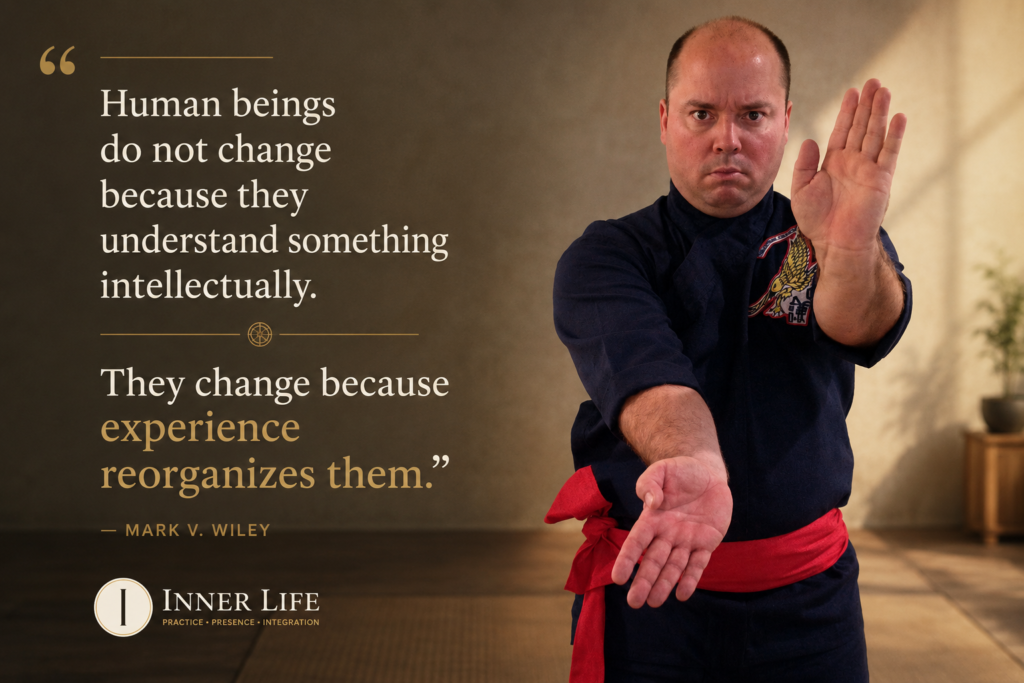
Although modern culture offers endless information, techniques, and solutions, information alone rarely produces transformation. Human beings do not change because they understand something intellectually. They change because experience reorganizes them.
The purpose of Inner Life is not merely self-improvement, relaxation, productivity, or the acquisition of techniques. Inner Life is a living framework of embodied development that explores how human beings cultivate integration through direct experience. Rather than separating body from mind, breath from awareness, or perception from action, it recognizes that human development emerges through the relationships between these dimensions. Lasting transformation occurs when the whole system begins functioning with greater coherence and continuity. That is where embodied practice and the structure of experience becomes lived.

Integrated Modular Training (IMT) was developed from this understanding. Drawing from contemplative traditions, meditation, Daoist cultivation, Zen practice, martial arts, physiotherapy, movement training, and decades of practical exploration, IMT provides a developmental framework through which fragmented experience gradually becomes integrated experience. It is not a collection of techniques. It is a process through which the structure of experience itself begins to change.
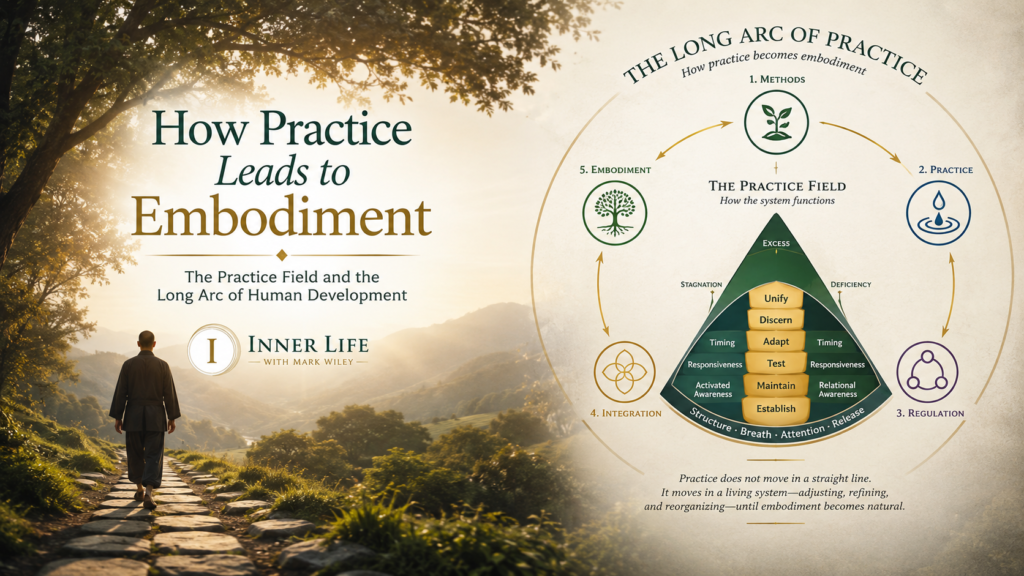
Experience → Awareness → Embodiment → Continuity → Entrainment → Regulation → Integration
Experience & Awareness
Every human being lives within experience, yet few people spend much time examining how experience is actually organized. Most attention is directed outward toward tasks, responsibilities, problems, and goals. The internal processes through which experience is constructed remain largely invisible.
Practice begins by bringing attention back to awareness itself.
Awareness is often mistaken for thought, but they are not the same. Thoughts arise within awareness, yet awareness exists before, during, and after every thought. Much of modern life conditions people to identify almost entirely with mental activity. Planning, analyzing, remembering, judging, and anticipating become so dominant that direct experience recedes into the background.
Embodied practice begins reversing this tendency. Rather than becoming lost within thought, the practitioner gradually learns to recognize awareness as the ground from which experience unfolds. This simple shift creates the possibility for deeper forms of perception and self-understanding.
“Human beings do not change because they understand something intellectually. They change because experience reorganizes them.” —Mark V. Wiley
Embodiment and Direct Experience
Embodiment is often reduced to body awareness, but embodiment is far more than paying attention to physical sensations. Embodiment is the restoration of direct participation in experience.
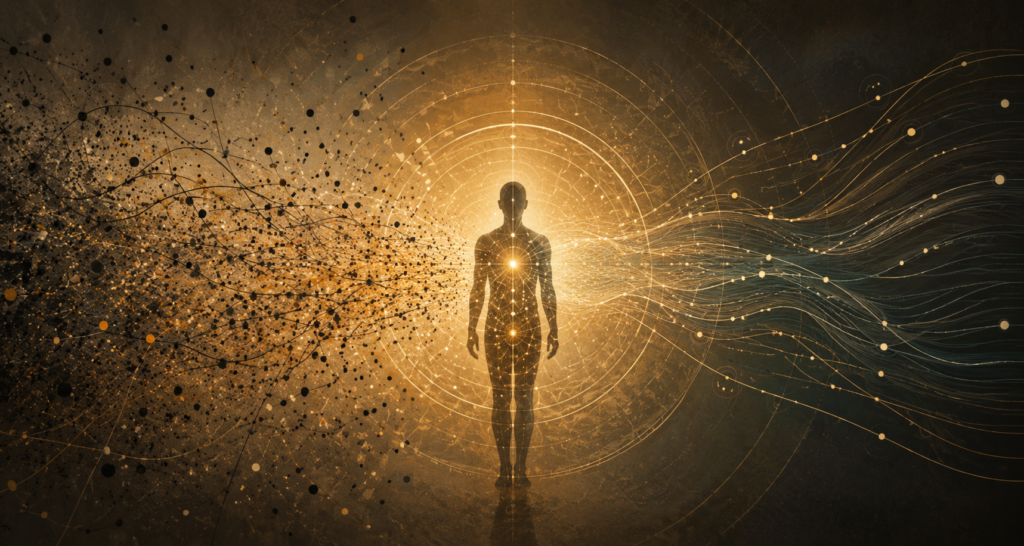
As embodiment deepens, awareness becomes increasingly grounded in direct experience rather than conceptual interpretation. The body ceases to be an object one possesses and becomes the living medium through which experience is known. This is when embodied practice and the structure of experience starts to feel real.
Continuity and the Reduction of Fragmentation
One of the primary goals of Inner Life practice is the cultivation of continuity.
Most people experience themselves as divided. Attention moves in one direction while the body moves in another. Breathing operates independently of awareness. Emotion pulls against intention. Thought competes with perception. The result is a fragmented experience of self and world.
Embodied practice gradually restores relationship between these dimensions.
Through repeated engagement with stillness, movement, breathing, and awareness, previously disconnected processes begin functioning together. The practitioner discovers moments in which body, breath, attention, and perception operate as a unified experience rather than competing streams of activity.
This continuity forms the foundation of all subsequent development. Without continuity, growth remains temporary. With continuity, experience begins organizing itself around coherence rather than fragmentation.
Entrainment and Human Organization
As continuity develops, a deeper process begins emerging: entrainment.
Entrainment is the natural tendency of living systems to organize around coherent rhythms. The heart functions rhythmically. Breathing functions rhythmically. Movement functions rhythmically. Attention itself exhibits rhythmic qualities. When these rhythms become increasingly synchronized, the human system begins operating with greater efficiency and stability.
This process can be observed throughout nature. Pendulums synchronize. Biological systems synchronize. Human beings synchronize with environments, relationships, and activities. Practice intentionally cultivates this tendency toward coherence.
As breathing aligns with movement, awareness aligns with perception, and attention aligns with action, the practitioner experiences increasing organization throughout the entire system. What once required effort gradually becomes natural. What once felt chaotic begins functioning with greater ease and flow.
“Much of what is commonly called development is, in reality, the progressive entrainment of body, breath, attention, and awareness into increasingly coherent relationships.” —Mark V. Wiley
Much of what is commonly called development is, in reality, the progressive entrainment of body, breath, attention, and awareness into increasingly coherent relationships.
Regulation and Adaptive Capacity
Many people associate regulation with relaxation, but true regulation is far more sophisticated than simply feeling calm.
A well-regulated system is capable of adapting to changing conditions without losing coherence. It remains stable without becoming rigid. It remains flexible without becoming chaotic.
Embodied practice develops this capacity by exposing practitioners to progressively more complex forms of experience while maintaining continuity. Through this process, awareness learns to remain present under changing conditions. Breathing remains available under stress. Perception remains clear during uncertainty. Action remains responsive rather than reactive.
The result is not control over experience but a more skillful relationship with experience. The practitioner gradually develops the ability to reorganize in real time without losing connection to body, breath, awareness, and perception.
This capacity becomes increasingly important not only in formal practice but throughout everyday life, relationships, work, and personal development. The process described throughout this article can be understood as the gradual emergence of coherence between body, breath, mind, perception, intention, and action.
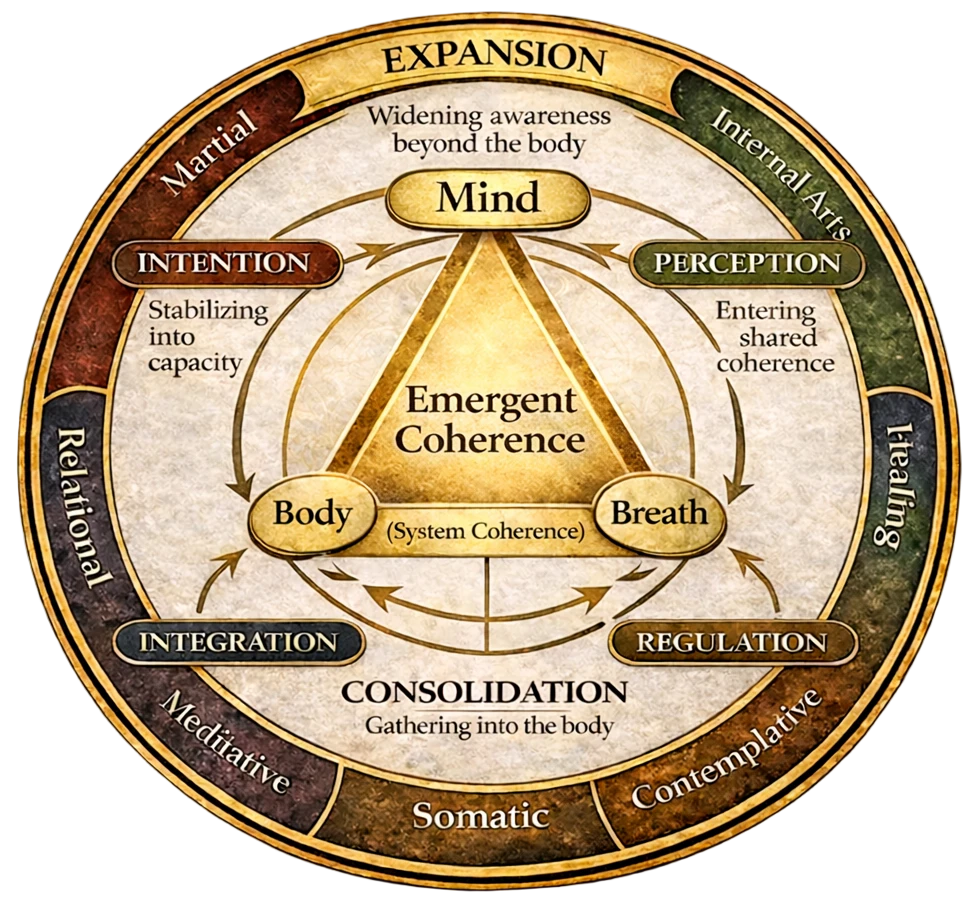
Integration and the Structure of Experience
Integration is not something added to the human system. It emerges when fragmentation decreases.
As embodiment deepens, continuity stabilizes. As continuity stabilizes, entrainment strengthens. As entrainment strengthens, regulation becomes more natural. Over time, awareness, movement, perception, breathing, and action begin functioning as a more unified whole.
The structure of experience itself begins changing.
What once felt divided becomes connected. What once required deliberate effort becomes increasingly natural. Awareness becomes less consumed by internal noise and more available to direct participation in life.
Many traditions have described aspects of this process using terms such as presence, flow, naturalness, mindfulness, wu wei, or no-mind. While the language varies, the underlying principle remains remarkably consistent. Human beings function differently when fragmentation decreases and integration increases.
Integration is the key to embodied practice and the structure of experience. This is not a final destination. It is an ongoing developmental process through which experience becomes increasingly coherent, responsive, and whole.
“What begins as awareness gradually becomes embodiment. What begins as embodiment gradually becomes continuity. What begins as continuity gradually becomes integration.” —Mark V. Wiley
Why This Matters Within Inner Life
These principles form the foundation of the entire Inner Life ecosystem.
The Inner Life Model, the ESD Framework, Integrated Modular Training, the Practice Field, Integral Being conversations, contemplative inquiry, and the Six Foundational Practices all arise from the same central question: How do human beings become more integrated?
The answer is not found through theory alone. It is discovered through embodied participation.
The Six Foundational Practices provide the practical entry point into this process. They translate the principles explored throughout this article into direct experience, offering a progressive pathway through which embodiment, continuity, adaptability, responsiveness, expression, and integration can be cultivated over time.
Understanding these principles is valuable. Experiencing them is transformative.
“What begins as awareness gradually becomes embodiment. What begins as embodiment gradually becomes continuity. What begins as continuity gradually becomes integration.” —Mark V. Wiley
What begins as awareness gradually becomes embodiment. What begins as embodiment gradually becomes continuity. What begins as continuity gradually becomes integration.
The journey begins not with mastering techniques, but with learning how to participate more fully in the experience of being human.
“The purpose of practice is not the accumulation of techniques. The purpose of practice is the cultivation of integration.” —Mark V. Wiley
Begin the Foundation
The concepts explored in this article on embodied practice and the structure of experience provide the philosophical and developmental foundation for Inner Life. The next step is practice.
The Six Foundational Practices are designed to be experienced, not merely understood. Beginning with Practice 1: Returning to the Soma, they provide a progressive pathway through which embodiment, continuity, adaptability, responsiveness, organization, and expression can be cultivated through direct experience.
Each practice builds upon the one before it. Stillness becomes movement. Movement becomes adaptability. Adaptability becomes responsiveness. Responsiveness becomes organized expression. What begins as practice gradually becomes a different way of experiencing life.
Continue Exploring