Gaining Stability Through Change
Why real stability is not the absence of change—but the ability to remain internally organized within it
by Mark V. Wiley
Most people spend an extraordinary amount of energy trying to eliminate uncertainty from their lives. We search for the perfect career, the perfect relationship, the perfect health, or the perfect set of circumstances. Beneath these pursuits often lies the hope that, once life finally settles down, we will be able to experience lasting peace — a measure of stability through change.
Yet life has never promised permanence.
Everything changes. Every breath is different from the one before it. Our bodies continually reorganize themselves. Relationships evolve, circumstances shift, and every stage of life gives way to another. The problem is not that change exists. The problem is that we unconsciously expect life to stop changing.
In this Inner Life Talk, inspired by an insight shared by Satya, I explore a deeper possibility. Perhaps stability is not something we find after change has ended. Perhaps genuine stability is cultivated within change itself.
Why We Resist Change
The common saying is, “change is the only permanent thing.”
Most of us agree with this intellectually, yet continue living as though permanence were possible. We cling to moments of happiness, resist discomfort, and hope that difficult seasons will eventually disappear forever. When reality inevitably changes, we experience disappointment not because change is unusual, but because our expectations have quietly opposed the nature of life.
Recognizing impermanence does not make life pessimistic. It makes life honest. Once we stop demanding certainty from an uncertain world, our attention can shift toward something much more valuable: learning how to participate skillfully in continual change.
Stability Is Not the Absence of Change
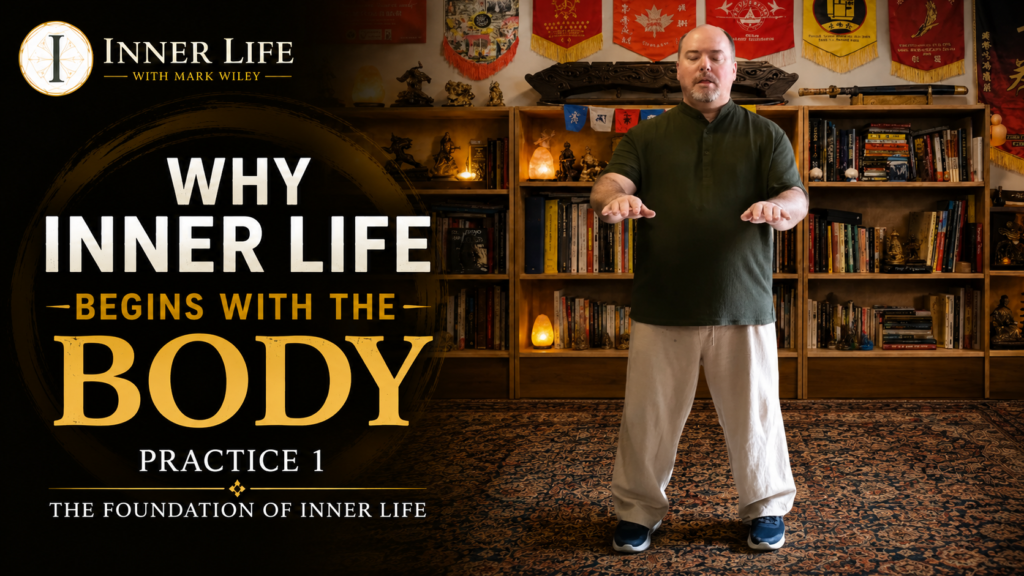
Anyone who has spent time in standing meditation has already experienced this principle firsthand. In the beginning, nothing feels particularly stable. The legs tremble, the shoulders tighten, attention wanders, emotions rise and fall, and the breath continually changes. If stability through change depended upon eliminating movement, standing practice would never succeed.
Instead, something unexpected begins to emerge.
Although sensations continue changing, awareness gradually becomes more continuous. Although the breath naturally expands and releases, the practitioner begins discovering an underlying organization that is no longer dependent upon external conditions. Stability arises, not because change has disappeared, but because awareness has learned to remain present throughout it.
This same principle extends into movement. The goal is never simply to memorize choreography. Rather, it is to maintain continuity while movement, rhythm, timing, and circumstances continually evolve.
“We don’t simply become comfortable with change. We train organization within change.” —Mark V. Wiley
This distinction represents one of the defining principles of the Inner Life approach.
Organization Creates Resilience
Nature continually demonstrates this principle. A tree remains upright because it bends with the wind rather than resisting it. Water maintains its nature because it flows around obstacles instead of opposing them. Even the nervous system remains healthy because it continually adapts to changing internal and external conditions.
Practice follows exactly the same pattern.
The more integrated the body, breath, attention, and awareness become, the more change the system can accommodate without losing coherence. As practitioners mature, they often notice an interesting paradox. Practice becomes increasingly unpredictable, yet they themselves become increasingly stable.
The stability was never located in the external conditions. It was always found in the quality of their organization.
This is why I often distinguish between control and organization. Control attempts to prevent change. Organization allows change to unfold without fragmentation. One creates rigidity. The other cultivates resilience.
“Control attempts to stop change. Organization allows change without fragmentation.” —Mark V. Wiley
Embodiment is not the elimination of uncertainty. Embodiment is the capacity to remain organized while uncertainty continues. it creates the environment to maintain stability through change.
Practice Trains Stability
This understanding is woven throughout the entire Inner Life curriculum. Practice begins by cultivating continuity in stillness. From there, continuity is extended into movement, then into variation, relationship, structured practice, and finally spontaneous expression. Each stage introduces greater complexity while asking the same essential question:
Can awareness remain continuous while conditions continually change?
The purpose of practice is therefore not to create perfect circumstances. It is to cultivate a practitioner who can remain organized regardless of circumstances.
Seen from this perspective, every challenge becomes part of the training. Difficulty is no longer an interruption of practice. It becomes one of practice’s greatest teachers.
Living Differently Through Change
Satya also offers another beautiful reminder:
“Good news: nothing stays. Bad news: nothing stays.” — Satya
At first glance, this observation may sound discouraging. With practice, however, it becomes profoundly liberating. Joy is appreciated without needing to possess it. Difficulty is experienced without becoming our identity. Success and failure are both understood as movements within a much larger process rather than permanent definitions of who we are.
As practice deepens, stability gradually reveals itself as something entirely different from what we originally imagined. It is no longer a fixed position or an unchanging state. It becomes a living capacity—the ability to remain present, organized, and responsive while life continues unfolding exactly as life always has.
The Practice of Becoming Stable
Perhaps the greatest misunderstanding about practice is believing that stability through change means becoming unshakable. Real stability is something much more alive. It is the capacity to meet continual change without losing your center—not because life has become predictable, but because your relationship with change has been transformed.
The body gradually reveals organization. That is what embodied practice cultivates. Not resistance to change, but participation in it. Not control over life, but increasing organization within life. And ultimately, that may be the deepest form of resilience available to us.
Watch & Listen
Watch on YouTube or listen on your favorite podcast platform




Continue Exploring