What Tai Chi and Aikido Teach About Embodiment
Embodiment, Failure, and the Difference Between Awareness and Lived Experience
by Mark V. Wiley
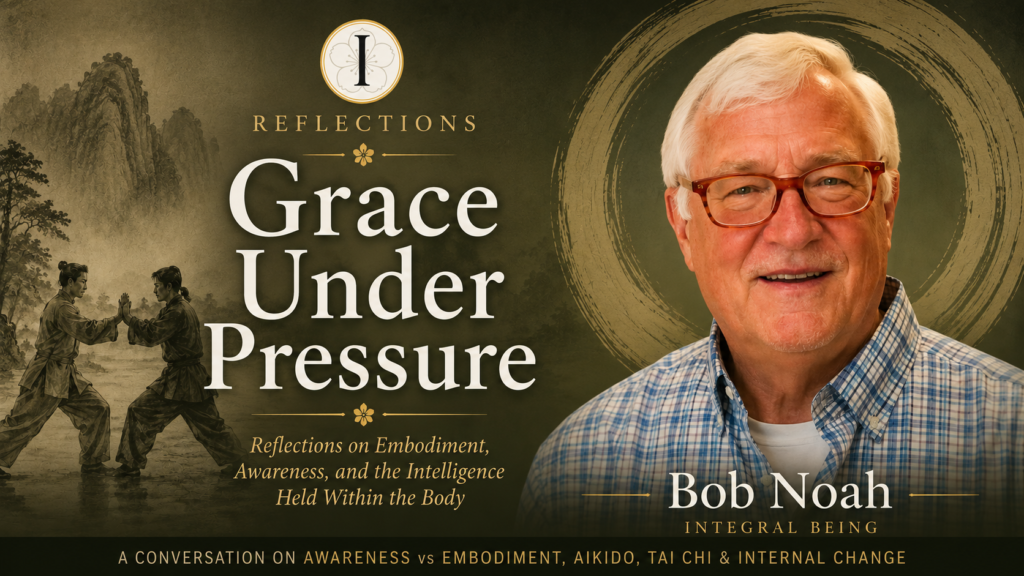
Tai Chi and Aikido are often approached as martial arts, but both are systems for cultivating embodied awareness under pressure. My Integral Being conversation with Bob Noah was one of those rare conversations. Beneath our discussion of Aikido, Tai Chi, breath, embodiment, and nervous system regulation was a deeper question:
How do temporary states become stable capacities?
This distinction may be one of the most important—and most overlooked—realities within both spiritual and embodied practice. Awareness can create the feeling of transformation long before transformation has actually occurred. A person may understand the language of practice. They may know the principles, the philosophy, the mechanics, and the terminology. They may even have meaningful experiences during meditation, martial arts training, therapy, or contemplative work.
Yet under pressure, the system often reveals something else entirely.
Tension returns. Reactivity returns. Fragmentation returns. The body contracts, attention narrows, and presence disappears. What seemed integrated in calm conditions suddenly dissolves when unpredictability or stress enters the system.
This is why serious practice traditions place such importance on pressure—not as punishment, but as revelation.
Grace Under Pressure Is Organized Presence
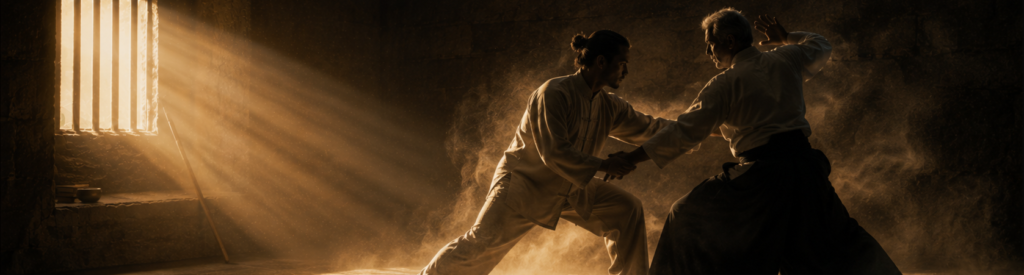
One of the deeper themes woven throughout the conversation was the idea of remaining coherent while force is entering the system. In Tai Chi push hands, the practitioner learns to receive pressure without collapsing into resistance. In Aikido rondori, multiple attackers create unpredictability, speed, and directional instability that challenge the practitioner’s ability to remain centered and responsive.
Both practices become laboratories for embodiment.
Not performance. Not technique alone. But direct environments where fragmentation becomes visible. What appears calm in isolation is tested in relationship. What appears stable internally is tested through incoming force. And what appears embodied conceptually is tested through unpredictability.
“The secret of Aikido is to be in harmony with the movement of the universe itself.” —Sensei Bob Noah
This harmony is not passive softness or withdrawal from conflict. Nor is it domination. It is continuity—the ability to remain internally organized while pressure is occurring. This changes how we understand both martial arts and transformation itself. The deeper work involves maintaining continuity of body, breath, attention, and perception while instability is unfolding.
What Tai Chi and Aikido ultimately teach extends far beyond self-defense. Grace under pressure is not emotional suppression. It is organized presence maintained while life becomes increasingly unpredictable. It is regulated participation. And this is precisely where many forms of practice begin revealing their limitations, because pressure exposes what has not yet stabilized.
Push Hands, Rondori, and the Nervous System
Bob repeatedly returned to the idea that the nervous system resists change far more than most people realize. Even small shifts in posture, alignment, relaxation, or organization can feel deeply uncomfortable at first. What practitioners often interpret as the posture “feeling wrong” is frequently the nervous system reacting against unfamiliar organization.
This becomes especially visible in practices like push hands and rondori. Push hands develops sensitivity, listening, yielding, and the ability to perceive tension and imbalance directly through contact. Rondori develops continuity amidst unpredictability and incoming pressure. Both reveal where the practitioner loses organization, where tension overrides perception, and where the body stops flowing and begins resisting.
“What do you do when what feels right is wrong?” —Sensei Bob Noah
Pressure reveals the nervous system. Habit explains why it responds the way it does.
What Feels Right Is Often Habit
Much of genuine practice begins when we realize that familiar does not necessarily mean functional. The nervous system often mistakes long-standing compensation for stability. What initially feels awkward may simply be unfamiliar organization replacing habitual tension. This is why skilled teachers matter. They help us distinguish discomfort caused by growth from discomfort caused by poor practice.
This question reaches far beyond martial arts. Most human beings organize around familiarity, not necessarily truth. The nervous system often mistakes habitual tension for stability because it has adapted around those patterns over years—or decades.
As a result, genuine change initially feels unnatural. The body resists unfamiliar openness. Attention resists stillness. Identity resists uncertainty. And this is why practice cannot remain merely conceptual. The body eventually reveals what the mind tries to bypass.
Within the Inner Life Model, pressure is not viewed as an obstacle to practice but as one of its most important teachers. Pressure reveals whether body, breath, attention, perception, and awareness have begun functioning as an integrated system. When continuity disappears under stress, practice has simply revealed where further integration is needed.
Investment in Loss
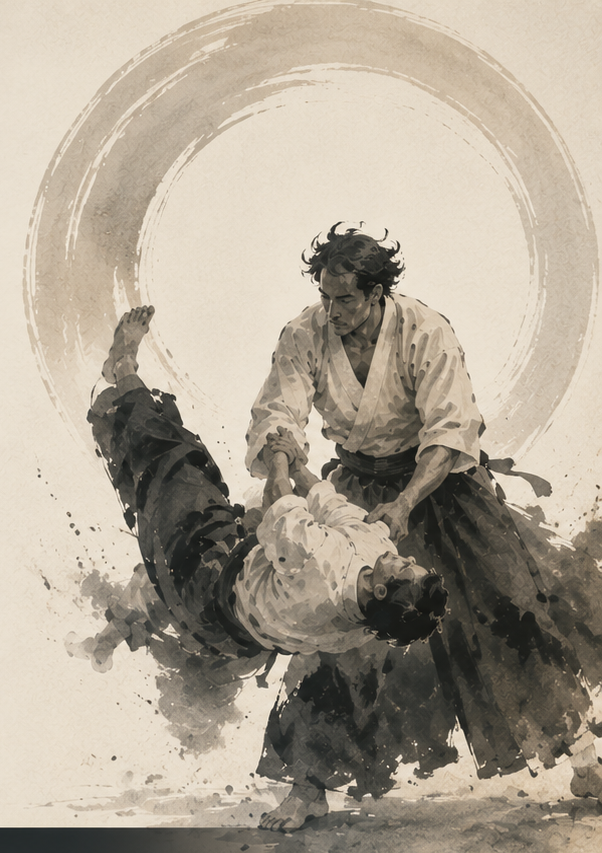
One of the most important principles discussed was Cheng Man-Ch’ing’s phrase: “investing in loss.”
At first glance, the phrase sounds paradoxical. Modern culture trains us to avoid failure, discomfort, instability, embarrassment, and defeat. We are conditioned to preserve competence and protect identity. But genuine embodied development requires something very different. It requires contact with our limitations.
In push hands practice, when a practitioner is uprooted, collapsed, stiffened, or thrown off balance, the instinct is often to blame the partner, tighten further, or compensate harder. But Cheng’s teaching reverses that impulse entirely. The loss itself contains the information.
“If the other person’s hard, it’s you.” —Sensei Bob Noah
This is not blame. It is developmental responsibility. Pressure reveals where the system is not yet integrated. Failure reveals where continuity breaks. Resistance reveals where contraction still organizes the body and mind. Without this feedback, transformation remains imaginary.
And perhaps this is why so many practitioners can spend decades training without fully embodying the deeper dimensions of the art. Conceptual familiarity is not the same as lived reorganization.
“Awareness is not the same as experience.” —Sensei Bob Noah
The body eventually tells the truth, especially under pressure. Awareness allows us to observe experience. Embodiment reorganizes how experience is lived. One expands understanding; the other changes the structure through which life is perceived and responded to.
This distinction between awareness and embodiment is explored further in the Inner L:ife Talk, “What Embodiment Actually Means,” where embodiment is described as the organization of the whole human system rather than simply greater body awareness.
Investing in loss does not mean seeking failure for its own sake. It means allowing every moment of collapse, stiffness, or imbalance to become feedback instead of self-judgment. In this sense, failure becomes information. Rather than protecting identity, practice becomes an ongoing refinement of organization.
Temporary experiences are valuable, but transformation occurs only when those experiences become stable capacities. A calm meditation session is a state. Remaining calm while life becomes unpredictable is a trait. Practice exists to bridge that gap.
This movement from temporary states toward stable capacities lies at the heart of the Six Foundational Practices, each of which develops greater continuity through progressively more demanding conditions.
Beyond Technique
One of the most meaningful threads in the conversation involved the recognition that these practices were never intended merely as systems of fighting or movement. At their depth, they become vehicles for reorganizing human perception itself.
This is why so many traditional internal systems emphasize relaxation, breathing, yielding, continuity, center, and energetic flow—not because these are mystical abstractions, but because they fundamentally alter how the system organizes under stress.
Over time, something begins changing. Attention stabilizes differently. Breathing changes. The body listens differently. Reaction slows. Perception widens. Force no longer immediately produces contraction. Eventually, what first appeared as technique becomes lived regulation. What first appeared as training becomes participation. What first appeared as method becomes perception.
This is where embodiment begins moving beyond isolated experiences or temporary states into something more stable—something lived.
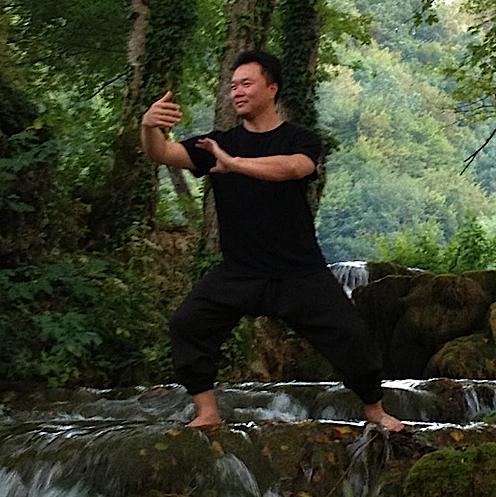
The Body Reveals What Remains Unintegrated
Perhaps the deepest insight lingering with me after the conversation is that the body is not resisting transformation. It is revealing where transformation has not yet occurred.
What appears as tension, collapse, emotional reactivity, rigidity, fear, or instability is often not failure in the moral sense. It is unfinished organization, adaptive patterning, and protective structure still held within the nervous system itself.
And this changes the meaning of practice entirely.
Practice is no longer about becoming superior. It becomes a gradual reduction of fragmentation—a process through which body, breath, attention, and perception slowly reorganize into greater continuity. Not through force. Not through self-rejection. Not through transcendence. But through direct contact. Through pressure honestly met. Through listening deeply enough that compensation no longer remains hidden.
This is one reason these principles continue to be explored through the conversations, reflections, and live practice sessions of The Practice Field, where understanding is tested through direct experience.
And perhaps this is why genuine practice requires investment in loss. Because what is being lost is not merely balance, control, or certainty—but the structures within us that prevent deeper integration from emerging.
“The body operates through a different language—one that must be felt, not explained.” —Sensei Bob Noah
The body never lies. Under pressure it reveals exactly how we are organized—not to condemn us, but to teach us. Every collapse, every contraction, every moment of imbalance becomes an invitation to greater integration. Practice is not about avoiding pressure. It is about becoming the kind of human being who can remain fully present within it.
The measure of practice is not what we understand in moments of comfort, but what remains available when life applies pressure. Pressure does not create our organization—it reveals it. Practice exists so that what is revealed under pressure becomes increasingly integrated in ordinary life.
The deeper lesson of Tai Chi and Aikido is not technique but transformation.
There are many great resources to learn more about Tai Chi and Aikido.
This Reflection emerged from my conversation with Bob Noah on Integral Being, where we explored embodiment, nervous system regulation, Tai Chi, Aikido, pressure training, and the deeper relationship between awareness and lived experience.
Bring the inner life into everyday life.
Every Friday, I share a Note from the Field—a personal story exploring how practice, awareness, and understanding unfold in ordinary life. Join my email community to receive it.
Continue Exploring This Theme