Tai Chi Beyond Choreography:
Relaxation, Internal Strength & Embodiment
with Dr. Robert Chuckrow
On Presence, Sensitivity, and the Intelligence of the Body
Dr. Robert Chuckrow explores Tai Chi beyond choreography through relaxation,
internal strength, sensitivity, embodiment, and the intelligence of the body.
For many people, Tai Chi appears to be little more than a slow sequence of choreographed movements. The hands rise and fall, the body shifts from one leg to the other, and practitioners move through forms that often seem mysterious to outsiders. Yet beneath the visible movements lies something far deeper than choreography. The true practice is not simply learning where the hands go. It is learning how the body organizes itself when unnecessary tension is released and awareness begins to inhabit movement.
In this conversation, Dr. Robert Chuckrow explores Tai Chi not as a collection of techniques, but as a lifelong investigation into embodiment, relaxation, sensitivity, and internal strength. Drawing upon decades of practice as well as his background as an experimental physicist, he approaches Tai Chi as a series of living experiments—experiments that reveal how the body functions when it is no longer dominated by habit, force, and unconscious tension.
“Most people discover that they’re not really in their bodies.” —Dr. Robert Chuckrow
That observation may be one of the most important lessons Tai Chi offers.
Discovering the Tension We Cannot Feel
One of the paradoxes of practice is that we often begin believing we are relaxed. Only through careful attention do we discover how much unnecessary tension we carry. Tight shoulders, restricted breathing, frozen patterns of movement, and subtle imbalances reveal themselves gradually through practice.
Tai Chi functions as a mirror. Rather than imposing an ideal onto the body, it exposes the habits already present. As practitioners move slowly and attentively, they begin to notice where movement is interrupted, where balance is compromised, and where effort replaces sensitivity.
This process is not limited to martial arts. The same patterns appear in daily life. Many people move through the world disconnected from sensation, disconnected from breath, and disconnected from the subtle intelligence of the body itself. Practice creates an opportunity to restore that relationship.
The first lesson is not learning a form. The first lesson is learning to feel.
Relaxation Is More Than Relaxation
A recurring theme throughout the conversation is the distinction between ordinary relaxation and the deeper quality sought in Tai Chi.
Many practitioners equate relaxation with reducing muscular tension while continuing to move in essentially the same way they always have. Chuckrow suggests that genuine relaxation involves something more fundamental. It requires releasing unnecessary contraction and allowing movement to arise through a different mode of organization.
This distinction changes the purpose of practice entirely.
If relaxation is merely the absence of tension, then Tai Chi becomes little more than slow exercise. If relaxation becomes a doorway into a different way of organizing movement, perception, and force, then practice begins to reveal dimensions that are not immediately visible.
The goal is not limpness. Nor is it passive softness. The goal is discovering how the body functions when force is no longer generated primarily through effort.
Internal Strength and the Expansion of the Body
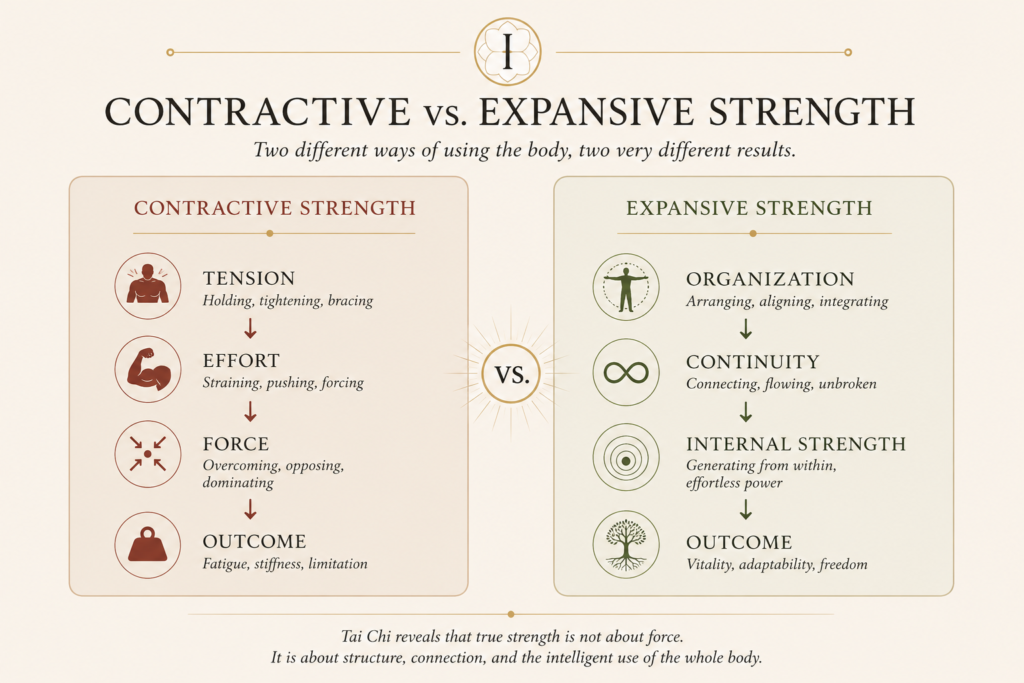
One of the most fascinating aspects of the conversation centers on the concept of internal strength. For Chuckrow, Tai Chi internal strength emerges not through muscular contraction but through organization, expansion, and continuity throughout the body.\Many practitioners spend years hearing terms such as internal power, energy, or Ne Jin without receiving a practical explanation. Chuckrow proposes a simple but profound distinction between contractive strength and expansive strength.
Contractive strength is familiar. Muscles pull, joints tighten, and force is generated through effort. Most human movement relies heavily upon this pattern. Expansive strength, however, operates differently. Rather than organizing movement through contraction, it creates a sense of extension, openness, and continuity throughout the body.
“The movement is not being forced. It is being supported.” —Dr. Robert Chuckrow
Whether one agrees with every aspect of his explanation is less important than the experiential invitation it provides. Practitioners are encouraged to investigate for themselves. What changes when movement is organized through expansion rather than contraction? What happens when the body remains open rather than braced? These questions transform Tai Chi from performance into inquiry.
The Body Knows More Than the Mind
One of the most valuable insights offered in the conversation concerns the relationship between intention and movement.
Beginners naturally focus on where the hands should go. They memorize positions, angles, and sequences. While necessary at first, this approach eventually becomes a limitation. The practitioner remains trapped in a model of controlling the body rather than listening to it.
Chuckrow suggests that movement should emerge from principles rather than from fixed positions. Instead of forcing the body into predetermined shapes, the practitioner learns to observe how the body naturally organizes itself through balance, momentum, structure, and relaxation. This perspective shifts attention away from external appearance and toward internal experience.
“The body begins to teach the practitioner rather than the other way around.” —Dr. Robert Chuckrow
The question becomes less about whether the hand reached the correct location and more about whether the movement emerged from a state of continuity, awareness, and embodied presence. The body begins to teach the practitioner rather than the other way around.
Presence in Motion
Many contemplative traditions emphasize the importance of remaining present. Tai Chi provides a practical laboratory for this principle.
When attention continually jumps ahead to the next movement, the practitioner leaves the present moment. Awareness becomes occupied by anticipation rather than experience. The body continues moving, but the mind is elsewhere.
The same pattern appears throughout life. We often move toward future goals while barely experiencing the present conditions through which we are moving. Tai Chi invites a different possibility.
Each shift of weight, each expansion of the rib cage, each opening of a joint becomes an opportunity to inhabit the moment more completely. The form becomes less about arriving somewhere and more about experiencing what is happening now.
“If you’re thinking about where the hand is supposed to go, you’re already out of the moment.” —Dr. Robert Chuckrow
This observation reaches beyond martial arts and into the heart of contemplative practice itself.
Sensitivity Before Force
Another important theme is the relationship between sensitivity and strength.
In modern culture, strength is often associated with exertion. We admire effort, intensity, and force. Internal arts reverse that assumption. Sensitivity becomes the foundation upon which effective action emerges.
The more force we apply unnecessarily, the less sensitive we become. Excess tension obscures perception. Excess effort reduces responsiveness.
Through practices such as push hands, practitioners learn to feel rather than impose. They learn to listen through contact, recognize subtle changes, and respond appropriately rather than react automatically.
This sensitivity is not weakness. It is a refinement of perception. The strongest response is often the one that emerges from awareness rather than force.
A Lifelong Exploration
After more than five decades of practice, Dr. Chuckrow continues to describe himself as a student.
That attitude may be one of the most important lessons contained within the conversation. Genuine practice does not lead to certainty. It deepens curiosity. The farther one travels, the more dimensions reveal themselves.
Tai Chi remains remarkable because it contains layers that continue unfolding across a lifetime. Physical movement becomes embodied awareness. Embodied awareness becomes sensitivity. Sensitivity becomes presence. Presence gradually reveals a different relationship with oneself, with others, and with the world.
What begins as learning a form becomes an exploration of human development itself. Perhaps that is why Tai Chi continues to endure.
Beneath the choreography lies an invitation—not simply to move differently, but to experience life differently.
About the Guest
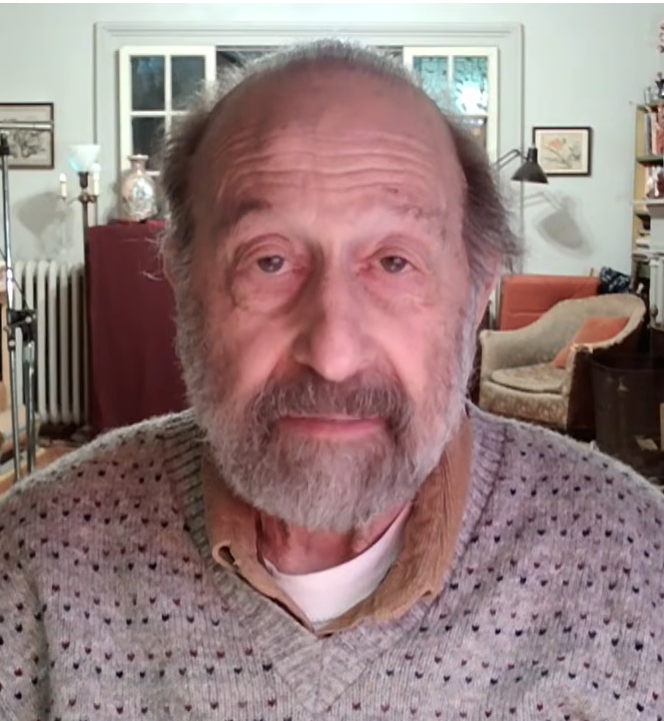
Dr. Robert Chuckrow is a physicist, educator, author, and one of the most respected voices in the world of Tai Chi Chuan. Since beginning his study of Tai Chi and Qigong in 1971, he has explored the principles of relaxation, internal strength, sensitivity, breath, and embodied awareness through both direct experience and scientific inquiry.
A student of influential teachers including Cheng Man-ch’ing, William C.C. Chen, Elaine Summers, Harvey I. Sober, Kevin Harrington, Alice Holtman, and Chin Fan-siong, Chuckrow is known for his ability to bridge traditional Tai Chi principles with modern understanding. His work emphasizes observation, experimentation, and authentic internal development rather than reliance on doctrine or mysticism.
The author of six books—including The Tai Chi Book and the widely respected Tai Chi Concepts and Experiments—he has helped generations of practitioners better understand the mechanics and deeper principles of Tai Chi practice. Holding a Ph.D. in Experimental Physics from New York University, he taught physics for more than four decades at institutions including NYU and The Cooper Union.
Continue Exploring This Theme