
The Flow State
What It Reveals About Embodiment and Human Transformation
by Mark V. Wiley
The flow state is a form of intelligence that does not appear as thinking.
As practitioners of action sports, martial arts, tai chi, qigong, somatic disciplines, and contemplative traditions know well, this intelligence does not announce itself as ideas or effort. It does not proceed step by step. Instead, it arrives as a kind of unfolding—an immediacy in which action, perception, and understanding arise together.
- In movement, it is felt as timing without deliberation.
- In meditation, as awareness without grasping.
- In writing or problem-solving, as insight without strain.
In Flow as Spontaneous Thought: Insight and Implicit Learning, John Vervaeke, Leo Ferraro, and Arianne Herrera-Bennett offer a striking reframing of what has often been called “optimal experience.” But this phrase, while accurate, does not fully reach its depth. What is being revealed is not simply performance at its peak, but cognition reorganizing itself in real time.
Insight and Implicit Learning
As Vervaeke and his colleagues argue, flow or the flow state, is not merely smooth execution, nor the automation of practiced skill. It is “a self-perpetuating dynamical system of insight and implicit learning.”
Flow is not the absence of learning, but a state in which implicit learning and insight become dynamically coupled—intensifying and reorganizing cognition in real time. From within embodied disciplines, this is often encountered not as reinterpretation, but as direct recognition—the dynamics described are lived as structure prior to conceptualization.
This challenges a central assumption: that intelligence must feel effortful—that meaningful engagement requires strain, control, or deliberation. But in flow, something else is happening. The system reorganizes itself such that obstacles are no longer interruptions—they become invitations to restructuring. Each moment of engagement contains the seed of the next transformation.
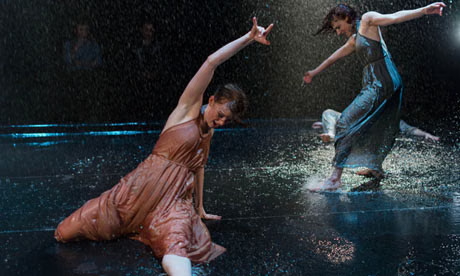
together without deliberation.
Vervaeke describes this as an “extended ‘aha!’”—a cascade of insight, each restructuring the conditions for the next. Seen this way, flow is not continuity—it is continuity through discontinuity: a seamless experience built from micro-transformations.
\While much of the academic framing emphasizes cognitive domains—thinking, writing, problem-solving—this dynamic is immediately evident within embodied practice. In martial and somatic disciplines, flow is not an abstract state but a directly observable reorganization of perception and action. What is described cognitively as insight and implicit learning is lived, in the body, as timing, sensitivity, and structural adaptation arising prior to deliberation.
In martial traditions, this has long been understood. The Zen concept of mushin (no mind) does not imply absence of awareness, but absence of interference. Action arises without obstruction from self-consciousness. Similarly, in Japanese Do traditions and internal arts like tai chi, the practitioner does not impose movement—they allow movement to organize itself through attunement.
What modern cognitive science calls the “flow state” older traditions appear to have recognized as a natural expression of integrated practice and being.
From Flow to the Cognitive Continuum
In more recent work, Hüseyin Beyköylü, John Vervaeke, and Daniel Meling extend this dynamic into a broader landscape of human experience:
Fluency → Insight → Flow → Self-transcendent experience
What unites these is not how they feel, but what they do—they represent increasing enhancement of what Vervaeke calls “relevance realization”: the organism’s capacity to dynamically attune to what matters in a given moment.
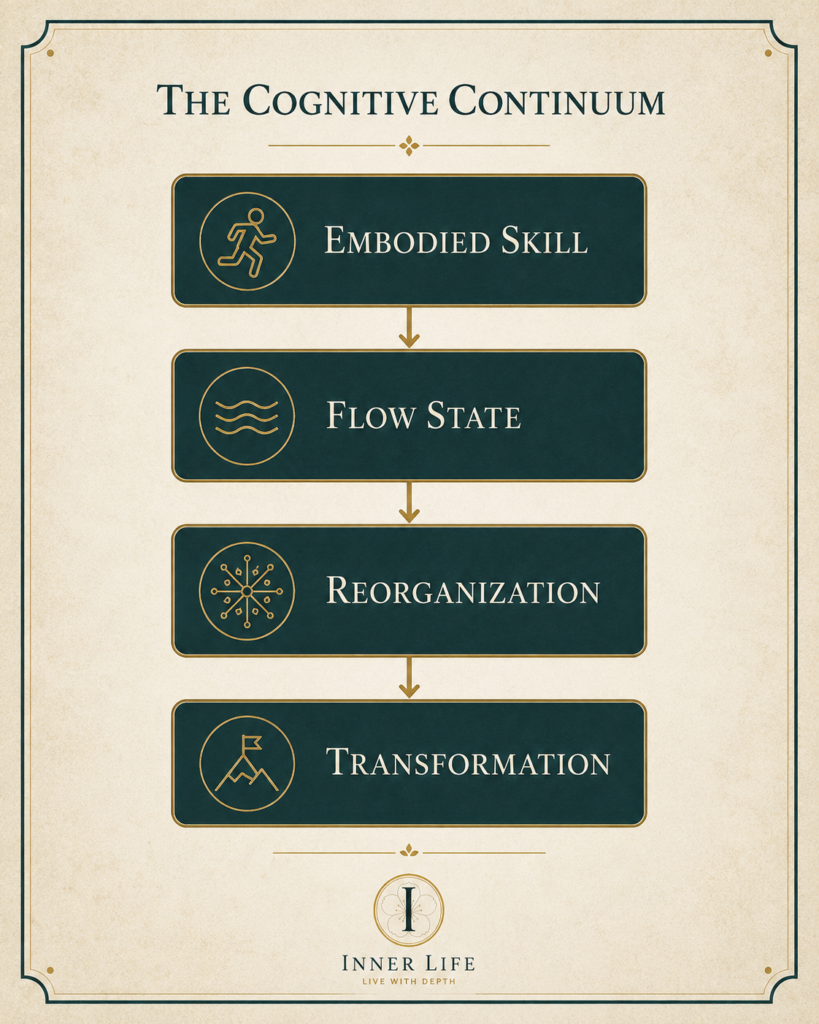
From this perspective, cognition is not computation. It is not the manipulation of representations. It is, within this framework, an ongoing, embodied negotiation with the world—a “person-world coupling,” where meaning emerges through interaction.
The flow state, then, is not just a psychological state. It is a reorganization of this coupling. The organism becomes more fluidly attuned to its environment. Action and perception begin to align. The boundary between self and world softens—not in a metaphysical sense, but in a functional one.
And yet this raises an important question: is this merely improved adaptation, or does it point toward a deeper form of attunement? From within embodied and contemplative traditions, this shift is often understood as more than functional—suggesting a transformation in how reality is disclosed and how one participates within it.
Whether framed scientifically or contemplatively, the experience points toward the same underlying movement: a reduction of interference, and a more direct participation in unfolding reality.
Entropy and Fluency: The Engine of Transformation
This alignment is not static. It is driven by a deeper dynamic—the interplay of entropy and fluency. As articulated by Vervaeke and his colleagues, “increased entropy signals destabilization followed by increased fluency.” Something must loosen for a more adaptive order to emerge.
At first glance, entropy and fluency appear opposed. Entropy signals disorder and destabilization. Fluency signals ease and coherence. But they are not opposites—they are phases of a single process. Destabilization is not collapse. It is the necessary opening through which a more adaptive coherence can emerge.
Within Inner Life, this process is reflected in the ESD Model, where growth often begins by recognizing patterns of excess, stagnation, and deficiency before the system can reorganize into greater integration.
At the level of lived experience, this is the softening of rigid patterns—of expectation, preconception, and anticipatory control. The tendency to project forward, impose structure, and hold tightly to what is known begins to soften. In its place, something quieter emerges: a state of allowing—an openness to what becomes relevant, rather than an imposition of what is expected.
In more advanced contemplative practice, this becomes explicit. One no longer attends to a specific object, but rests in awareness itself—without directing, without grasping, without interference. This is not passivity, but heightened sensitivity. Awareness no longer organizes experience through effort, but allows what is relevant to disclose itself.
In this sense, allowing is not merely a strategy within action—it is a mode of being.

Perception and action reorganize together in real time.
Destabilization as the Condition for Growth
We tend to resist destabilization. We interpret confusion or disorientation as failure. But within this framework, destabilization is not failure—it is necessary. The system must loosen its existing constraints in order to reorganize into something more viable.
As Vervaeke’s work suggests, real transformation requires more than substitution. It requires reconfiguration. Not the addition of new techniques onto an existing structure, but a restructuring of the system itself.
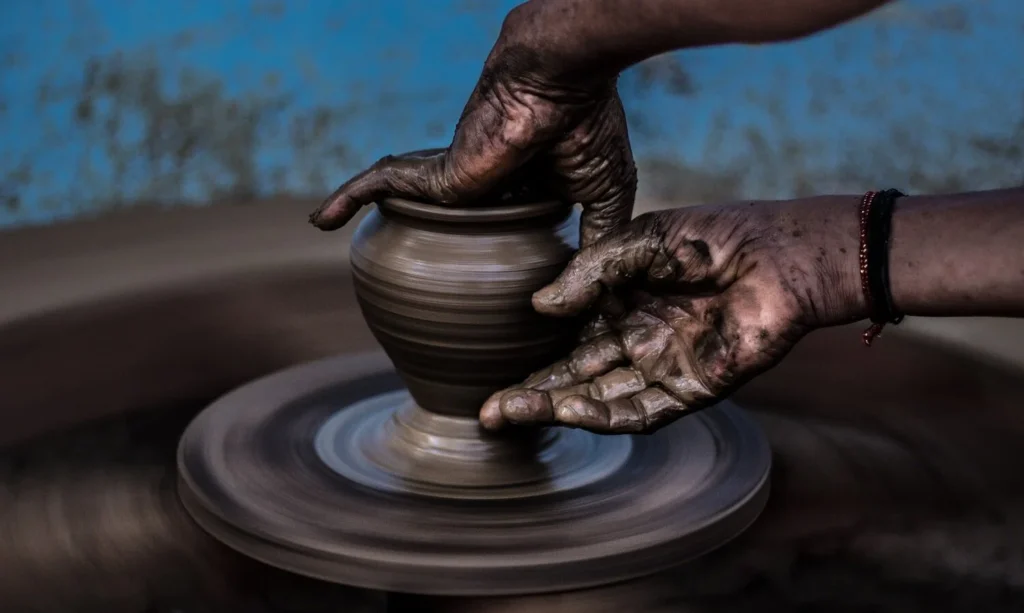
sensitivity, and skilled engagement.
This principle is clearly embodied in tai chi’s tui shou (push hands) and wing chun’s chi sao (sticking hands). Two practitioners connect, each seeking to destabilize the other. In that moment, one cannot simply add technique to a failing structure. One must reorganize entirely—adjusting posture, redistributing weight, recalibrating structure, and restoring connection.
What emerges is not reaction, but reorganization.
At higher levels, an even subtler dynamic appears. One may intentionally yield or open space—not as error, but as invitation. What begins as strategy becomes spontaneous responsiveness. The body no longer thinks through movement—it organizes from within it.
The flow state reveals this paradox: it feels effortless, yet it is driven by continuous micro-instability. It feels like control, yet it emerges from relinquishing rigid control in favor of dynamic attunement.
From Flow to the Transformative
Within the cognitive continuum framework, what is often described as mystical or self-transcendent experience can be understood as a further shift in the same underlying dynamics.
Where flow reorganizes perception and action within a domain, more global transformations involve the reorganization of awareness itself. The boundaries of self and world—normally stabilized by habit—loosen more deeply. From this, a new form of fluency emerges: not fluency in doing, but fluency in being.
What differs across this continuum is not the underlying process, but the scale of reorganization. This suggests a unifying possibility: that skilled action, contemplative stillness, and transformative experience are not separate domains, but expressions along a shared continuum of human development.
Inner Life: Practice as the Ground of Transformation
What this makes clear is that transformation is not achieved through insight alone, nor through technique in isolation. It emerges through sustained engagement—where practice becomes the medium through which cognition reorganizes, stabilizes, and deepens over time.
Within the Inner Life framework, this is approached not as a collection of methods, but as an integrated field of development. This integrated approach is explored more fully in the Inner Life Ecosystem, which maps how conversations, reflections, practices, field notes, and community learning become parts of a single developmental system rather than isolated pieces of content.
Martial, somatic, internal, and contemplative practices are not treated as separate domains, but as interrelated pathways through which the same underlying dynamics can be trained, observed, and refined.
This is also the rationale behind Integrated Modular Training (IMT). Rather than mastering isolated techniques, practitioners develop complementary capacities through interconnected training modules that progressively reorganize perception, movement, awareness, and action.
Flow, in this sense, is not the goal. It is an early expression of a deeper capacity—the system learning to reorganize itself in real time.
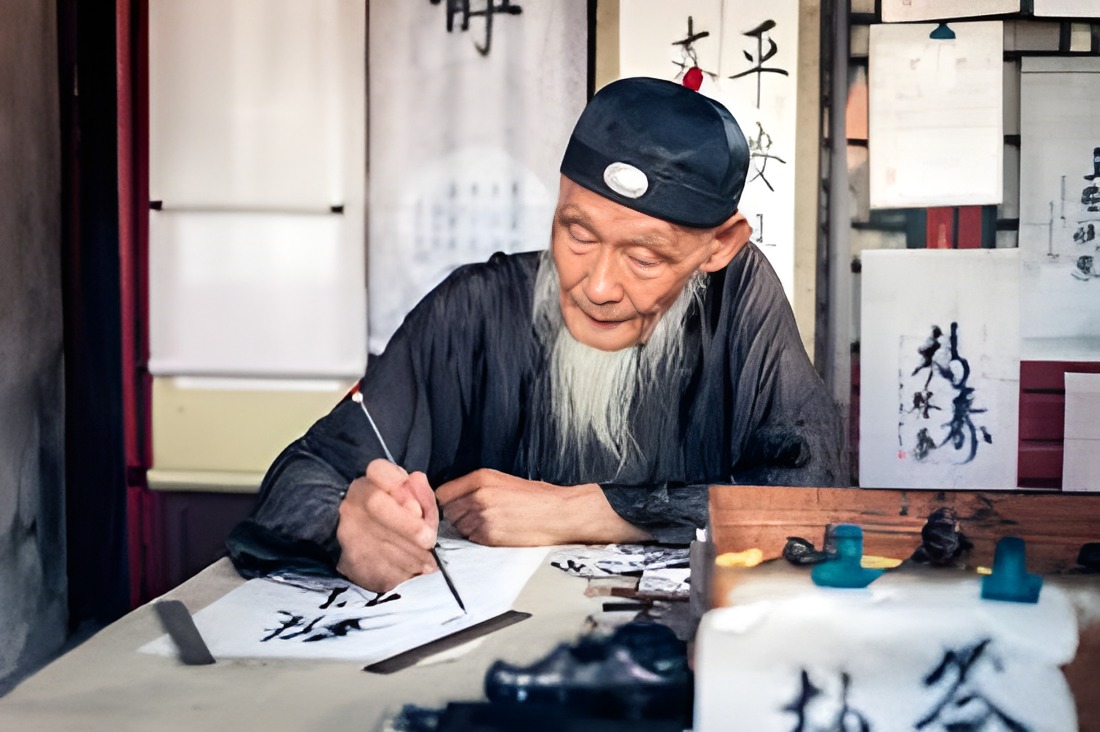
the embodiment of practice over time.
As this capacity stabilizes, it moves beyond performance into embodiment—and from embodiment into a more continuous participation in experience itself.
What begins as practice becomes transformation.
What becomes transformation stabilizes as embodiment.
And what stabilizes as embodiment becomes participation.
And we should endeavor to transform the flow state into a permanent trait.
Practice Invitation:
Flow is not developed through understanding alone. It emerges through sustained practice, reflection, experimentation, and community.
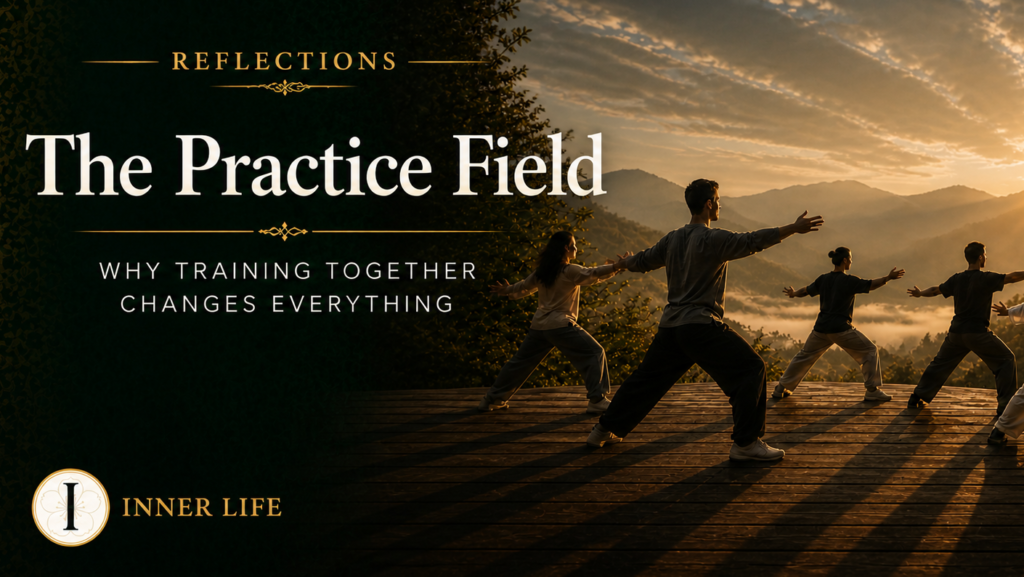
If you would like to explore these principles directly with others, visit The Practice Field, where these ideas are investigated through guided practice, dialogue, and ongoing cultivation.
References
Beyköylü, H., Vervaeke, J., & Meling, D. (2025). From flow to mystical experiences: Connecting entropy and fluency along the unifying framework of cognitive continuum. Philosophical Psychology. Advance online publication. https://doi.org/10.1080/09515089.2025.2601717
Vervaeke, J., Ferraro, L., & Herrera-Bennett, A. (2024). Flow as spontaneous thought: Insight and implicit learning. Unpublished manuscript.
Enter the Conversation
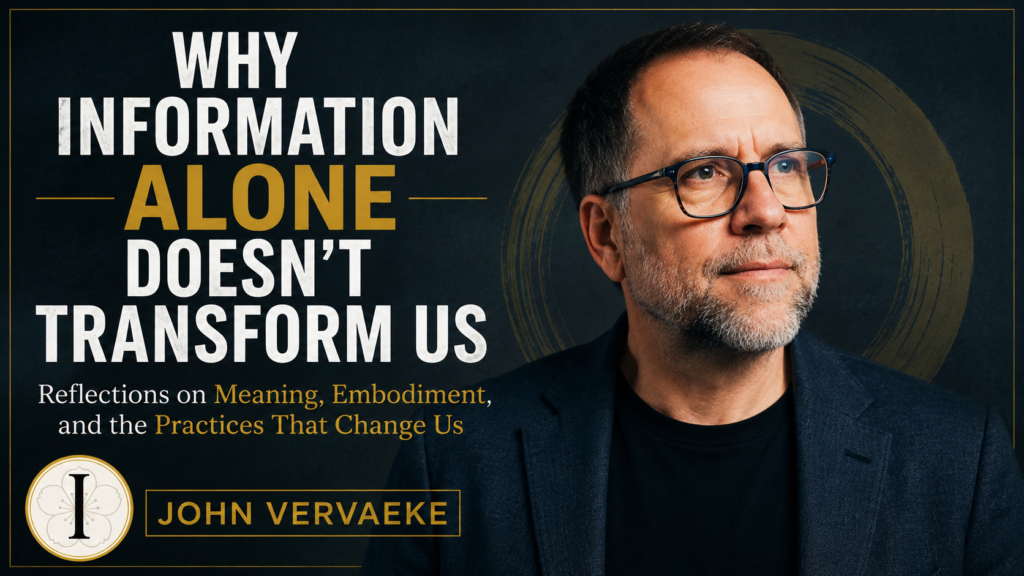
This Reflection introduces several ideas from John Vervaeke’s work. In our Integral Being conversation, we explores the meaning crisis, embodied cognition, participatory knowing, the ecology of practices, and why information alone cannot produce genuine human transformation.
→ Watch the Integral Being Conversation
Continue Exploring This Theme