2 — Awakening Through Movement
Entry Through Rhythm & Motion
an Inner Life practice by Mark V. Wiley
What the Practice Reveals
As movement becomes more familiar, attention gradually learns to accompany action through space. Where movement goes, awareness follows. What was discovered in stillness now begins accompanying movement itself.
A simple movement coordinated with breath becomes an opportunity to experience continuity rather than perform a technique. Movement begins organizing itself through repetition, rhythm, and awareness. Over time, breathing becomes quieter, attention steadies, and the body begins moving with less effort and greater coordination.
This practice develops rhythm, coordination, movement-attention coupling, and continuity through action. Breath, movement, and attention gradually cease feeling like separate activities and begin functioning as a single coordinated process.
Rhythm is one of the primary organizing forces of human experience. Breathing follows rhythm. Walking follows rhythm. Speech follows rhythm. Even relationships unfold through rhythm. As movement and breath repeat together, continuity becomes easier to maintain.
Coordination is not athletic performance. Coordination means that breath, movement, and attention increasingly function together rather than separately. The body gradually begins organizing itself from within.
The goal is not movement.
The goal is continuity during movement.
This marks an important developmental shift. Continuity is no longer limited to stillness. It begins accompanying action itself. What begins here is simple: movement, no longer performed mechanically, gradually begins organizing itself from within.
Establishing Continuity
Practice 2 is not intended as a performance or a technique to master quickly.
Spend time allowing movement, breath, and attention to settle into continuity through repetition and direct experience. Take your time and be in the movement, be in the breath, be in the body, and be in the moment.
Some practitioners may work with this practice for several days. Others may remain with it for weeks before moving further into the system. There is no required pace. It is entirely based on your individual experience.
The important shift is not conceptual understanding, but the gradual emergence of greater continuity, steadiness, and embodied awareness during movement itself. As the practice matures, movement feels less forced. Rhythm becomes more natural. Awareness remains present with less effort. Breath, movement, and attention increasingly function together rather than separately.
Relationship with Movement
Practice 2 develops a new relationship with movement. Rather than moving automatically through habit, reaction, and conditioning, the practitioner gradually learns to remain present while action unfolds. Movement becomes something experienced rather than merely performed.
As breath, movement, and awareness increasingly function together, action feels less fragmented and more continuous. What begins as a simple seated exercise gradually becomes a new way of inhabiting movement itself. When movement begins to feel less mechanical and more natural—when breath, body, and attention increasingly function together rather than separately—you are ready to proceed.
Continue to Practice 3
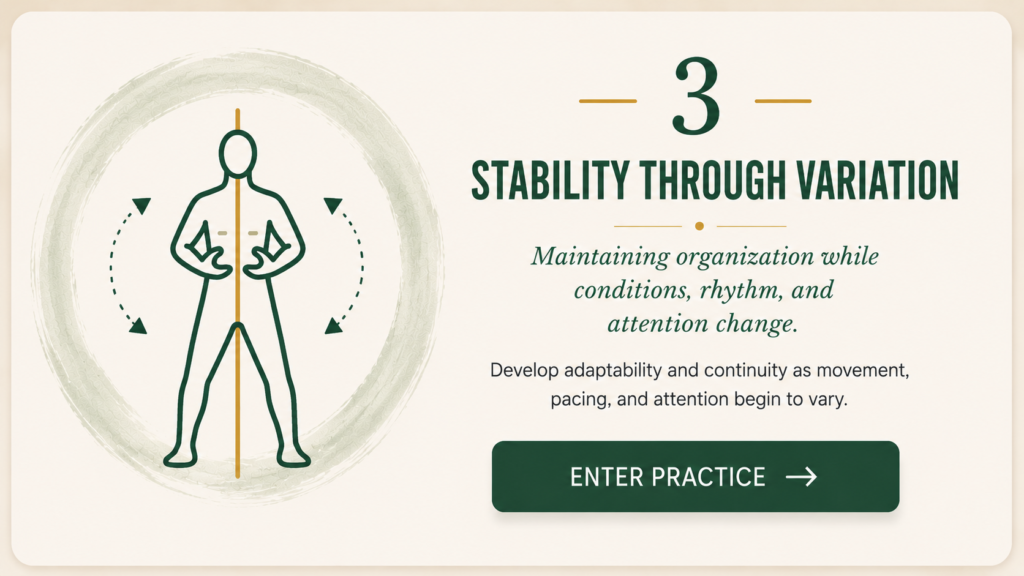
In Practice 1, continuity was discovered through stillness. In Practice 2, continuity begins accompanying movement. Practice 3 brings these together.
Stillness and movement are no longer practiced separately. Instead, continuity must remain stable as conditions, rhythms, and patterns begin to change. This is where continuity begins developing into stability.