Why Less Movement Can Produce Greater Effect
How Whole-Body Organization Transforms Movement from Something We Do into Something We Embody
by Mark V. Wiley
There is a curious reversal that happens in long practice. In the beginning, we tend to do too much. Movements are large. Effort is obvious. The body announces what it is trying to accomplish. We extend farther, swing harder, hold more deliberately, and separate actions so that we can understand what each part is supposed to do.
Over time, with proper practice and understanding, something should begin to change. The movement becomes smaller. The effort becomes less visible. Separate actions begin to merge. This process of movement refinement is not simply a matter of doing less. What once required several movements may happen in one. What once required a large physical action may eventually occur through an adjustment barely visible to the eye.
It is tempting to call this simply less is more. But that does not quite capture what is happening. Less movement does not necessarily mean less activity. Often, it means that more of the body has learned how to participate.
“The movement becomes smaller, but the participation becomes larger.” —Mark V. Wiley
I have encountered this principle repeatedly in very different practices—Qigong and Zhan Zhuang, Eskrima, and Ngo Cho Kun. The methods differ considerably, yet they seem to reveal a similar developmental movement from exaggeration toward refinement, from separation toward integration, and from externally visible effort toward increasingly subtle organization.
“Refinement is not reduction. Refinement is integration that makes reduction possible.” —Mark V. Wiley
From Large Movement to Stillness: Qigong and Zhan Zhuang
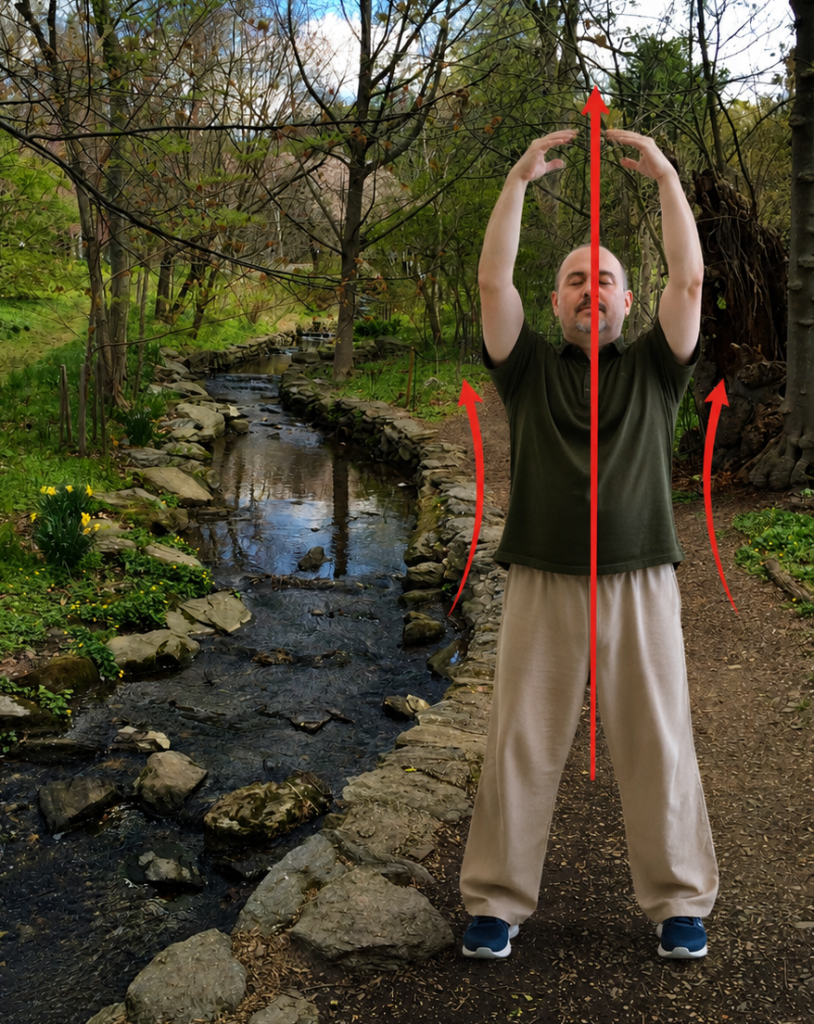
Many Qigong practices begin with large, easily discernible movements. In a method such as Ba Duan Jin, the arms rise and fall through broad arcs. The body stretches and turns. One hand may press upward while the other presses downward. The hands scoop and circle around the body. Muscles contract and release, joints move through their ranges, and tendons and connective structures are progressively conditioned.
Within the traditional framework, these movements are understood as helping regulate and circulate qi (vital energy), blood, and fluids within the body. But they also serve an important developmental purpose for the beginning practitioner: they make subtle internal changes easier to perceive.
When the arms move apart and come together, something changes. Tension changes. Pressure changes. Breathing changes. The relationship between the hands and the rest of the body changes. Sensations described as warmth, fullness, tingling, expansion, contraction, or resistance may gradually become perceptible.
“The large movement gives the novice something through which to discover the subtle sensation.” —Mark V. Wiley
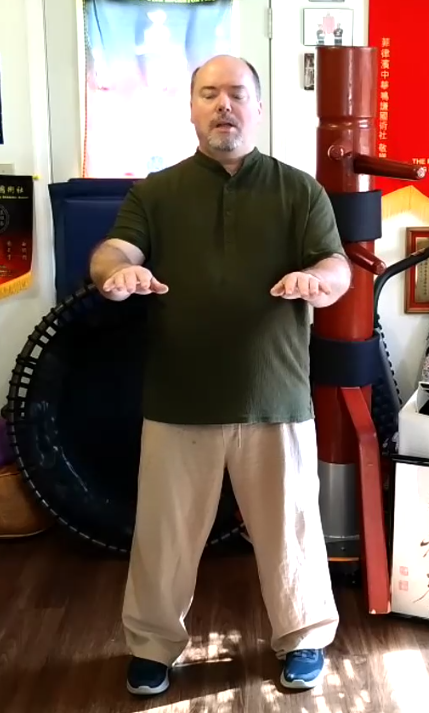
Later, much less movement may be necessary. The practitioner might hold the hands in front of the body as though holding a ball. Instead of sweeping the arms through a large arc, the hands slowly expand away from one another and contract toward one another by only a small amount. The movement has diminished considerably, yet the sensation between the hands may become more apparent, not less.
What once required a large movement to perceive can now be experienced through a small one. Eventually, even that movement can diminish.
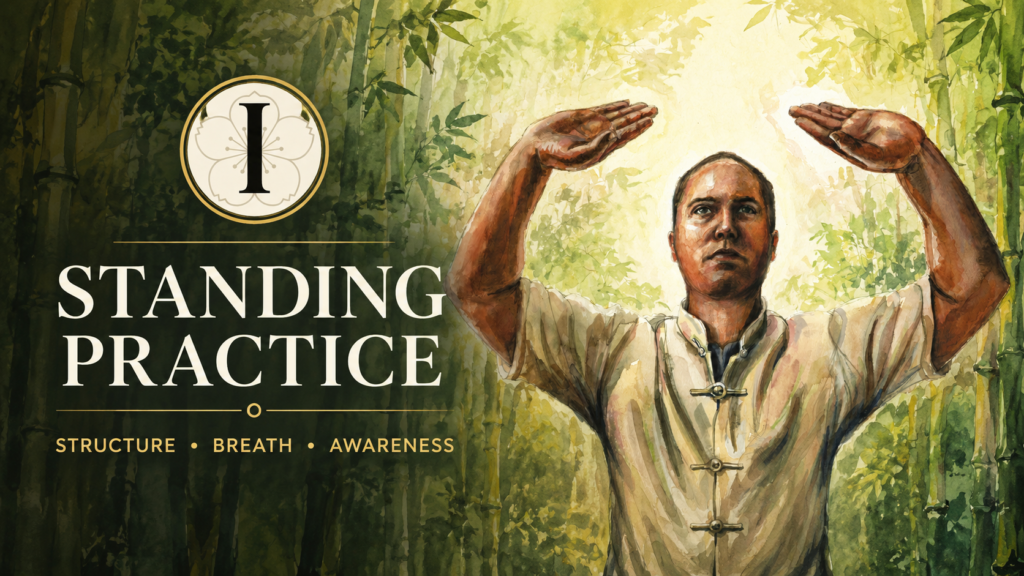
This brings us toward Zhan Zhuang, the standing practices in which the body may appear almost completely still. There is an idea associated with standing practice commonly expressed along the lines: large movement is not as good as small movement; small movement is not as good as no movement. But standing still does not mean that nothing is happening.
Weight continually reorganizes over the feet. Minute postural adjustments occur. Muscular tensions appear and release. Breath alters pressures within the torso. Relationships among the feet, legs, pelvis, spine, shoulders, arms, hands, and head become increasingly perceptible. Within the traditional language of Qigong, qi may eventually be experienced without needing to produce the broad external movements through which the practitioner first learned to recognize it.
“As the external movement diminishes, sensitivity to what is occurring within the movement increases.” —Mark V. Wiley
From the outside, there may be almost nothing to see. Inside, an entire field of activity may be becoming more apparent. Taken literally, this could easily be misunderstood. It might suggest that movement itself is inferior and that the objective is simply to
The progression, then, is not simply movement, less movement, no movement. It is closer to large movement, perception, refinement, subtle movement, and stillness. The large movement was not a mistake to be discarded. It was part of what taught the practitioner how eventually to need less of it.
This brings to mind Laozi’s observation in the Daodejing:
“In the pursuit of the Dao, every day something is dropped.” —Laozi, Daodejing, Ch. 48
What gets dropped is not necessarily what was useless from the beginning. Sometimes the thing being dropped was precisely what allowed us to discover what could later remain without it.
The Shrinking Arc: Whole-Body Power in Eskrima
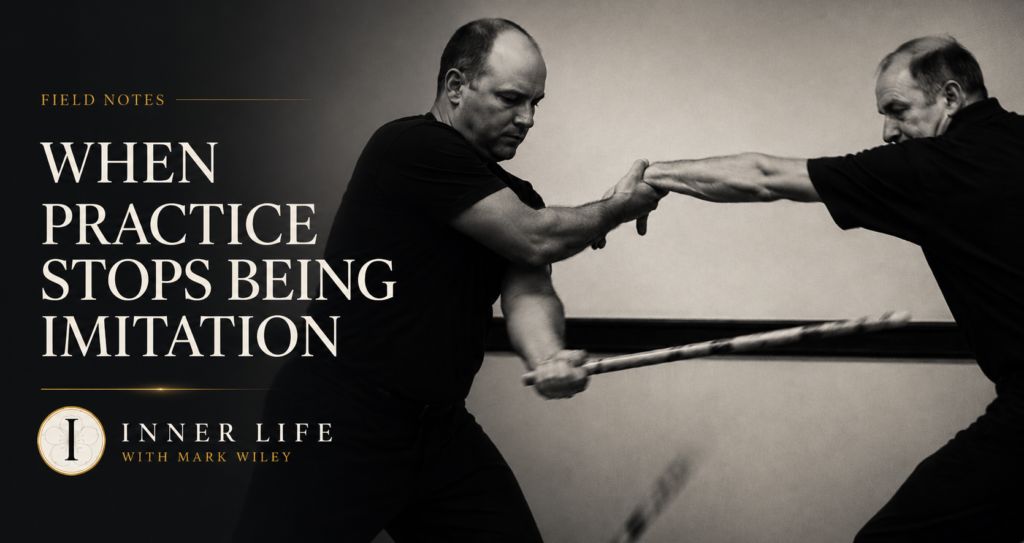
I have experienced the same principle through a very different doorway in Eskrima. When we first learn to strike, the movements are generally large. The arm swings through a broad arc. The shoulder is obvious. The weapon travels a considerable distance. These exaggerated movements help us understand trajectory, angle, range, structure, and intention.
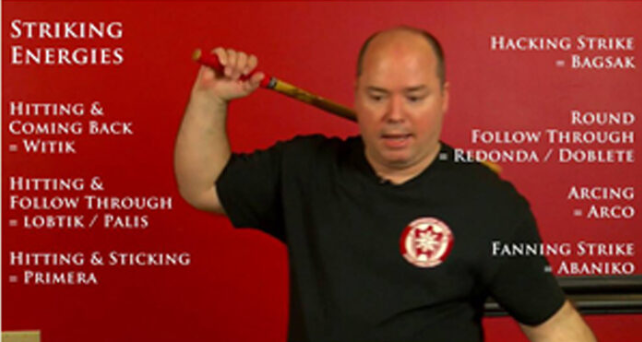
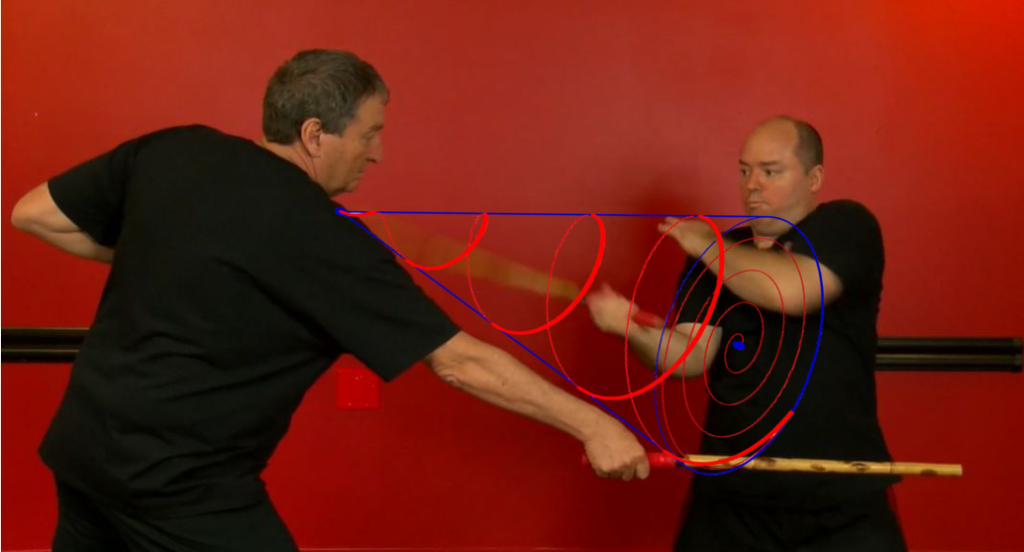
With practice, however, the arc begins to shrink. The waist starts contributing to what the arm had previously attempted to accomplish largely by itself. Then the legs become involved. The ankles and feet enter the action. The relationship with the ground changes. Force becomes increasingly distributed through the body rather than generated by an isolated limb.
Eventually, a strike that once required a large swing can emerge from a remarkably small movement.
The beginner may move a great deal of the arm while involving relatively little of the rest of the body. The experienced practitioner may move the arm considerably less while involving the feet, legs, waist, torso, shoulder, and arm as a coordinated whole.
What appears to have been removed from the technique has actually been redistributed throughout the system. This is why simply making the movement smaller does not make it more advanced. If I shorten the arc but have not developed the relationships that allow the shorter movement to work, I have not refined the strike. I have merely shortened it.
Tightening the Circle: Training with Angel Cabales
I witnessed an especially revealing example of this during my years training under the late Grandmaster Angel Cabales, founder of Cabales Serrada Escrima. Serrada already favored tighter movements and a somewhat shorter stick than those commonly used in many other systems of Eskrima. But there was something interesting in the evolution of Cabales’s own movement.
When he began teaching publicly in Stockton, California, in the late 1960s, Cabales was still in his physical prime. His movements were tight and economical, but they were also strong and extended. When the structure and arrangement of the technique permitted a larger stroke, he used it. Economy did not mean simply making everything as small as possible.
By the time I trained with him, Cabales was in his mid-seventies. He no longer possessed the physical strength of the younger man who had begun teaching decades earlier. His movements had become shorter, tighter, and increasingly economical. He sometimes described this process to me as “tightening the circle” or “tightening the spiral.”
Part of this was undoubtedly adaptation to age. But age was acting upon a body that already possessed decades of accumulated experience. Cabales could remove movement because he had spent a lifetime developing what remained.
What happened around him was equally instructive. Students saw the master’s increasingly small and rapid movements and naturally assumed that this was what advanced Serrada was supposed to look like. They began making their own movements smaller and tighter. Some shortened their sticks even further, believing the reduced length would allow them to move faster.
Externally, they were moving toward the appearance of the master. Developmentally, however, they were sometimes moving in the opposite direction. They were attempting to begin with the product of a process Cabales had arrived at only after decades of practice.
“We can imitate the master’s movement. We cannot imitate the master’s development.” —Mark V. Wiley
This is an easy mistake to make in any embodied tradition. We observe the refined practitioner and copy what we can see. But what we see is the result of development, not the development itself. Cabales had not become skilled because he moved in small circles. His circles could become smaller because of the skill he had already developed.
A practitioner who deliberately shortens a strike without developing the body mechanics, timing, structure, distance, coordination, and experience that allow the strike to become smaller has not necessarily refined the movement. He may simply have abbreviated it.
There is an important difference between removing what is unnecessary and never having developed what was necessary in the first place. The student sees where the master arrived and tries to start there.
“Do not mistake where practice arrives for where practice begins.” —Mark V. Wiley
Five Parts Power in Ngo Cho Kun
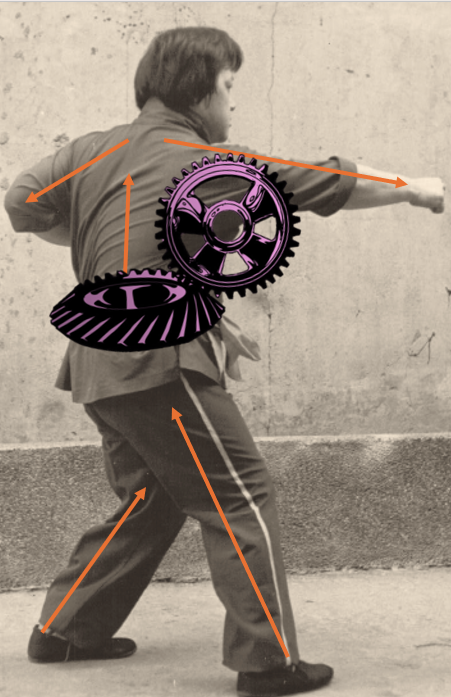
Ngo Cho Kun offers another expression of this principle through Ngo Ki Lat, or Five Parts Power. In the early stages of training, movements are deliberately extended. The arms swing from the shoulders. Stances are long and wide. Actions are visibly expressed so the practitioner can learn the shapes, sequences, alignments, and relationships of the system. Over time, those external movements begin to contract.
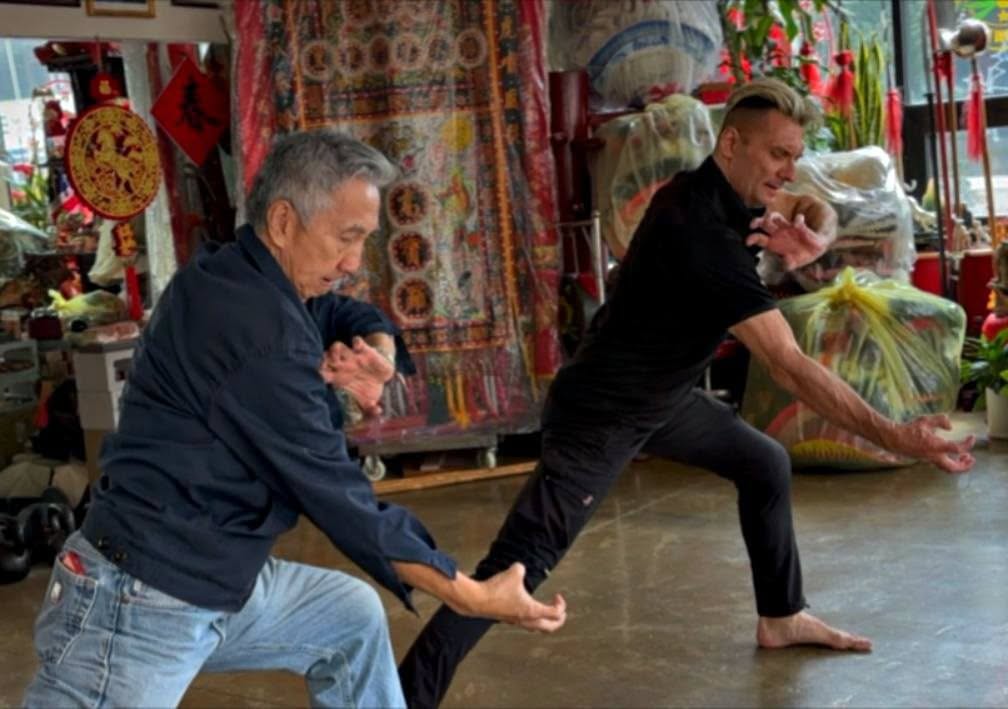
Power increasingly emerges through the relationship between the body and the ground. It travels through the feet and legs, coils through the body and spine, transfers through the shoulders, and continues down the arms until expressed through the fist or fingers. What was once a large visible action becomes a sequence of much smaller coordinated actions.
The body may shake. The shoulders may vibrate. There can be a sudden pulse through the frame while relatively little gross movement is visible. What had previously been produced through a large swinging action is now expressed through an increasingly coordinated kinetic chain involving the whole body.
Once again, the movement becomes smaller while the organization behind it becomes greater. Sifu Alex Co (left image) illustrates the force flow in Ngo Cho Kun (Five Ancestor Fist Kung-Fu) by way of “Five Parts Power” (Ngo Ki Lat).
When Three Movements Become One
Ngo Cho Kun reveals another aspect of the same principle. Refinement does not only make movement smaller. It can also make time smaller. When single- and double-hand techniques are first learned, the movements are deliberately large and distinct. The hands extend and retract through their full ranges. One hand may extend as the other contracts, or both may operate concurrently. The movements are separated sufficiently that the practitioner can understand what each hand is doing and how the actions relate to one another.
An application may initially be learned as a sequence: deflect or block, grab, counterstrike. Each action has its place. Each must first be understood on its own. The beginner needs these distinctions before the distinctions can be integrated. Later, the timing changes.
The practitioner no longer needs to perform three clearly separated actions. Long and short movements begin to combine. One hand can be defending while the other is already countering. A deflection can become part of the counter rather than merely something that occurs before it.
What had been several actions performed across several moments begins collapsing toward a single coordinated event. Defense and counter become one movement occurring on one beat.
Again, this looks like subtraction. There are fewer visible movements. There are fewer beats. There is less elapsed time between receiving the attack and expressing the response. But less is happening only from the perspective of appearances. Internally, more has been integrated. The practitioner has not simply eliminated the deflection, grab, or counter. Their functions have been incorporated into a more economical organization of movement and timing. What previously had to occur sequentially can now occur concurrently.
“The technique has not merely become shorter. It has become more whole.” —Mark V. Wiley
This is an important distinction. Refinement does not mean doing the same three things faster. The relationship among those things has changed.
Again, the separated movements were not mistakes. They taught distinctions that the practitioner needed before those distinctions could be integrated. Remove them too early and something may simply be missing. Integrate them after they have been developed and something very different occurs: several functions can become one expression.
- Less distance.
- Less effort.
- Fewer movements.
- Fewer beats.
Yet potentially greater coordination, efficiency, and effect.
Form Can Be Copied. Embodiment Cannot.
This returns me to something I explored in an Inner Life Talk on embodiment. Imagine two people performing the same routine. From across the room, their movements may look almost identical. Both know where the hands go. Both turn at the correct moment. Both reproduce the sequence.
But one may essentially be mimicking the choreography while the other is expressing relationships that have been cultivated within the body through years of practice. Ground, structure, breath, attention, timing, tension, release, intention, and whole-body coordination may all be present within the second practitioner’s movement even though none of them can be easily seen.
The external form can therefore look remarkably similar while the internal organization producing it is profoundly different.
“Form can be copied. Organization has to be cultivated.” —Mark V. Wiley
This is why refinement itself cannot simply be imitated. Making a movement smaller does not make it more embodied. Standing still does not make Zhan Zhuang internally alive. Shortening the stick does not reproduce Angel Cabales’s Serrada. Performing defense and counterattack simultaneously does not mean the practitioner has integrated the lessons contained in learning them separately.
The appearance of advanced practice is not advanced practice.
This may be one of the most persistent misunderstandings in embodied traditions. We look at accomplished practitioners and naturally imitate what we see. We copy their stillness. We copy their relaxed posture. We copy their economy. We copy their speed. We copy their small movements.
But what we cannot see may be precisely what makes those outward characteristics possible.
What Embodied Practice Removes
This is where Laozi’s idea of subtraction becomes particularly meaningful to me. Embodied practice often does seem to involve dropping things—not arbitrarily, and not merely for the sake of doing less, but because what once had to be deliberately expressed has become integrated into the practitioner.
“Practice does not become embodied because we remove things. We can remove things because the practice has become embodied.” —Mark V. Wiley
Long practice often does seem to involve dropping things. Excess tension disappears. Unnecessary preparation disappears. Telegraphing decreases. Localized muscular effort gives way to greater whole-body participation. Separate actions merge. Conscious interference diminishes.
But this is not indiscriminate subtraction. There is a profound difference between removing something because it has become unnecessary and omitting something because it was never developed.
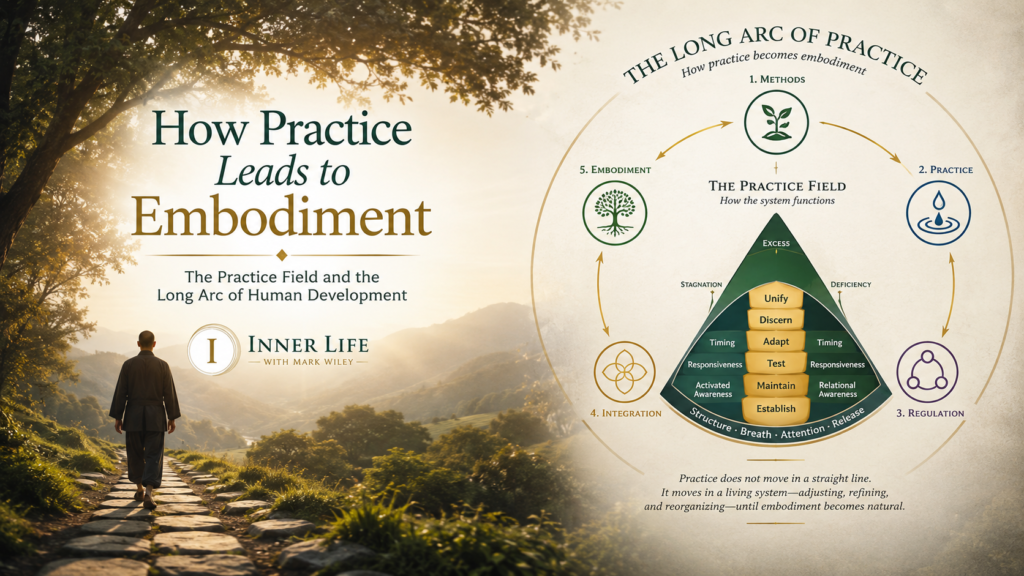
Early practice therefore often involves accumulation. We acquire movements, techniques, forms, concepts, corrections, distinctions, and methods. We make things large enough to perceive them. We separate things sufficiently to understand them. We repeat them consciously because they are not yet embodied.
Then, somewhere along the way, the direction begins to reverse. We start removing.
The arc can become smaller because the rest of the body has entered the strike. Three movements can become one because their functions have been integrated. Large Qigong movements can become subtle because sensitivity has developed. Eventually, the practitioner may stand almost motionless while perceiving relationships that once required broad movement to recognize.
The Daoist image of emptiness is relevant here as well. In Chapter 11 of the Daodejing, Laozi points toward the usefulness of the empty center of the wheel, the emptiness within the vessel, and the empty space that makes a room useful. What is absent is not necessarily a deficiency. Sometimes the removal of what occupies space allows another kind of function to appear.
Perhaps mature practice works in much the same way. We begin by deliberately constructing something. Then we progressively remove the scaffolding that was required to construct it.
- The large movement teaches the small movement.
- The separate actions teach the integrated action.
- Movement teaches stillness.
- Conscious coordination prepares the ground for spontaneous coordination.
What remains can appear simpler than what came before it, while containing far more.
“The beginner needs more movement to learn what the movement contains. The experienced practitioner needs less movement because the body now contains it.” —Mark V. Wiley
This is why less is more is both true and insufficient.
Less becomes more only when reduction is supported by integration. Otherwise, less is simply less.
Perhaps that is one of the quiet signatures of practice becoming embodied: not that we learn to do less for its own sake, but that increasingly little is required for the whole of us to participate.
“The movement becomes smaller. The participation becomes larger.” —Mark V. Wiley
About Mark
Mark V. Wiley is a martial artist, author, and researcher with nearly five decades of training across traditional martial arts, internal cultivation systems, healing arts, and contemplative disciplines. He is the founder of Integrated Eskrima, a lineage holder in orthodox Ngo Cho Kun, and the creator of Inner Life — a practice-based system exploring embodied development, integration, and lived transformation.
Continue Exploring