How Practice Leads to Embodiment
The Practice Field and the Long Arc of Human Development
by Mark V. Wiley
One of the most common misconceptions in long-term practice is believing that every model or diagram is trying to describe the same thing. They are not.
The two diagrams used throughout the Inner Life Practices work together, but they operate at two different levels of the same living system. One explains how practice functions. The other illustrates what gradually emerges through sustained practice.
Understanding this distinction changes how we understand development itself.
The Difference Between Practice and Progress
Before looking at the diagrams themselves, it helps to understand why they exist. Over many years of teaching, I became increasingly interested in a simple question: Why do some people accumulate techniques for decades, yet show relatively little change in how they move, perceive, respond, or participate in life?
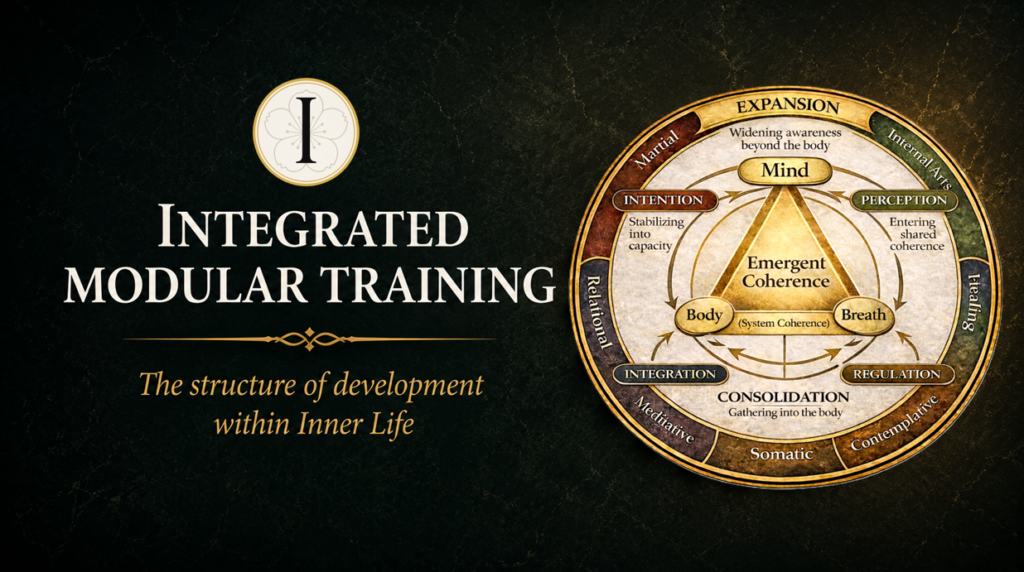
That question eventually led to the development of Integrated Modular Training (IMT)—a framework based on the insight that genuine development comes less from accumulating methods than from cultivating the underlying capacities those methods are intended to develop.
Different practices may appear very different on the surface, yet many cultivate the same fundamental human capacities through different entry points. The Practice Field emerged from this realization. Rather than presenting isolated techniques, it maps the developmental relationships that allow those capacities to grow together as a living system.
Related Reading
Integrated Modular Training (IMT): The Structure of Development
Discover the framework that explains why lasting transformation comes through the progressive integration of human capacities—not simply the accumulation of techniques.
The Practice Field: How the System Functions
“The Practice Field is more than a collection of techniques. It is a framework for understanding how practice can gradually reorganize the human system.” —Mark V. Wiley
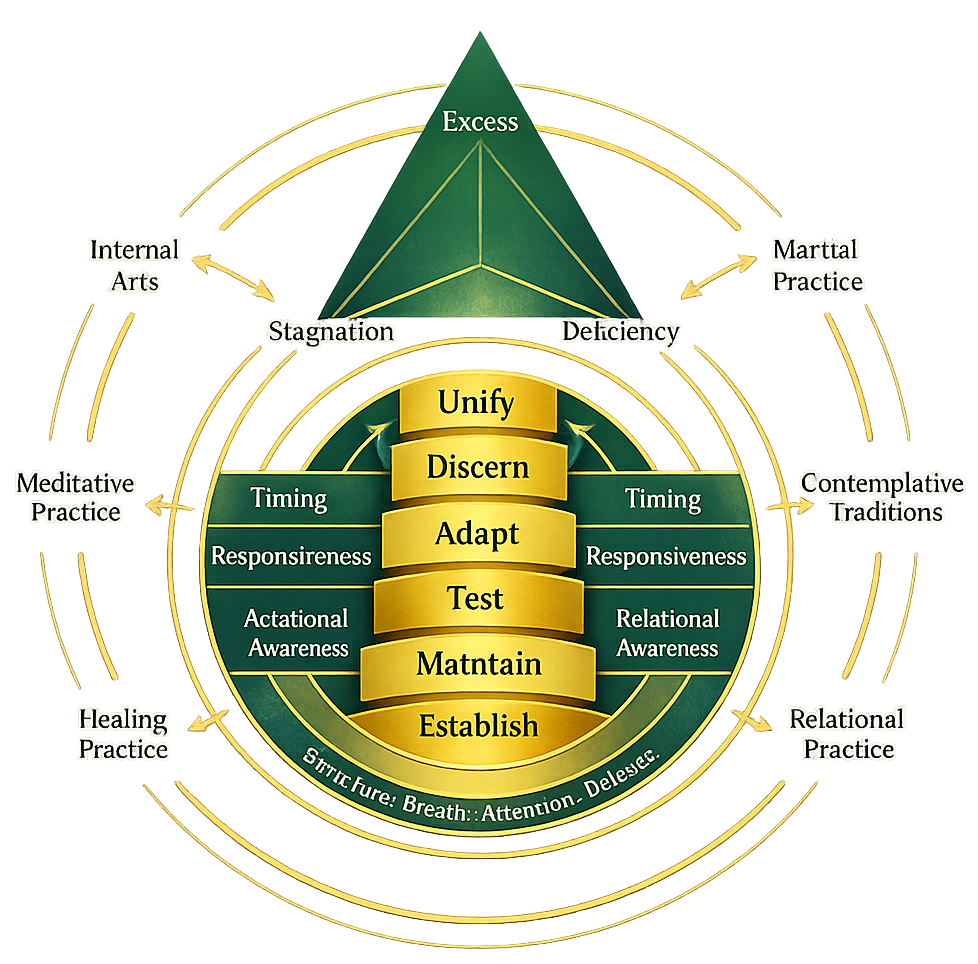
The Practice Field diagram is the foundation. It is not a map of stages, nor is it a progression from beginner to advanced. Instead, it represents the living architecture of practice itself.
Whenever we engage in authentic practice, multiple processes are operating simultaneously. We enter through one or more domains of practice. We continually regulate excess, stagnation, and deficiency. We establish structure, maintain organization, test that organization under changing conditions, adapt, discern what is occurring, and gradually unify the entire system. Beneath all of this lie the foundational conditions of structure, breath, attention, and release.
This is the Practice Field—a dynamic system that is always active whenever we practice. It is not something we move through. It is something we continually return to, each practice session revealing new opportunities for regulation, refinement, and integration.
What Happens When You Stay in the Field?
If the Practice Field explains how practice functions, another question naturally follows.
What happens when someone remains within this field for years?
Development does not occur randomly.
The same processes of regulation, adaptation, and integration gradually stabilize into recognizable patterns. These patterns are not separate from the Practice Field—they are what naturally emerge from sustained participation within it. This is an essential aspect of how practice leads to embodiment.
The Progression: What Practice Produces Over Time
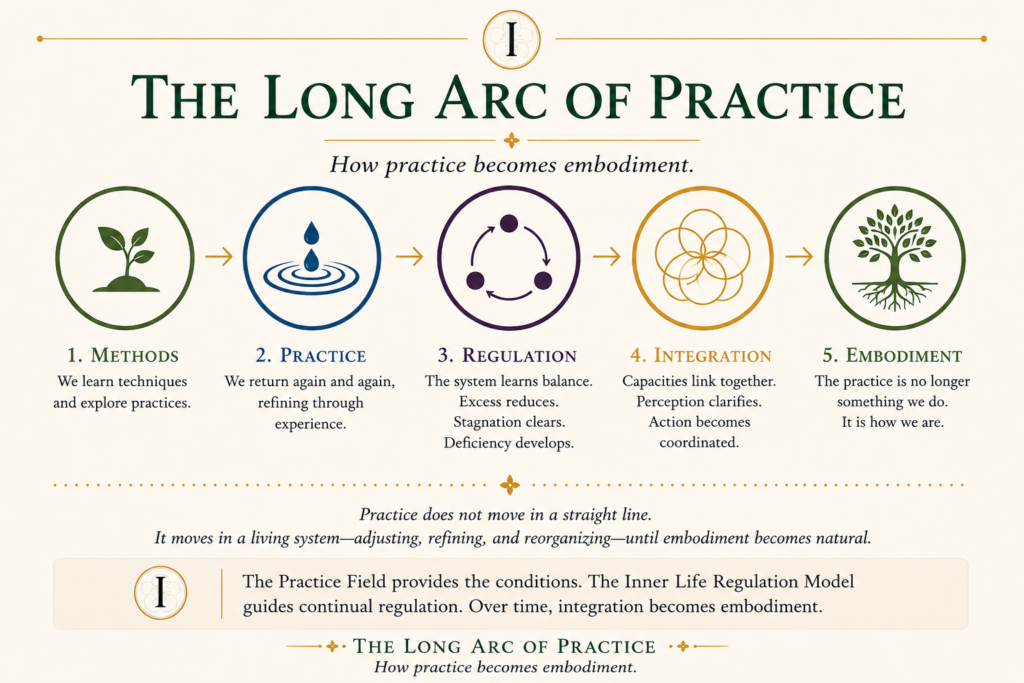
The progression diagram is not another model to master. It illustrates the long view of what naturally emerges through sustained participation in the Practice Field.
As practice deepens, attention becomes increasingly stable. The nervous system regulates more efficiently. Perception becomes clearer. Functional integration develops as the practitioner learns to remain organized under increasingly varied conditions. Eventually, stability is no longer something consciously created—it becomes a natural expression of the whole person.
“Practice cannot guarantee transformation. It can only cultivate the conditions in which transformation becomes possible.” —Mark V. Wiley
Development Is Field-Based, Not Step-Based
It is important not to misunderstand the progression as a ladder of achievement. Authentic development is rarely linear. We revisit familiar challenges, encounter new forms of instability, and continually deepen capacities that were only partially developed before.
The progression does not describe a series of levels to complete. It illustrates recurring patterns that emerge as practice reorganizes the human system.
Every stage shown in the progression can be traced back to the Practice Field itself. Attention stabilizes because we repeatedly establish and maintain organization. Regulation develops because imbalance is continually recognized and refined. Perceptual clarity grows through discernment. Functional integration appears as adaptation is tested under changing conditions. Embodied stability emerges when these capacities become sufficiently integrated that they no longer require constant conscious effort.
Regulation Makes Development Possible
One aspect of the Practice Field remains to be considered. As capacities develop, the system does not simply become stronger—it also becomes more sensitive to imbalance. Growth is rarely linear. At times we over-apply effort. At other times development stalls, or we discover capacities that have not yet matured. Rather than viewing these as failures, the Practice Field understands them as valuable information that guides further development.
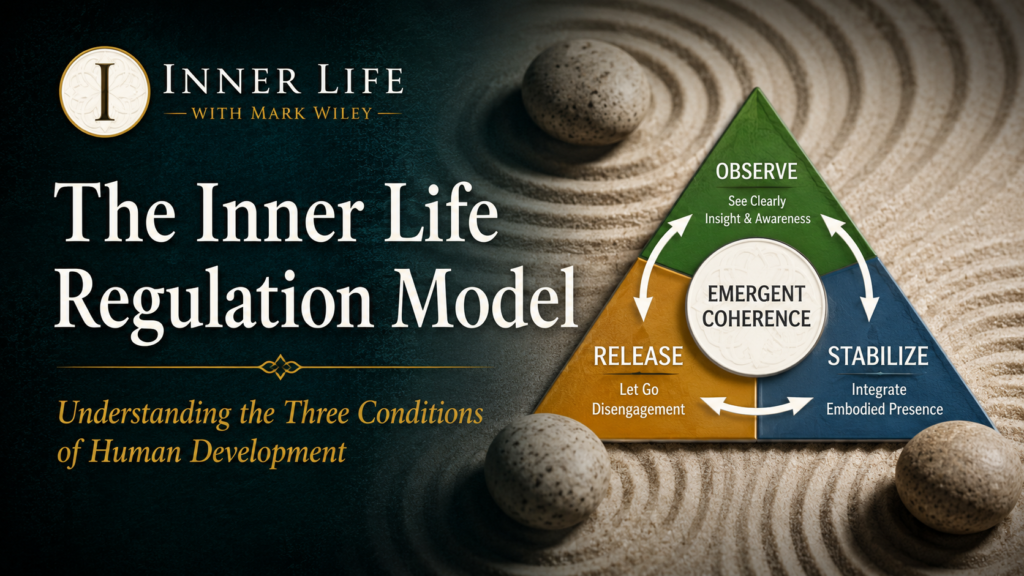
This ongoing process is explained through the Inner Life Regulation Model. It describes how the human system continually moves toward greater coherence by recognizing and responding to patterns of Excess, Stagnation, and Deficiency. Regulation is not separate from practice—it is one of the fundamental processes through which practice becomes development.
The Practice Field provides the conditions for development. The Inner Life Regulation Model explains how the system continually regulates itself as those capacities mature. Together, they describe how sustained practice gradually reorganizes the human system until integration becomes embodiment.
Embodiment Is the Fruit of Practice
Seen together, the two diagrams describe one living process. The first shows the conditions that make transformation possible. The second shows what those conditions gradually produce. Neither diagram stands alone. One reveals the architecture of practice. The other reveals the unfolding life of that architecture through time.
By embodiment, I mean something more specific than body awareness or feeling present: the gradual organization of experience into capacities that become available in how we actually live. I explore this distinction more fully in What Embodiment Actually Means.
The goal, then, is not to climb from one stage to another. It is to return to the Practice Field again and again, allowing the same living system to organize us more deeply with each encounter.
Development is not step-based. It is field-based. Yet over time, recognizable patterns emerge—not because we chase them, but because they are the natural expression of sustained participation in the Practice Field. These illustrate how practice leads to embodiment.
Continue Exploring This Theme