When Imitation Becomes Mastery
The moment the body begins to reveal genuine transformation
by Mark V. Wiley
One of the greatest misconceptions about practice is that we become better because we accumulate more techniques. We learn another form, another meditation, another breathing exercise, another philosophy. But after enough years of serious practice, something should begin to happen. The body starts becoming the teacher. This is the beginning of when the body starts teaching you—that is, you start developing the ability to perceive, adapt, and respond through lived experience rather than accumulated knowledge.
When we’re beginners, our attention is almost completely external. We’re watching the instructor. We’re trying to remember the sequence. We’re correcting posture. We’re asking ourselves: “Did I do it right?”
That’s exactly how it should begin. Imitation is a necessary stage of learning. But if practice remains there, it never becomes embodied. However, over time, something much more interesting should begin to happen. The body starts giving feedback—if you are aware enough to notice it. You notice tension before it becomes obvious. You notice your breathing changing under pressure. You recognize the instant your structure collapses. Recovery becomes something you can actually feel instead of merely understand intellectually.
None of this appears overnight. It accumulates quietly through years of attentive practice. One of the great shifts in serious practice is moving from appearance…to perception. You see, two people may perform exactly the same movement. Outwardly they look almost identical. But internally they are completely different. One is connected. The other is simply reproducing choreography.
That’s one of the great secrets traditional practices preserve. Practice isn’t ultimately about producing better-looking movement. It’s about reorganizing the person performing it. Over time, something remarkable happens. The body begins revealing things the mind alone could never discover. You see, when the body starts teaching you, you begin to feel continuity instead of simply thinking about it. You begin to sense relationships instead of isolated techniques.
Breath…Structure…Timing…Pressure…Awareness… They stop being separate ideas. They begin functioning as one living system. That is embodiment.
This isn’t limited to martial arts. The same principle appears in meditation, music, craftsmanship, healing traditions, rock climbing, figure skating, wood carving, and even relationships. Eventually the method stops being the teacher. Reality becomes the teacher. And the body becomes the place where reality is continuously revealed.
One of my own teachers, Sifu Alex Co, often reminded us that forms were never the destination. The purpose of practice wasn’t simply learning movements. It was becoming someone capable of perceiving what those movements were designed to cultivate. That completely changed how I understood my training specifically and the deeper purpose of practice overall.
So perhaps some questions worth asking yourself are:
- What is your practice actually teaching me?
- Is it giving me more information?
- Has it begun changing the way I perceive myself?
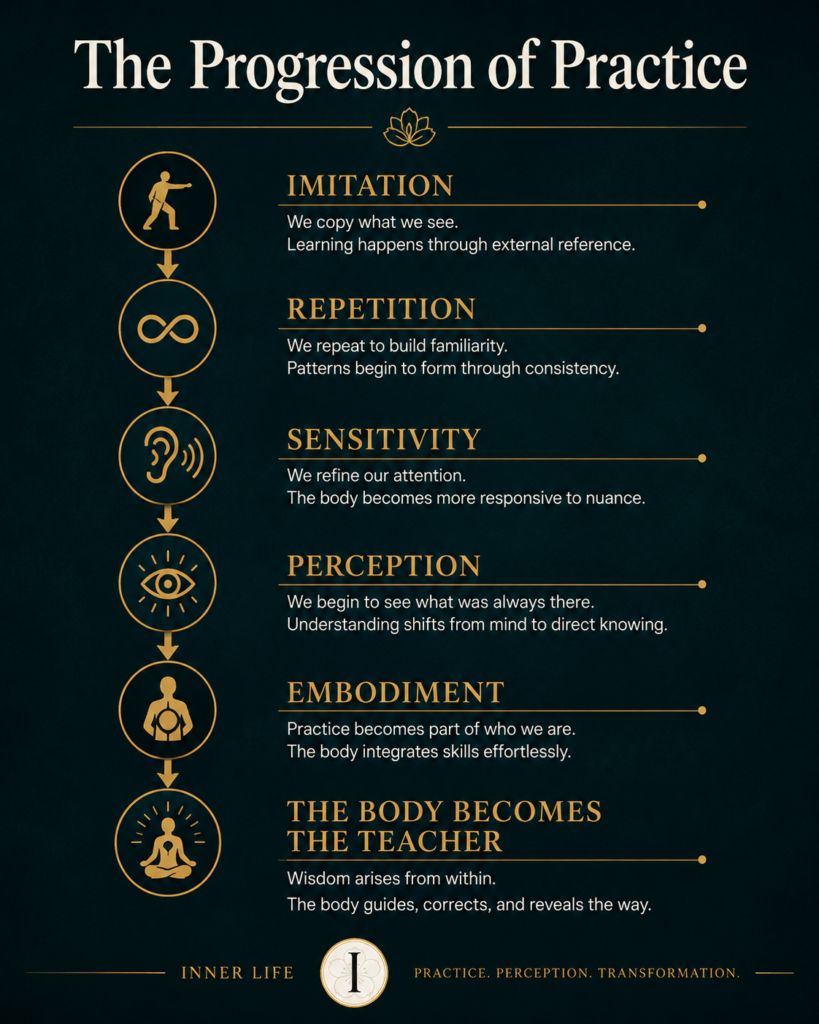
Because when that begins to happen, you’ve crossed an important threshold. The body is no longer something you’re trying to control. It has become a source of intelligence.
As Francisco Varela, Evan Thompson, and Eleanor Rosch argue in The Embodied Mind, cognition is not simply something the brain does—it emerges through the ongoing relationship between body, perception, and lived experience. Long-term practice gradually transforms not only what we know, but how we come to know.
This is only the beginning of a much larger conversation. In two accompanying Field Notes (links below), perform the same movement while embodying completely different internal realities, and what the body gradually reveals that no amount of theory can teach.
Because sometimes the deepest lessons aren’t learned by thinking more. They’re revealed by the body—over time.
Watch & Listen
Watch on YouTube or listen on your favorite podcast platform




Continue Exploring