When Realization Becomes Lived
with Shaykh Fadhlalla Haeri
From spiritual seeking to presence, honesty, and the art of letting go
What does realization in everyday life mean? In this Integral Being conversation, Shaykh Fadhlalla Haeri explores how spiritual understanding shapes our conduct, relationships, and willingness to let go. He brings that question back to the assumptions beneath it. Who is the person seeking realization? What do we imagine we will acquire? And how easily can spiritual life become another way of reinforcing the identity we hope to understand?
Haeri’s responses move between the timeless and the ordinary: the unity of reality, the illusion of a separate self, the uncertainty of earthly existence, and the need to be honest, recognize mistakes, and apologize. Stories of his teacher, Swami Chinmayananda, bring humor and immediacy to the inquiry. Again and again, a lofty idea meets a practical correction.
A central thread emerges: realization involves relinquishing our claims to possession, knowledge, and spiritual importance. That relinquishment has consequences for how we meet other people, respond to difficulty, and participate in life. As Shaykh Fadhlalla puts it: “It’s the loss rather than gain.”
There Are Not Two Realities
Early in the conversation, I suggest that human beings seem to live between two realities. One is bound by personality, biography, memory, time, and survival. The other appears timeless, limitless, and already whole. Shaykh Fadhlalla challenges the premise.
“There are no two realities. There’s only one that appears in different zones or dimensions of intensity.” —Shaykh Fadhlalla Haeri
The distinction matters. If our ordinary existence is inseparable from its source, the spiritual search cannot finally be a journey toward something wholly elsewhere. The inquiry concerns how we encounter what is already present, and what prevents us from recognizing it.
He describes our identities as a combination of the temporary and the timeless: a changing creature within space and time, alive through a source that is not confined by those conditions. We experience ourselves through the body, its needs, our memories, and the roles through which we function. Yet none of these, he insists, fully answers the question of who we are.
When I ask what changes for someone who has realized this, he refuses the status my question offers him.
“I don’t claim any of that. The only thing I can say is that I’ve been privileged to discover there is no I. It’s an illusion of the self.” —Shaykh Fadhlalla Haeri
He invites inquiry: look for this “I.” Where is it? What durability does it have? The challenge reaches into spiritual development itself. We may begin by wanting to become wiser, more peaceful, or more awake. Those aspirations can guide us, but they can also sustain an increasingly refined image of ourselves. Even the identity of someone progressing toward realization remains open to examination.
Life in the Second Womb
Shaykh Fadhlalla gives earthly existence a striking image: we are living in a second womb. The first womb prepares us for birth into this world. This earthly life, he suggests, prepares us for a further passage. Our present condition is temporary, formative, and incomplete.
This understanding gives his teaching its urgency. The question is larger than how to become comfortable within our circumstances. It concerns how we use the brief opportunity of being alive, and whether we are preparing to release what we continually mistake for ourselves.
Death therefore runs through the conversation. He speaks of becoming ready to leave the body joyfully, rather than holding ever more tightly to an identity that cannot endure. For a reader approaching spirituality through personal development, this can be a demanding shift. We often hope practice will help us build a more satisfying life. Shaykh Fadhlalla asks us also to examine our attachment to the person whose satisfaction we are pursuing.
The two concerns meet in ordinary experience. Relationships, work, pleasure, disappointment, and loss reveal what we cling to. They give us repeated opportunities to recognize the limits of possession and control, and to respond with greater honesty.
Discovering Through Loss
One of the most revealing stories concerns Shaykh Fadhlalla’s encounter with Swami Chinmayananda. Outwardly, Fadhlalla was successful. He had accomplishments, professional standing, and a balance sheet that could demonstrate how well he was doing. Inwardly, he knew this success was not durable.
When he met Chinmayananda, he recognized something he hoped to have. Later, he understood the encounter differently: what mattered was something he needed to lose.
This reversal exposes a familiar pattern. We learn, gather experience, improve our abilities, and acquire the resources needed to function. It is natural to carry that movement into spiritual life. We seek more teachings, more practices, more retreats, and more unusual experiences.
Yet the habit of acquisition can survive every change in what we acquire. Spiritual knowledge may become another possession. An experience of unity may become evidence of personal attainment. Renunciation itself may become something about which we feel superior.

Shaykh Fadhlalla’s challenge concerns the claims beneath these attachments: I possess. I know. I have power. I have become someone. Relinquishing those claims does not remove the responsibilities of ordinary life. It changes how we hold them.
A Teacher Who Returned Him to Honesty
Chinmayananda did not ask Shaykh Fadhlalla to construct a new spiritual identity. He did not tell him to change his name, clothing, or outward circumstances. The instruction was direct:
“Be honest, be real and carry on as you are. Make mistakes, come out of it, apologize, repent and move on.” —Shaykh Fadhlalla Haeri
Shaykh Fadhlalla adds that he is still doing the same: making mistakes and apologizing. There is something consequential in that admission. Spiritual maturity does not make a person exempt from correction. It calls for the willingness to recognize a mistake without turning the defense of oneself into a further mistake.
His recollections of other teachers extend this learning beyond formal spiritual settings. Porters, workers, street sweepers, and vendors could reveal something worth learning through their behavior. Asked what they showed him, he answers:
“That I can learn conduct, proper conduct, proper behavior at all times, wherever I am.” —Shaykh Fadhlalla Haeri
The encounter with a teacher may happen in the way someone performs a task, meets a stranger, or responds to a difficult person. What matters is our capacity to notice and learn.
Realization in Everyday Life Through Conduct
Presence can remain an attractive abstraction until a situation requires something of us. How do we respond when we are contradicted? What happens when our plans fail? Can we acknowledge that our intentions were mixed?

Can we apologize without quietly asking the other person to restore our image of ourselves? Shaykh Fadhlalla brings attention to the whole movement of action:
“Before you act, clarify your inner intention.” —Shaykh Fadhlalla Haeri
He then asks us to examine the means through which we act, and the action itself. A worthy intention does not settle every question about how it is expressed. Honesty requires attention throughout.
He connects this vigilance with discovering the “real me.” Accountability is therefore integral to the inquiry. Our behavior reveals attachments that spiritual language can easily conceal.
How we live matters deeply, yet we can become attached even to being recognized as a person of good conduct. The work continues wherever self-importance finds a foothold.
When Seeking Becomes Collecting
Access to spiritual teachings offers extraordinary opportunities. It also makes it easy to remain perpetually in search of the next explanation. We can move among teachers, traditions, books, videos, and practices while giving little sustained attention to what we have already encountered. Learning becomes a habit that postpones the quieter demands of practice.
Shaykh Fadhlalla speaks sharply about becoming a collector of spiritual teachers and pathways. His instruction is to stop and remain present.
“Stay in consciousness without being conscious of anything.” —Shaykh Fadhlalla Haeri
He describes returning to this regularly during the day as a recalibration. He also acknowledges its difficulty.
The question is whether what we learn is changing our relationship with experience. Can a teaching bring us into silence? Does practice help us recognize a defensive reaction before acting upon it? Are we becoming more willing to see what is uncomfortable about ourselves? Accumulation can continue indefinitely. Allowing a teaching to penetrate our lives asks something more intimate.
A Good Mood Is Not Realization
Shaykh Fadhlalla recalls an early morning in India while traveling with Chinmayananda. They were waiting for a small aircraft to be refueled, walking on the runway as the day began. Caught by the beauty and wonder of existence, he spoke enthusiastically about the world, the cosmos, and the mystery of it all. Chinmayananda looked at him and said: “You’re in a good mood.”
The correction is funny because it is so recognizable. An uplifting state can feel like a final discovery while it lasts. Later, circumstances change. Someone irritates us. An obligation intrudes. Our chemistry shifts. The experience may have been meaningful, but we can easily make too much of what it proves about us.
This story also raises the question of how a passing state becomes a more enduring way of living. Shaykh Fadhlalla resists turning that inquiry into another promise of personal attainment. He returns to the temporary nature of the body and the need to continue. The invitation is to meet the condition that is here, rather than organize our spiritual lives around recovering a condition we once enjoyed.
Living with Uncertainty
Uncertainty is one of the conversation’s most persistent themes. We spend much of our lives trying to secure our circumstances. We want reliable relationships, stable work, physical safety, and confidence about what comes next. These are understandable concerns, but outward certainty has limits.
Shaykh Fadhlalla speaks of doing our best to establish reasonable certainty while accepting that uncertainty remains. A plan may fail despite careful preparation. A circumstance may change without warning. He locates inward certainty in the spirit, while describing the source of life as ultimately beyond the duality of certainty and uncertainty.
Presence brings this inquiry into immediate experience:

We encounter life now, even while memory and anticipation continually draw our attention elsewhere. Returning to the moment does not tell us everything that will happen. It allows us to attend more fully to what is happening and what it asks of us.
Participating Without Carrying Everything Forward
Shaykh Fadhlalla illustrates nonattachment through a story Chinmayananda told him. Two renunciates encounter a woman who is drowning. One enters the water, rescues her, and continues on his way. Later, his companion objects to the physical contact involved. The rescuer replies:
“You are carrying it all the time. I left her there. It is you who are carrying it.” —Shaykh Fadhlalla Haeri
The necessary action was completed. His companion continued to carry its image and implications. The story offers a practical understanding of participation. We can respond fully to a situation without making it a lasting possession of the self. An act of service need not become a story about our goodness. A completed encounter need not be continually rehearsed.
This has consequences for relationships as well. We can care for people, respect them, and help them while examining our wish to control their lives or secure their recognition.
Spiritual Ego and Participative Destiny
The danger becomes especially acute when spiritual understanding brings authority, followers, or influence. Shaykh Fadhlalla warns that a teacher can begin sincerely and become entangled in the desire for power or recognition. The language of spirituality offers no automatic protection.
Of spiritual ego, he says: “It’s the worst, the most dangerous one.”
Even humility can become an identity. We may become invested in appearing selfless, wise, or free of ambition. Continuing vigilance matters because our motives can change while our preferred description of ourselves stays the same. He places this warning within a wider understanding of responsibility:
“We are participative creatures. We participate in our destiny, good or bad.” —Shaykh Fadhlalla Haeri
What we cultivate has consequences. Our habits, intentions, relationships, and choices help shape the course of our lives. Participation does not give us complete control. It does mean that we are involved. We cannot claim that the self is an illusion and then use that claim to evade responsibility for what we do.
Meeting the Living Moment
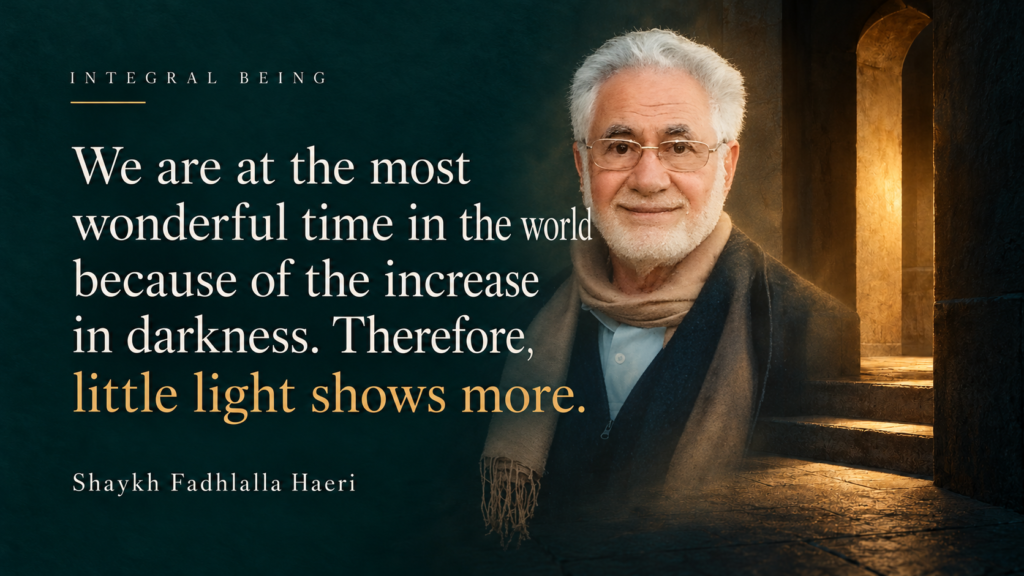
Near the end, I ask what we should do amid the confusion and instability of contemporary life. Shaykh Fadhlalla declines to offer a universal prescription, warning: “The prescription of today may be the poison of tomorrow.”
Sometimes it may be appropriate to withdraw. At another time, the task may be to enter a difficult situation, help someone, or complete necessary work. A response that served one circumstance may fail in another. His direction is to become still enough to recognize what the present situation requires. Silence, honesty, and vigilance prepare the ground for discernment. The response must still be lived.
After I begin closing the conversation, he continues. He speaks of people from different backgrounds finding one another through shared understanding, and of the reassurance that we are not alone.
Then comes an invitation to enjoy life: food, silence, fasting, and even the eventual moment of leaving the body. Be fully in this world while remembering the source from which life comes.
The conversation leaves us with a demanding and intimate inquiry. Can we learn without endlessly collecting? Can we act responsibly and release our claim to the action? Can we recognize a mistake, apologize, and move on? Can we enjoy what is here while becoming willing to let it go?
These questions give realization a place in the life we are actually living.
About the Guest
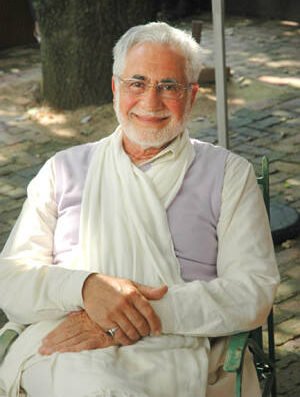
Shaykh Fadhlalla Haeri is a Sufi teacher and author whose work connects spiritual self-discovery with the demands of contemporary life. Raised in Karbala, Iraq, he studied in the United Kingdom and pursued a career in the oil industry before turning increasingly toward teaching and writing. His encounters with spiritual seekers across cultures deepened an inquiry into the limits of material success and the search for lasting contentment.
Rooted in Sufism and Islamic spirituality, his teaching explores the relationship between the changing self and the timeless source of life. He brings questions of consciousness and identity into practical discussions of honesty, responsibility, and conduct. In this Integral Being conversation, he explores realization in everyday life through presence, relinquishment, and lessons from his teacher, Swami Chinmayananda.
Continue Exploring This Theme