Freedom Is Not What We Think It Is
with Brook Ziporyn, PhD
On Daoism, Tiantai Buddhism, Spinoza, and the Practice of Becoming Less Fixed
Prefer to listen? Play the audio.
What if freedom is not primarily the ability to choose what we want, escape limitation, or become independent of the forces acting upon us? What if freedom has more to do with becoming less fixed—less confined by a single identity, perspective, interpretation, purpose, or way of experiencing the world?
That possibility runs throughout Mark Wiley’s Integral Being conversation with philosopher and scholar Brook Ziporyn. Moving between Daoism, Zhuangzi, Tiantai Buddhism, Chinese internal alchemy, and Spinoza, Brook traces a surprisingly consistent concern: the relationship between what appears fixed and what remains open, between limitation and possibility, and between the particular thing we are experiencing and the larger field of relationships within which it exists.
These can sound like abstract philosophical questions. But our conversation repeatedly returned to something much more practical. If a way of thinking changes perception, and perception changes how we experience and respond to the world, then philosophy itself can become a form of practice. The question is no longer simply whether an idea is true.
The question becomes: What happens to us when we learn to see through it?
Freedom from Fixation
Across the very different traditions Brook has spent his life studying, he recognizes a recurring concern with boundaries, determinations, and the ways things exceed the categories we use to define them. In Tiantai, something is never definitively only itself. In Spinoza, finite things are expressions of infinity. In Daoist thought, opposites continually imply, depend upon, and transform into one another.
What emerged during our conversation was the possibility of understanding this entire trajectory through the language of freedom. Brook does not commonly use that word himself, preferring terms such as openness or indeterminacy, partly because freedom is so easily reduced to personal choice, autonomy, or free will. Yet when I suggested that his work seemed to point toward freedom from being locked into a fixed mold or identity, he agreed that this was very close to the thread running through his work.
“I would even say freedom from fixation. It’s freedom, all the way in every dimension.” — Brook Ziporyn, PhD
This is not freedom because limitations magically disappear. It is freedom because no particular limitation, identity, perspective, or determination exhausts what something can be. Becoming less fixed does not require becoming nothing. It means becoming less imprisoned by the assumption that what we presently are, perceive, believe, or experience is the only possible configuration.
Depending on Everything
One of the most striking reversals in our conversation concerned independence. We commonly imagine freedom as requiring fewer dependencies. The freer person should need less from circumstances, other people, the body, culture, nature, or the world.
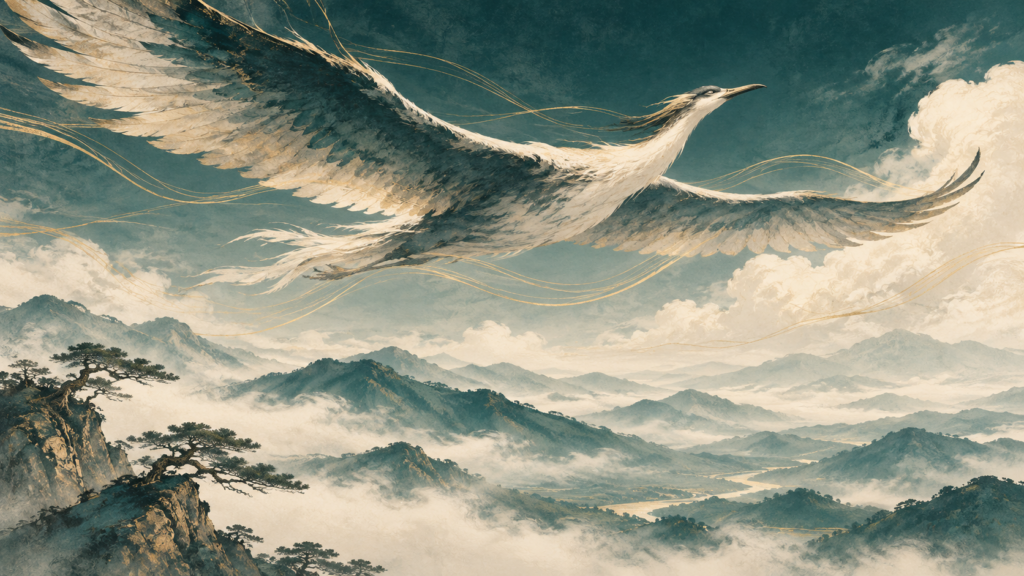
Brook pointed toward almost the opposite possibility through Zhuangzi. Even the enormous Peng bird in the opening of the Zhuangzi, capable of extraordinary flight, depends upon the wind. Every perspective depends upon its context. Trying to remove every dependency does not necessarily make us freer; it may simply produce another form of confinement.
“The only real independence would have to be the ability to depend on anything and everything.” — Brook Ziporyn, PhD
This reversal is especially relevant to embodied practice. We do not become capable by eliminating relationship. A martial artist depends upon ground, distance, timing, structure, perception, and the movement of another person. A meditator depends upon breath, sensation, attention, and the conditions of the body. We develop greater freedom by becoming capable of participating within more relationships rather than requiring the world to conform to fewer of them.
From this perspective, freedom begins to resemble adaptability. The more conditions through which we can remain present, organized, and responsive, the less a particular circumstance determines what we are capable of becoming within it.
Philosophy as a Practice of Perception
This led us into one of the most important parts of the conversation: whether philosophy itself can be a practice. Brook’s answer is emphatically yes.
Rather than treating philosophy solely as a contest for determining which proposition is correct, he described working through a philosophical system as something closer to learning a movement. We follow its implications, relationships, premises, and conclusions until we can move through them ourselves. Gradually, a different style of thinking—and therefore perceiving—becomes available.

“Thinking is a kind of action. It’s a kind of doing.” — Brook Ziporyn, PhD
Brook compared this directly to physical exercise. As we learn new movements, the body becomes capable of moving in ways that previously were unavailable. Thinking can operate similarly. By repeatedly moving through a different organization of ideas, we acquire another way of seeing.
This is where philosophy crosses directly into Inner Life. Practice is not merely the accumulation of information about reality. Practice reorganizes the capacities through which reality is encountered. Meditation changes attention. Martial arts change our relationship with force and pressure. Qigong changes how movement, breath, sensation, and intention are perceived. A philosophical practice can similarly change the conceptual structures through which experience is organized.
When Thinking and Embodiment Stop Being Opposites
Our conversation also challenged the familiar division between intellectual and embodied practice. We often speak as though thinking occurs in one realm while breathing, moving, sensing, and acting occur in another. Yet this distinction becomes difficult to maintain when examined closely.
Brook described thinking through a philosophical problem as a motion, an action, a deed—something both bodily and mental. This resonated strongly with my own experience in martial arts and internal cultivation, where breath, posture, attention, intention, sensation, and movement gradually cease functioning as independent elements.
At one point I suggested that movement, thought, breath, and interoception might be understood as different languages through which the organism expresses and perceives itself. Brook pushed the idea further: breathing itself can be understood as a language, while language can also be understood as a form of breathing.
The implication is not that all distinctions disappear. It is that the boundaries between these dimensions of experience may be far more permeable than we usually assume. Thought affects breath. Breath alters perception. Perception changes movement. Movement changes thought. What we call mind and what we call body continually participate in one another.
Practice Opens the World
Brook’s relationship with these traditions is therefore not exclusively scholarly. He described philosophical contemplation itself as practice, but also spoke about meditation, ritual, Zhuangzi’s “sitting and forgetting,” Tiantai contemplative methods, and his engagement with Chinese internal alchemy.
With Zhuangzi, practice can involve inhabiting a perspective from the inside—setting aside a portion of the day, adjusting one’s assumptions, and discovering what happens when the world is encountered through them. Tiantai offers much more elaborate practices involving sitting, chanting, visualization, ritual, Buddha images, and careful attention to the arising of thought. Brook also described the Tiantai practice sometimes translated as “following one’s own thoughts,” which can be undertaken amid ordinary activity rather than only within formal meditation.
“I regard thinking through a philosophical problem as already a kind of practice. It is motion and action, a deed, a bodily and mental thing.” — Brook Ziporyn, PhD
This is an important distinction. A teaching does not become transformative simply because we understand its explanation. We have to inhabit it long enough for another possibility of perception to become available. In that sense, philosophy, meditation, ritual, martial arts, and contemplative practice may be doing something structurally similar: they create conditions in which our habitual organization of experience can loosen.
What Changes on Thursday Night?
Eventually I wanted to bring the conversation down from philosophical systems, contemplative traditions, and metaphysical questions into ordinary life. We can speak about infinity, interpenetration, freedom, emptiness, or the transformation of perception—but what happens on Thursday night?
Brook’s answer was refreshingly unsentimental. Sometimes our understanding changes the moment, and sometimes it does not. We forget. We become irritated. We fall back into our habitual perspective. Yet even forgetting does not have to stand completely outside remembering. The moment in which we lost the perspective can later be recontextualized within another one.
“Thursday night is not just Thursday night. Thursday night goes on forever.” — Brook Ziporyn, PhD
On what Brook called the best days, this recontextualization can happen while washing dishes, drinking tea, experiencing a bad mood, becoming obsessed with something, or recognizing our own foolishness. The ordinary condition does not necessarily disappear. Instead, another context becomes available around and through it.
This is where the conversation moved closest to what I mean by embodiment. A teaching becomes consequential when it is no longer available only while discussing the teaching. The question is whether some trace of it becomes available while irritated, uncertain, pressured, distracted, disappointed, or caught inside our own interpretation of events.
Creating Space
Later in the conversation, Brook returned to a Chinese term important to his understanding of Zhuangzi: tong (通). It can suggest an open road, unobstructed passage, thoroughfare, or the activity of opening what has been obstructed. Brook translates it as openness.
This gave us another way to understand freedom. Freedom need not mean escaping every condition. It can mean opening space where there previously appeared to be none—overstepping a boundary, loosening an obstruction, or gaining access to possibilities excluded by the structure through which we had been perceiving.
“Freedom is the ability to overstep, to eliminate an obstruction… to access space beyond any given set of constraints or determinants.” — Brook Ziporyn, PhD
This connects directly with contemplative and embodied practice. In sitting quietly, we may begin to discover space between awareness and thought. In conversation, space can appear between hearing another person and immediately preparing our response. Under pressure, practice may create space between stimulus and reaction. Even a small daily ritual—making tea or coffee, standing quietly, breathing before beginning work—can interrupt the continuity of habit long enough for another way of participating to become possible.

The external situation may not have changed. What changed is the space available within our relationship to it.
Becoming Less Fixed
Toward the end of our conversation, Brook extended this openness even to the question of purpose. If reality as a whole does not possess a single ultimate purpose, that need not result in nihilism. Purposelessness can instead become the open space within which innumerable finite purposes arise, conflict, reverse, transform, and coexist.
“The purposelessness is the space. It’s the open space.” — Brook Ziporyn, PhD
We still make plans. We still value things, pursue goals, choose directions, form relationships, and undertake practices. But perhaps we can hold them without requiring one purpose, identity, interpretation, or outcome to become the final description of reality.
That may be one of the deepest implications of this conversation. Freedom is not necessarily somewhere beyond limitation. It may emerge through discovering that every boundary participates in something beyond itself, every perspective exists among other perspectives, and every determination contains possibilities that our present way of seeing has excluded.
Practice, then, does not simply make us better at maintaining the structure we already have. At its deepest, it may make that structure more permeable.
We become less fixed. More can enter. More becomes possible.
About the Guest

Brook Ziporyn is the Mircea Eliade Professor of Chinese Religion, Philosophy, and Comparative Thought at the University of Chicago Divinity School. A scholar of Chinese philosophy and religion, his work explores Daoism, Tiantai Buddhism, comparative philosophy, metaphysics, and the ways philosophical traditions can transform how we understand perception, identity, freedom, and reality.
Brook Ziporyn is the author and translator of numerous books, including Zhuangzi: The Complete Writings, Emptiness and Omnipresence: An Essential Introduction to Tiantai Buddhism, Beyond Oneness and Difference, and Experiments in Mystical Atheism: Godless Epiphanies from Daoism to Spinoza and Beyond. Across his work, Ziporyn brings Chinese philosophical and contemplative traditions into conversation with thinkers such as Spinoza, Nietzsche, and other currents of Western philosophy.
Continue Exploring This Theme