What Embodiment Actually Means
What is embodiment? It is the process through which what we practice, experience,
and understand becomes organized into capacities we can actually live.
by Mark V. Wiley
Embodiment is not simply awareness of the body. It is the organization of the entire living system.” —Mark V. Wiley
Embodiment is often confused with simply feeling the body more clearly. We may notice sensations more vividly, become aware of tension, or feel more grounded and present. These experiences can be valuable, but they do not necessarily mean that something has become embodied.
Embodiment is one of the most frequently used words in contemplative practice today, yet it is rarely defined with precision. In this talk, Mark V. Wiley explores embodiment not as a feeling or philosophy, but as the lived integration of body, breath, attention, perception, and awareness.
Embodiment Is More Than Feeling the Body
Embodiment has become one of the defining ideas within contemporary meditation, movement, psychology, and contemplative practice. It is often described as becoming aware of the body, expressing emotions more fully, or remaining present within experience. While each of these descriptions points toward something important, none fully explains what embodiment actually is. They describe experiences that may accompany embodiment, but they do not describe the condition itself.
So what is embodiment in practical terms? It is not simply greater awareness of the body, but a change in how the human system is organized.
Within Inner Life, embodiment is not measured by how intensely you feel your body. Rather, it is measured by how well the entire human system functions as an integrated whole. A person can notice every sensation arising in the body and still remain fragmented. Pain makes us aware of the body. Tension makes us aware of the body. Even the tingling sensations often associated with meditative or energetic practices create awareness of the body. Yet awareness by itself does not create organization. Genuine embodiment begins only when sensing gradually develops into integration.
The Three Layers of Embodiment
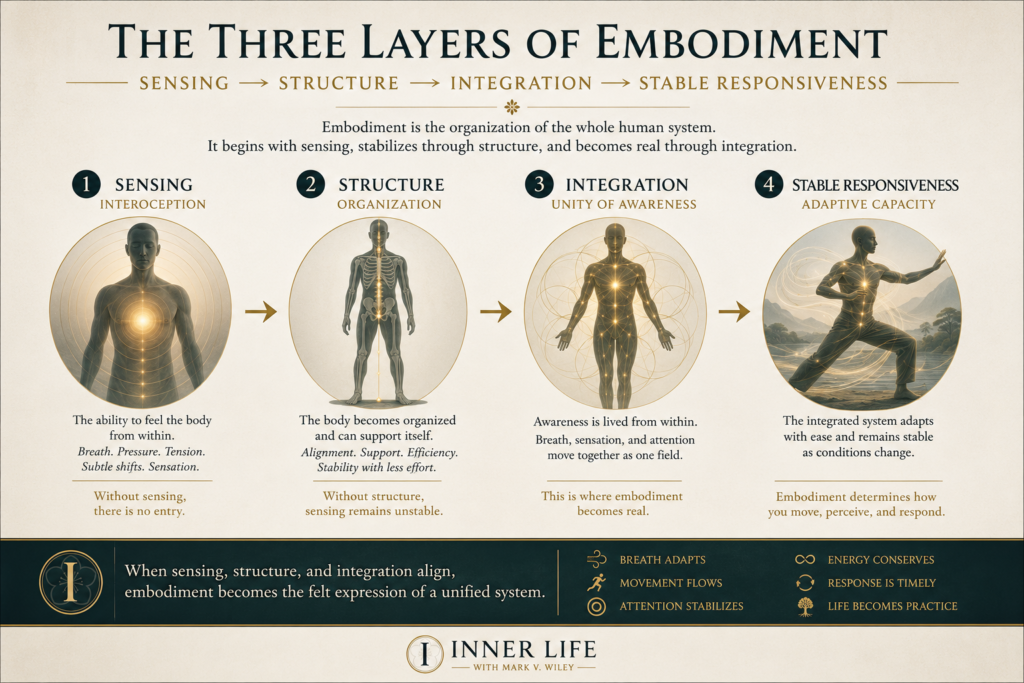
Embodiment develops progressively rather than appearing all at once. It unfolds through practice as the body, breath, attention, and perception become increasingly coordinated. This process can be understood as three interrelated layers that gradually transform awareness into a stable way of being.
The first layer is sensing, often called interoception—the capacity to perceive the body from within. As this capacity develops, breath becomes easier to notice, pressure beneath the feet becomes clearer, and areas of tension begin revealing themselves without conscious searching. Instead of merely thinking about the body, you begin directly experiencing it from the inside. Sensing is the doorway into embodiment because without it there is no relationship with your own living experience.
At the same time, sensing alone is not enough. Many practitioners become fascinated by sensations, believing that warmth, tingling, or energetic feelings are signs of deep development. While these experiences may accompany practice, they remain temporary unless the body has the capacity to organize around them. Feeling more does not necessarily mean functioning better.
The second layer is structure. Here, embodiment becomes less about perception alone and more about organization. Structure is not concerned with posture as appearance or achieving a particular aesthetic shape. It is concerned with function. The relationship between the feet and the ground, the position of the pelvis, spine, ribs, shoulders, and head all begin working together as one coordinated system. As this organization develops, breathing becomes freer, unnecessary muscular effort diminishes, stability increases, and movement requires less correction.
Whether in Tai Chi, Qigong, wrestling, ballet, Wing Chun Chi Sao, or countless other movement disciplines, structural organization is what allows awareness to remain stable under changing conditions. Without structure, the body cannot support what awareness begins to perceive.
“Structure allows the body to support awareness instead of constantly fighting against itself.” —Mark V. Wiley
The third layer is integration, and it is here that embodiment becomes a lived reality rather than an interesting concept. Awareness is no longer directed toward isolated body parts or individual sensations. Breath, movement, attention, and sensation begin functioning together as one continuous field of experience. The body is no longer perceived as disconnected regions requiring constant supervision. Instead, it is experienced as a unified living system.
At this point, presence no longer feels like something you are trying to achieve. It becomes the natural condition from which perception and action arise. Awareness is no longer something directed toward the body. It is lived from within it.
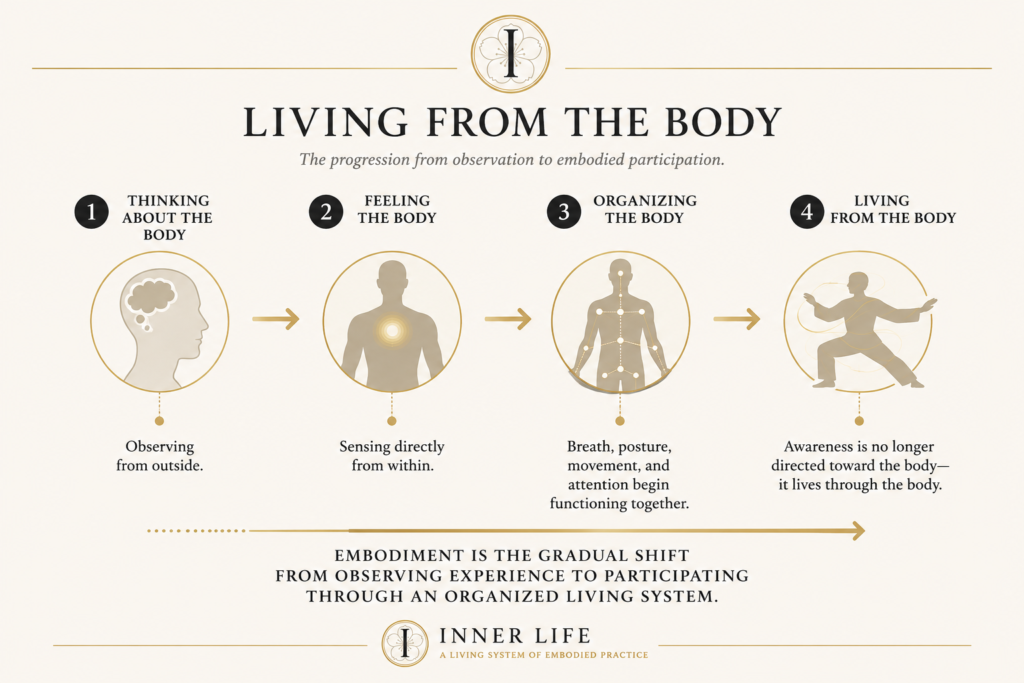
Embodiment develops through sensing, organization, and integration until awareness becomes a stable way of being.
Why Embodiment Matters
Embodiment matters because it fundamentally changes how we participate in life. As the body becomes increasingly integrated, movement adapts with less effort, breathing adjusts naturally to changing conditions, and attention remains steady even when circumstances become unpredictable. Instead of continually correcting yourself, the system begins responding intelligently on its own.
This is why embodiment occupies such a central place within Inner Life. It transforms temporary experiences into lasting capacities. Insight may inspire us for a moment, but embodiment allows those moments of clarity to become enduring traits that influence perception, behavior, and action long after the original experience has passed.
Practice Organizes the Human System
Many people assume practice exists simply to accumulate techniques or master increasingly complex methods. The deeper purpose is something far more profound. Practice gradually removes interference. It creates the conditions through which the body can reorganize itself from within rather than forcing change from the outside.
As breath, structure, and attention become increasingly coordinated, the system naturally develops greater coherence. Movement begins feeling continuous rather than segmented. Attention no longer fractures as easily. Breathing becomes quieter and more efficient. Stability begins remaining present even as conditions continually change.
These qualities cannot be memorized intellectually or understood through theory alone. They must emerge through direct experience.
“Embodiment is not imposed upon the body. It emerges as interference is reduced and coordination is restored.” —Mark V. Wiley
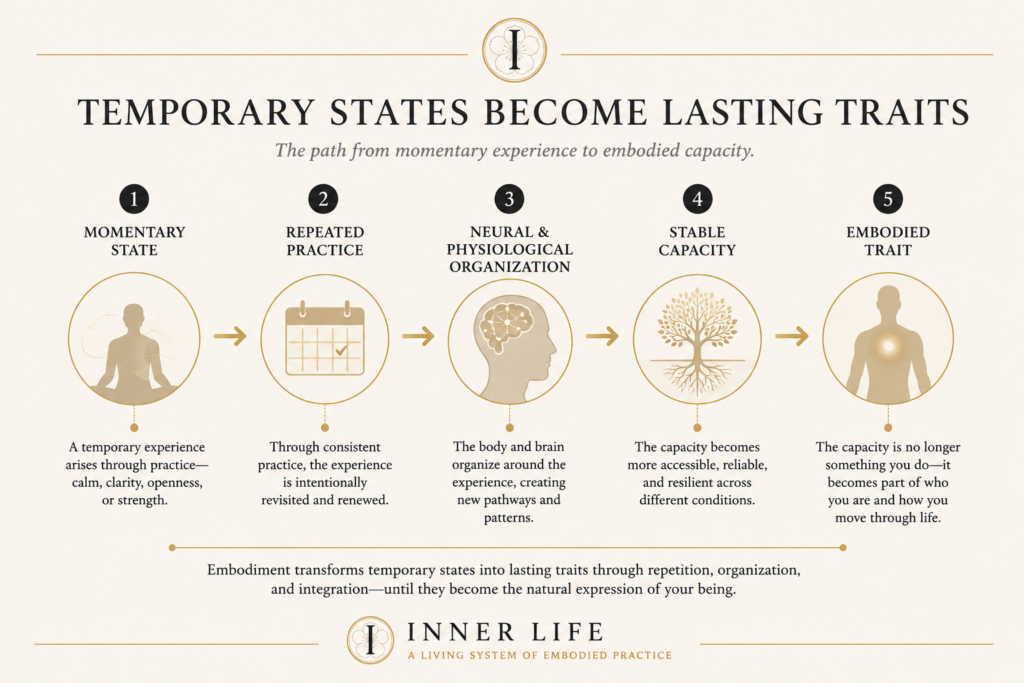
attention, and awareness into lasting patterns of perception and action.
From State to Trait
Everyone experiences moments of clarity, presence, or deep connection. The challenge is not having these experiences but learning how to stabilize them. Within Inner Life, this distinction is described as the movement from temporary states to lasting traits.
Without embodiment, profound experiences often fade as quickly as they arise. They remain isolated moments that inspire but do not fundamentally reorganize the person. As embodiment develops, however, these experiences begin reshaping how the entire system functions. Awareness becomes increasingly available during ordinary life rather than only during formal practice.
How you stand, how you move, how you breathe, how you perceive, and how you respond gradually become expressions of the same integrated process. Practice is no longer something reserved for a particular place or time. It becomes inseparable from daily living.
“Embodiment is the gradual organization of the human system until awareness, perception, breath, and movement function together as one organized living system.” —Mark V. Wiley
Embodiment Is How Inner Life Becomes Visible
Embodiment is not another technique to master, another philosophy to adopt, or another mystical state waiting somewhere in the future. It begins with sensing, stabilizes through structure, and becomes fully realized through integration. As these capacities mature together, practice ceases to be something you perform and becomes something you embody.
This is where Inner Life becomes visible. Transformation is no longer occasional or dependent upon special experiences. It becomes woven into how you move through the world, how you meet change, and how you remain present in every aspect of life.
“Embodiment begins with sensation, stabilizes through structure, and becomes real when awareness is lived continuously from within.” —Mark V. Wiley
Watch & Listen
Watch on YouTube or listen on your favorite podcast platform




Keep Exploring This Theme