
When a Symbol Becomes a Practice
The Difference Between Understanding a Teaching and Allowing It to Work Upon Us
by Mark V. Wiley
A symbol can remain with us for years without changing us. We can understand its history, explain its meaning, recognize its appearance, and even feel some affinity for what it represents. Yet none of this necessarily means that symbolic practice has entered deeply enough into our experience to alter how we perceive or participate in life.
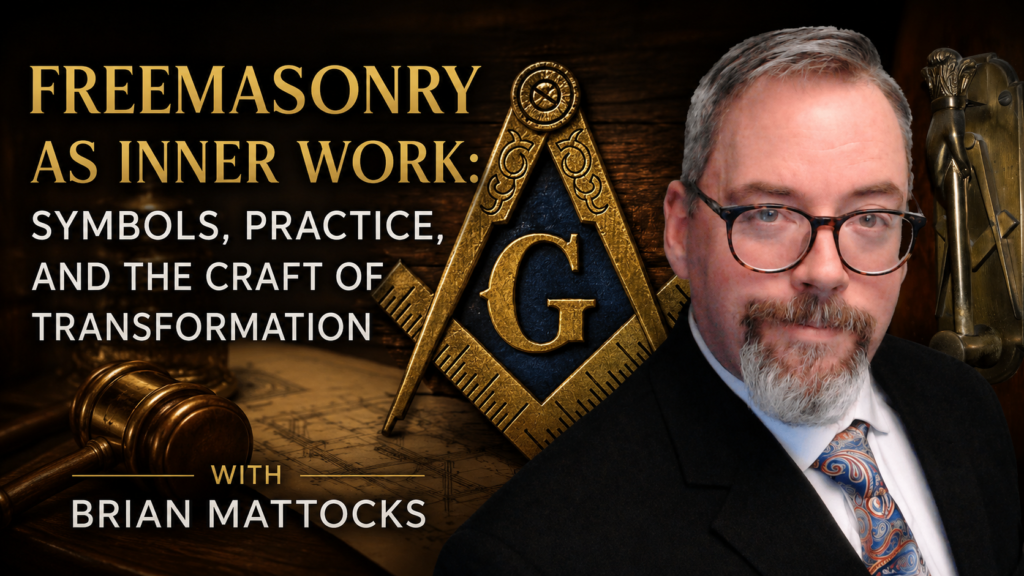
This distinction arose during my recent Integral Being conversation with Brian Mattocks about Freemasonry and the inner work hidden within its symbolic tools. What interested me was not Freemasonry as an institution, nor the mystery that has accumulated around it, but something much more fundamental:
What happens when a symbol stops being something we understand and becomes something we use?
That question extends far beyond Freemasonry. In fact, every serious tradition contains symbols, teachings, metaphors, rituals, movements, prayers, postures, and practices intended to orient the practitioner toward something that ordinary perception may overlook. But there is an enormous difference between encountering these things intellectually and allowing them to reorganize the way we live.
A teaching becomes transformative only when it begins changing the person receiving it. —Mark V. Wiley
The Tool and the Work
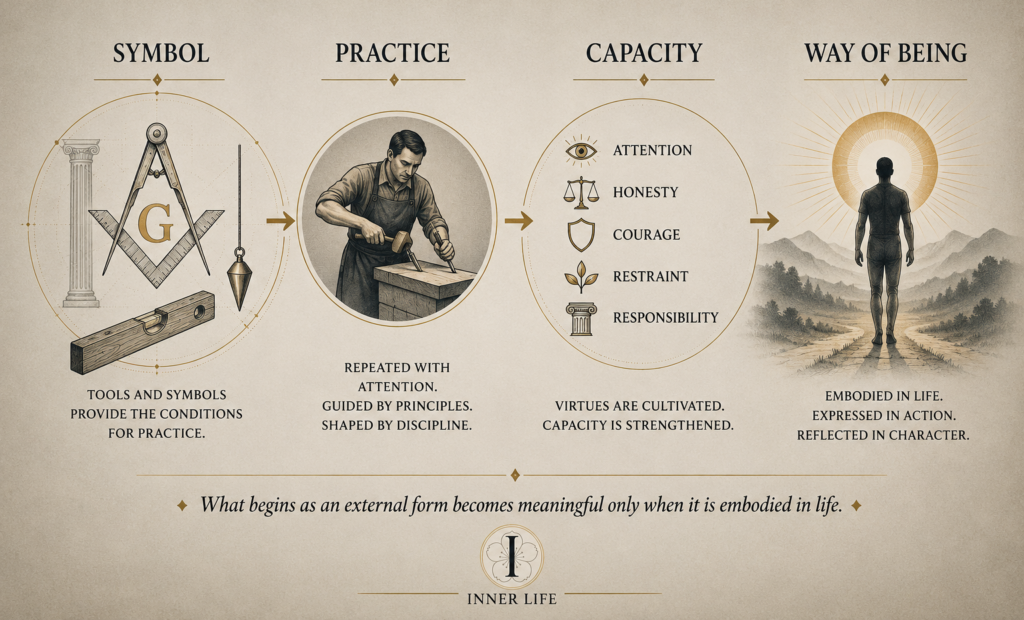
The symbolism of Freemasonry makes this distinction unusually clear because many of its symbols began as actual tools. A gavel is used to strike and shape material. A level establishes relationship and proportion. A plumb determines whether something stands truly upright. A compass establishes boundaries and defines a field.
These things have practical functions. They were not created merely to represent ideas.
When they become symbolic, however, their physical functions can be turned inward. The question is no longer only whether a stone is properly shaped, but whether there are aspects of our own behavior that require refinement. The level can become a way of considering proportion in our reactions. The plumb can become a question of whether we have discovered an inner orientation from which we can stand upright.
The physical tool becomes a psychological instrument. But even this does not go far enough. The symbol becomes truly useful only when it returns to life.
If I understand the symbolism of the level beautifully but continue allowing every minor inconvenience to consume my attention, then I understand the level without having learned to use it. If I speak eloquently about remaining upright while abandoning my principles whenever they become inconvenient, then the plumb remains an idea.
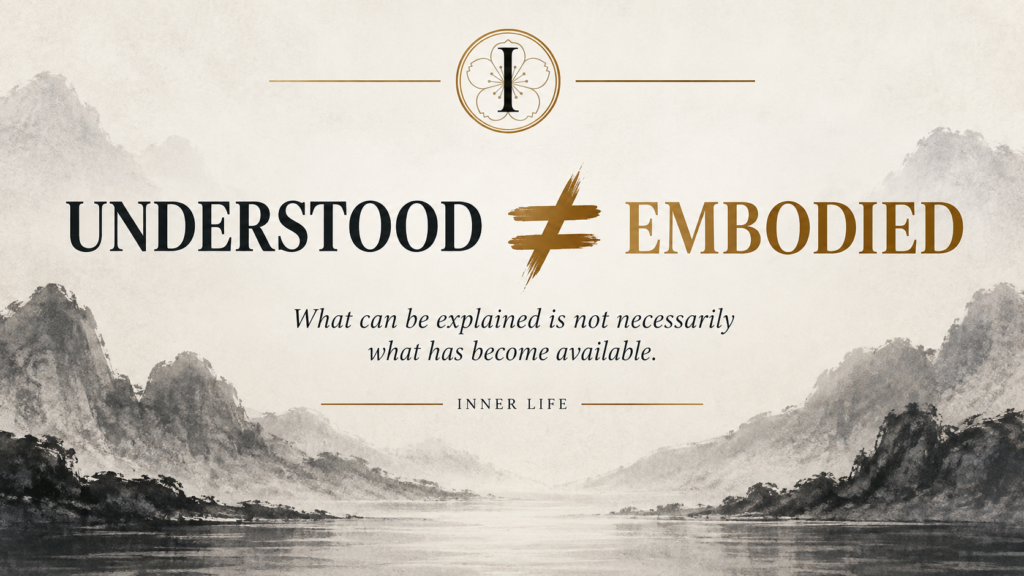
Knowing the meaning of the tool is not the same as doing the work.
When Knowledge Enters the Body
This points toward a broader understanding of embodiment.
We often associate embodiment with physical practices: posture, breathing, movement, sensation, balance, relaxation, structural organization, or coordination. These are certainly important dimensions of embodied practice, but embodiment does not end with the physical body. A teaching becomes embodied when it changes how we meet experience—not only what we think about it.
Perhaps something happens that would normally provoke an immediate reaction. Anger rises. The chest tightens. The body prepares to defend itself. A familiar argument begins forming in the mind. But this time we notice it. Something has changed. We have not necessarily eliminated anger, fear, defensiveness, or discomfort. Instead, awareness has entered the sequence early enough that reaction no longer automatically determines behavior.
There is now a small interval in which another response becomes possible. That interval may seem insignificant, but much of inner development occurs there.
Embodiment is revealed not by what we can explain, but by what becomes available to us in the moment of experience. —Mark V. Wiley
This is why knowledge alone rarely transforms us. Information can give us another idea. Practice gradually gives us another possibility.
The Knock Before the Story
One of the ideas Brian discussed that stayed with me was what he calls the knock. The knock is the first indication that something within us requires attention. It may appear as tension, anxiety, irritation, uneasiness, an impulse to flee, or a sudden contraction somewhere in the body. What makes this interesting is that the knock often arrives before the story.
The body registers something, and then the mind begins interpreting it. We decide why we are angry. We determine who is responsible. We remember previous offenses. We construct arguments. We justify our response. Within moments, a simple internal signal has become an elaborate psychological event.
But what if we learned to recognize the knock before becoming completely absorbed in the story that follows it? This is one of the capacities cultivated through many forms of practice.
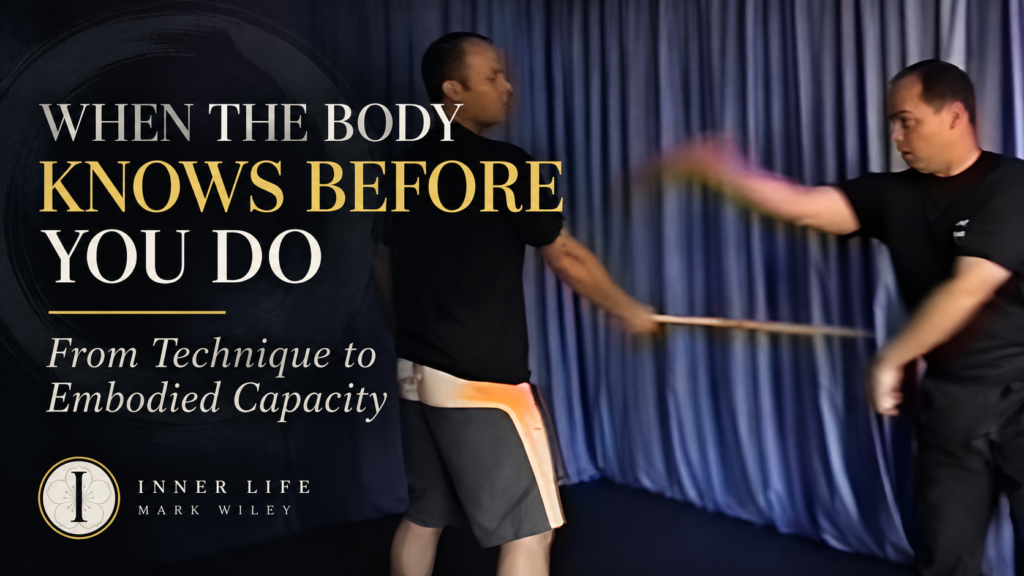
Meditation develops it through stillness and attention. Internal practices cultivate it through sensation and regulation. Martial training can reveal it through pressure and interaction. Prayer and contemplative disciplines may reveal it through watchfulness of thought, intention, and action.
The methods differ, but something similar is being cultivated: the ability to notice experience before habitual interpretation completely takes possession of it.
A Symbol Must Be Practiced
This brings us back to the difference between practicing and a practice.
Practicing is something we do for a period of time. We meditate for twenty minutes. We train for an hour. We attend a class. We perform a ritual. We read a teaching and contemplate its meaning. A practice begins to emerge when what is cultivated during those periods becomes increasingly available outside them.
- The meditation session ends, but awareness continues.
- The martial arts class ends, but the way we organize ourselves under pressure begins changing.
- The prayer ends, but remembrance continues to influence how we speak and act.
- The symbol leaves the lodge, temple, dojo, church, mosque, meditation hall, or book and accompanies us into ordinary life.
At that point we are no longer simply practicing something. We are beginning to live a practice.
Life Reveals Whether the Practice Is Working
This is also why ordinary life is such an uncompromising teacher. Within a controlled practice environment, it can be relatively easy to feel centered, attentive, compassionate, patient, or spiritually oriented. The conditions have been arranged to support those qualities.
Then someone insults us. A family member pushes exactly the right button. Someone cuts us off in traffic. A colleague dismisses our work. An unexpected expense appears. The body becomes tired. Plans collapse. Suddenly the quality of our practice becomes visible.
Not because a mature practitioner never becomes angry, frightened, impatient, or confused, but because practice gradually changes our relationship to those states.
- We notice sooner.
- We recover more quickly.
- We become less compelled to obey every internal impulse.
- We develop greater capacity to remain present while something difficult is occurring.
This is where transformation becomes measurable—not through what we claim to understand, but through the increasing range of responses available to us when life does not cooperate with our preferences.
Those Around Us Are Part of the Practice
Another important dimension of my conversation with Brian concerned community. Most traditions of transformation eventually recognize that solitary practice has limitations. We need other people because other people reveal us to ourselves. Someone who agrees with everything we say may make us comfortable. Someone who irritates us may reveal far more.
Our impatience appears. Our need for recognition becomes visible. Our desire to control the situation surfaces. We discover how attached we are to being correct, respected, included, admired, or understood.
The other person has become part of the practice field. This does not mean seeking conflict or remaining in unhealthy situations. It means recognizing that relationship provides forms of information unavailable in isolation. The friction of human interaction exposes the places where our understanding has not yet become integrated.
Community, at its best, therefore does more than provide companionship. It creates conditions in which our practice is continually tested against life.
Courage and Honesty
Near the end of our conversation, I asked Brian what genuine inner work ultimately requires from the individual. His answer was remarkably simple: courage and honesty.
The more I considered it, the more complete the answer seemed.
Honesty allows us to see what is actually present rather than what we would prefer to believe about ourselves. Courage allows us to remain with what we discover without immediately turning away, rationalizing it, blaming someone else, or covering it with another spiritual idea. Without honesty, we cannot see the material we are working with. Without courage, we cannot work with what we see.
These qualities are not uniquely Masonic. They are requirements of any serious path of transformation.
Allowing the Practice to Work Upon Us
Perhaps the deepest meaning of a tool is not that we possess it, but that we allow it to act upon us. We can accumulate practices just as easily as we accumulate books, credentials, techniques, initiations, and ideas. We can become extremely knowledgeable about transformation without allowing ourselves to be transformed.
- The more difficult movement is inward.
- What does this teaching reveal about me?
- What happens when I become uncomfortable?
- Where do I lose proportion?
- What causes me to abandon my center?
- What am I unwilling to see?
- And what would change if I stopped treating the teachings I encounter as things to understand and began using them as instruments through which to examine my life?
A gavel cannot shape stone if it remains hanging on the wall. Neither can a practice transform us if it remains something we merely know.
The measure of a practice is not how much of it we understand, but how deeply it has entered the way we live. —Mark V. Wiley
To learn more about the symbols and inner work of Freemasonry, A Mason’s Work by Brian Mattocks is a great resource.
Continue Exploring