Cultivation Without Seeking
with Deng Ming-Dao
Practice, Embodiment, Spontaneity, and the Taoist Path
Most of us begin a practice because we want something from it. We want greater strength, health, awareness, skill, peace, insight, or perhaps some experience we imagine will confirm that the years of effort have led somewhere. Even spiritual practice can quietly become another form of acquisition.
Deng Ming-Dao began his formal training in Taoism and martial arts more than five decades ago. Looking back, he says one of his earliest misunderstandings was believing that cultivation would give him an advantage—that it would make him stronger, more powerful, and ultimately better able to impose himself upon the world.
What he describes now is almost the reverse. The longer he has practiced, the less cultivation seems to be about becoming someone and the more it has become about allowing unnecessary things to fall away.
“I practice every day, but I practice for its own sake. I’m not trying to get somewhere. I am trying to be there in my practice.” —Deng Ming-Dao
When the Goal Begins to Distort the Practice
There is a paradox at the heart of Taoist cultivation. We may need a reason to begin, but eventually our attachment to that reason can interfere with the very development we are seeking.
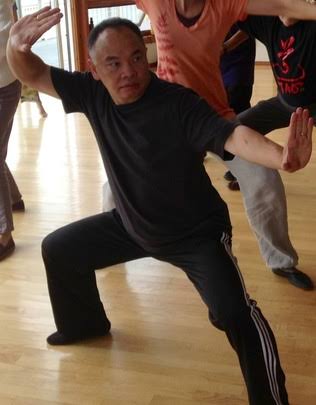
Deng describes beginning martial arts with a strong desire to become powerful and dominant. There is nothing unusual about this. Much of life trains us to think in precisely these terms. We study to earn credentials. We work to earn money. We train to become stronger. We pursue methods because we expect results. The activity becomes valuable because of what we believe it will eventually give us.
But Deng came to recognize that approaching cultivation this way changes the practitioner. The desire for the result begins organizing the practice itself. Instead of being fully involved in what we are doing, part of us is continually measuring where it might lead.
This does not mean abandoning standards or effort. Deng still speaks about trying to perform every movement as well as he can. What has changed is the relationship between effort and identity. Being “the best” is no longer a destination somewhere ahead of him or a comparison with someone else. The practice itself becomes the place where attention, effort, and participation meet.
That distinction matters for Inner Life. A practice may begin by asking, What can this give me? Mature practice gradually introduces another question: What happens when I participate fully without continually demanding that the experience become something else?
Cultivation May Be More About Removing Than Adding
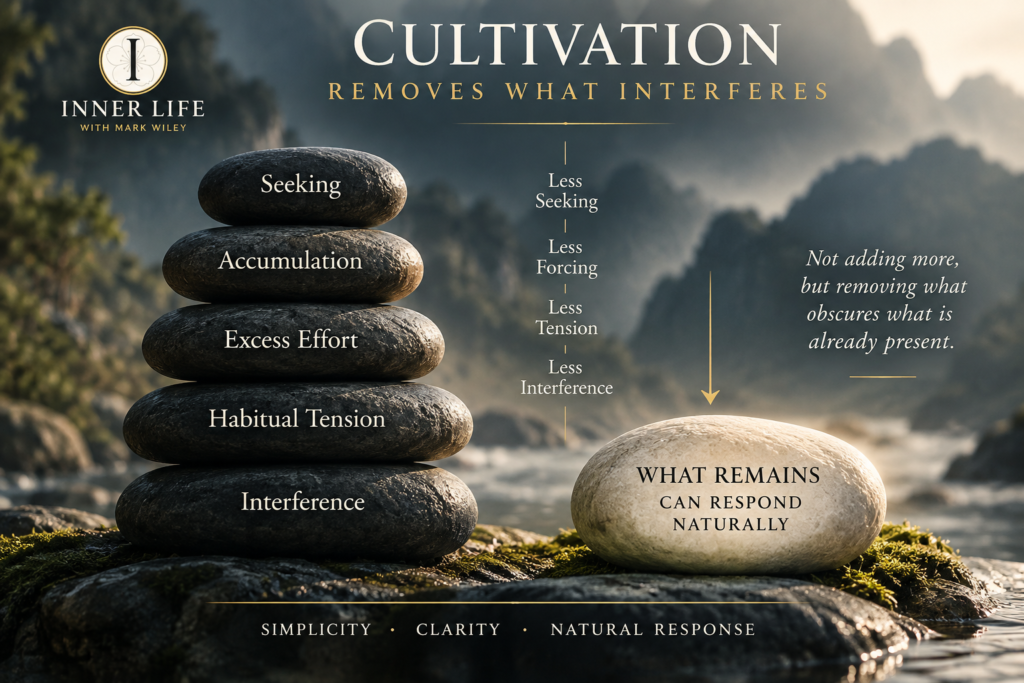
One of the most important ideas in this conversation is Deng’s description of cultivation as removal.
We often imagine development as accumulation. We acquire techniques, knowledge, experiences, initiations, forms, exercises, philosophies, and increasingly sophisticated explanations. Yet Taoist cultivation can point in the opposite direction.
Deng uses the image of water flowing toward a field. The practitioner does not manufacture the water. If a barrier prevents the water from entering, the work is to remove the obstruction so that what is already available can flow.
The same principle appears when he discusses musical improvisation. A musician practices scales for years not simply to accumulate more scales, but until technical limitations no longer interfere with the music. Skill becomes sufficiently embodied that conscious effort no longer needs to control every movement.
“We don’t need to make the water. We can’t do anything to make the water…. Our practice is about identifying why the water isn’t coming in.” —Deng Ming-Dao
This gives us a different way of understanding embodiment. Embodiment is not merely the acquisition of an ability. It can also involve the gradual removal of whatever prevents an existing capacity from expressing itself freely: unnecessary tension, hesitation, distraction, self-consciousness, excessive thought, fear, or the need to control what happens next.
Eventually, the practitioner does less to make the appropriate response occur because less stands between perception and response.
Outer Stillness, Inner Movement
Deng offers a particularly useful way of understanding the relationship between meditation and martial arts.
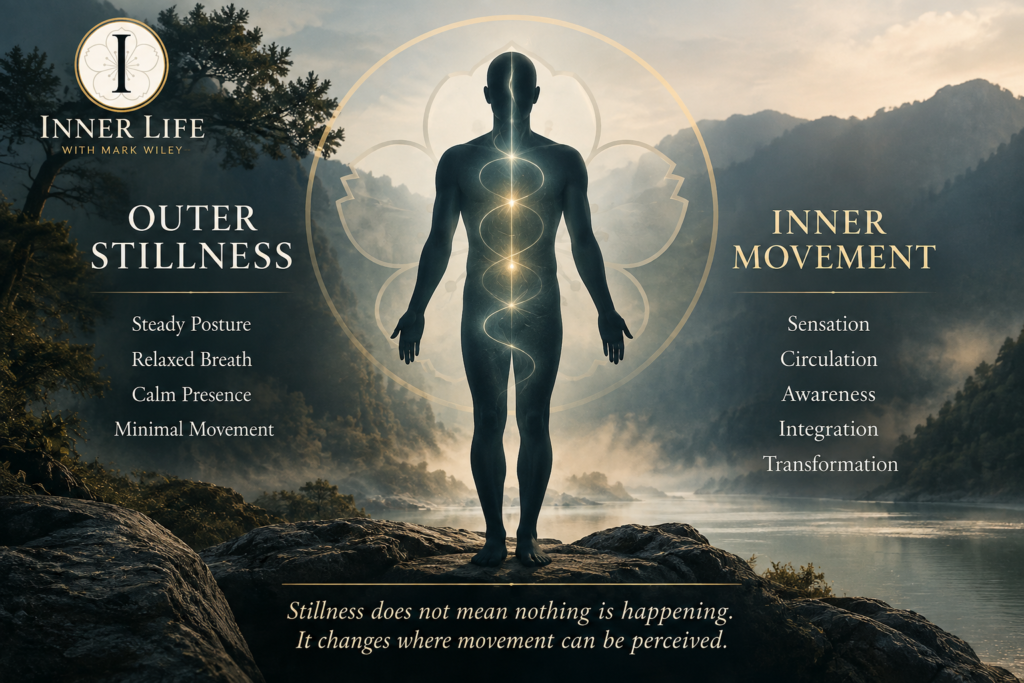
Meditation is often described as stillness. Yet he points out that complete stillness would contradict a basic Taoist understanding of reality as movement and change. The body may become outwardly quiet during meditation, but breathing continues. Circulation continues. Sensation continues. Awareness moves. Internal processes become increasingly perceptible precisely because gross external movement has diminished.
- Meditation can therefore be understood as outer stillness with inner movement.
- Martial arts present the inverse possibility: outer movement with inner stillness.
The body turns, steps, strikes, receives force, changes direction, and responds to another person, while internally the experienced practitioner becomes less agitated rather than more. Deng compares this with watching a veteran fighter facing someone inexperienced. The novice may be moving intensely both outside and inside. The veteran can remain remarkably calm while the body responds.
“We have to be utterly still inside while everything outside is moving.” —Deng Ming-Dao
Seen this way, meditation and martial arts are not opposing forms of practice. Each provides a different condition through which the relationship between movement, awareness, and internal organization can be cultivated.
For Inner Life, this is where practice becomes especially interesting. The question is no longer whether we can remain peaceful while sitting in a quiet room. It becomes whether something of that inner stability remains available while life itself is moving.
The Basics Are the Secret
Long-term practitioners frequently become attracted to advanced practices. More elaborate methods can feel as though they represent deeper development. Complexity is easily mistaken for refinement.
Deng is remarkably direct about this. After more than five decades, he remains preoccupied with fundamentals. He describes arriving early to martial arts class and repeatedly performing basic movements while others socialize. He is not doing this because he has failed to progress beyond them. He does it because he increasingly understands what the fundamentals contain.
A stance can always become more organized. A turn can become more integrated. A kick can reveal unnecessary tension. A movement practiced for decades can suddenly disclose something that had previously gone unnoticed.
This is an important distinction between complexity and depth. Advanced practice does not necessarily mean performing increasingly complicated things. It may mean perceiving increasingly subtle relationships within apparently simple things.
“I don’t want to know your fancy techniques. Show me the basics, because the basics are the secret.” —Deng Ming-Dao
The beginner may perform a movement primarily by remembering its external shape. The experienced practitioner can begin sensing alignment, timing, breath, intention, weight, continuity, internal movement, and the relationship of the whole body within the same gesture. The movement has not necessarily become more complicated. The practitioner has become capable of entering it more deeply.
When Practice Makes Spontaneity Possible
Spontaneity can sound like the absence of discipline. Deng suggests almost the opposite.
During the conversation, we discuss jazz musicians who spend countless hours practicing scales, chords, timing, and technical fundamentals. Those musicians are not practicing because they intend to consciously assemble those elements while improvising. They practice so thoroughly that technique eventually stops obstructing expression.
The same principle applies to embodied practice. At first, we must remember where the foot goes, how the hand turns, when to breathe, where the weight shifts, or what comes next. Attention is occupied with managing the mechanics. Through repetition, those relationships gradually become less dependent upon conscious recall.
Eventually, the practitioner may respond without first deciding how to respond. Deng’s point is subtle: practice does not manufacture spontaneity. Practice removes some of the barriers preventing spontaneity.
This is why repetition alone is not necessarily embodiment. Repetition creates the conditions through which something can become embodied, but only when attention, correction, experience, and continued participation are present. The goal is not simply to perform the same movement thousands of times. It is to become less of an obstacle to what the movement is capable of teaching.
Finding the Same Thing Through Different Practices
Deng has spent decades with martial arts, meditation, painting, calligraphy, writing, and other disciplines. I asked whether the internal experience produced by these different activities ultimately feels different. His answer was immediate.
“No, it’s the same. Same—and that’s the only reason to do this.” —Deng Ming-Dao
This leads the conversation toward one of the deeper purposes of cultivation: discovering unity within apparent difference.
Hard and soft. Movement and stillness. Martial arts and meditation. Painting and writing. Conflict and peace. Each appears to be a separate activity when viewed from the outside. But what is being cultivated through them? Attention. Integration. participation. Discipline. Sensitivity. The capacity to bring mind, body, intention, and action into relationship.

For Deng, this inquiry ultimately opens into the Taoist question of oneness. The ten thousand things remain ten thousand things, yet they arise within something that cannot finally be divided. The practical expression of this is not philosophical abstraction. It is integration.
Can the different parts of ourselves participate without continually working against one another? Can what we discover while meditating remain present when we stand up? Can what martial practice teaches about stability, timing, attention, and responsiveness become available outside the training hall?
A practice becomes embodied when its organizing principles are no longer confined to the practice.
What Falls Away After Decades of Practice
When I ask Deng what he has let go of, his answer extends beyond attachment to outcomes.
He has stopped practicing certain forms. He has become less impressed by famous masters and elaborate systems. He questions whether everything transmitted through traditional martial arts remains complete simply because it is traditional. He has become willing to examine what may have been lost as cultural circumstances changed.
This is another form of refinement.
Early in a path, development often requires addition. We need instruction, methods, repetitions, distinctions, teachers, and experiences because we do not yet possess enough material to discern what matters. Later, development may require subtraction.
Some methods have served their purpose. Some assumptions no longer withstand experience. Some things we once considered essential reveal themselves as scaffolding. Even our image of what an accomplished practitioner should look like may need to disappear.
What remains is not necessarily a more impressive practice. It may be a more honest one.
From Cultivation to the Way We Live
Near the end of our conversation, Deng brings Taoist cultivation back to something much more ordinary than mystical attainment.
He discusses Dao De, commonly encountered through the title Dao De Jing, and emphasizes virtue as the support of life. If Tao, heaven, and earth support life without continually dividing the world according to personal preference, then human virtue must eventually become visible in how we participate in the lives around us.
Do we support life through our actions? Do we attend to the people immediately before us? Do our choices contribute to unnecessary conflict, or reduce it? Does what we call spiritual practice make us more capable of participating wisely in ordinary circumstances?
These questions move cultivation beyond technique. The ultimate evidence of practice cannot only be what happens while practicing. It must eventually become visible in how a person lives.
And perhaps that is why Deng’s final teaching in this conversation is so simple. Great development does not require us to imagine one enormous leap toward realization. Large things are assembled from small things. One stance. One breath. One movement. One act. One day followed by another.
No dramatic declaration is required. “One step, one step, one step. That’s the only secret.” And then Deng offers what may be the simplest summary of more than half a century of cultivation:
“I only have one superpower: I don’t give up.” —Deng Ming-Dao
About the Guest
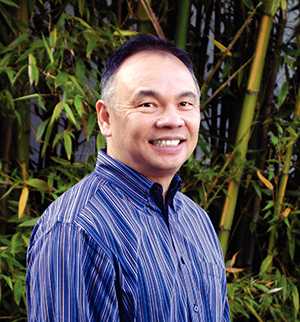
Deng Ming-Dao is an author, artist, philosopher, teacher, and martial artist whose work explores Taoism as a living path of cultivation and daily practice. From a young age, he studied Taoism and the internal arts, including qigong, tai chi, and kung fu, and over the decades his inquiry has extended through meditation, calligraphy, painting, poetry, Chinese philosophy, and other traditional arts. Since 1983, he has been known internationally for his writing on the Tao and its expression in contemporary life.
He is the author of numerous books, including 365 Tao, Everyday Tao, Scholar Warrior, Chronicles of Tao, The Living I Ching, The Way of Heart and Beauty, and Each Journey Begins with a Single Step. His books have been translated into fifteen languages. His newest book, Taming Tigers and Butterfly Dreams: 144 Taoist Fables, was published in 2026, continuing his exploration of how traditional Taoist wisdom can illuminate the circumstances of modern life
Continue Exploring