Spiritual Transformation from Conception to Perception
Ravi Ravindra on Consciousness, Self-Study, and Direct Experience
by Mark V. Wiley
Before there is meditation… Before there is religion… Before there is philosophy… There is a question for those seeking spiritual transformation:
What am I?
For those seeking genuine spiritual transformation, it may be the most important question we ever ask.
Most spiritual seekers begin with the assumption that they are searching for something. They seek peace, wisdom, awakening, healing, truth, God, or some deeper understanding of life. Books are purchased, retreats are attended, teachers are sought, and practices are adopted. The entire spiritual journey appears to be a movement toward something that is absent—something we hope to discover through enough effort, discipline, or insight.
Yet during his Integral Being conversation, philosopher, physicist, and contemplative scholar Dr. Ravi Ravindra quietly overturns this familiar assumption with a single observation he learned from one of his teachers.
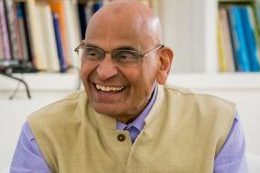
“People imagine they are searching for God. It is the other way around. God is searching for them. But I am running away.” —Dr. Ravi Ravindra
It is a startling reversal. Perhaps the deepest realities are not hidden from us at all. Perhaps what must change is not reality itself, but our capacity to receive it. In that single insight, the entire meaning of spiritual practice shifts. Instead of becoming a search for something we lack, practice becomes the gradual cultivation of receptivity—a movement we explore throughout the Inner Life framework.
The Question Beneath Every Spiritual Path
Long before Ravi Ravindra became an internationally respected scholar of comparative religion, physics, yoga, Gurdjieff, and Christian mysticism, another question had already taken hold of his life. As a young boy growing up in India, he found himself asking a series of deep questions that most people rarely consider.
Why was I born here? Why these parents? Why this country? Why this body? Why am I here at all?
His friends heard these questions so often that they eventually gave him a nickname based upon them. What appeared to others as youthful curiosity was, for Ravi, the beginning of a lifelong spiritual inquiry.
That inquiry eventually matured into what he calls the seed question of authentic spiritual life. Not, “Who am I?” but, “What am I?” The distinction may seem subtle, yet it fundamentally changes the direction of the search. Asking who we are often leads us toward biography—our profession, personality, relationships, beliefs, culture, or life story. Asking what we are points beyond these changing identities toward the deeper mystery of existence itself.
None of us created ourselves. None of us selected the family into which we were born, the culture that shaped us, the body we inhabit, or the particular strengths and limitations through which our lives unfold. We arrived in a world we did not make, participating in forces we scarcely understand. For Ravindra, recognizing this is not an exercise in abstract philosophy. It is the beginning of genuine humility.
Not moral humility, born of self-deprecation or modesty, but ontological humility—the recognition that life is already infinitely larger, more intelligent, and more mysterious than the small self through which we ordinarily interpret it. It is from this humility that authentic spiritual inquiry begins, opening the possibility that transformation is less about becoming someone new than awakening to what has always been present.
From Self-Improvement to Transformation
Modern culture is deeply invested in improvement. We are encouraged to become more productive, healthier, wealthier, happier, and more successful. Even spirituality is often presented through the same lens. We meditate to reduce stress, practice mindfulness to improve performance, and study wisdom traditions in hopes of becoming better, more capable versions of ourselves. Spiritual practice can easily become another strategy for personal optimization.
Ravi Ravindra gently challenges this entire orientation with a distinction that lies at the heart of every authentic contemplative tradition.
“The purpose of spiritual discipline is not self-improvement but transformation.” —Dr. Ravi Ravindra
These are not the same thing. Self-improvement seeks to refine the personality we already identify as ourselves. Transformation asks a far more radical question: Can the very structure through which we perceive and experience reality change? This is the difference between self-improvement and what we call embodiment—where understanding gradually becomes lived experience. Improvement strengthens the person we believe ourselves to be. Transformation gradually loosens our identification with that person, allowing a deeper dimension of being to emerge.
This distinction echoes throughout the world’s great wisdom traditions. The Buddha did not simply teach people to think more clearly. Christ did not invite humanity to become slightly kinder versions of themselves. The Sufi path is not merely emotional refinement, nor does yoga promise greater efficiency or productivity. Each points toward a fundamental reorganization of human perception—a shift in the way we participate in life itself. The goal is not merely becoming better. It is becoming different.
Wandering Gathers Honey
One of the most refreshing aspects of Ravi Ravindra’s work is his refusal to become confined within the boundaries of a single tradition. As a young man, he encountered an ancient Sanskrit saying that remained with him throughout his life: “Wandering one gathers honey.” Over the years he came to understand that this wandering was not simply geographical. It was an inner disposition—a willingness to remain open to truth wherever it revealed itself.
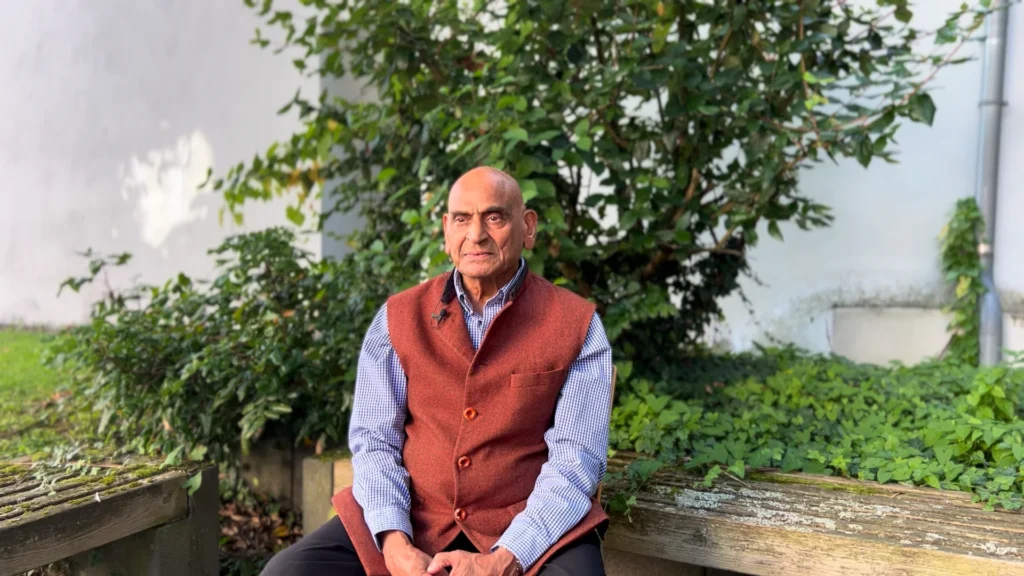
For Ravindra, every authentic spiritual tradition offers a different language for describing the same living mystery. The Buddha spoke to people shaped by the religious culture of India. Christ taught within the world of first-century Judaism. Taoism emerged from China, while Sufism flowered within Islam. Their symbols, practices, and metaphors differ, yet each points beyond itself toward realities that transcend culture and history.
This openness has become one of the defining characteristics of Ravindra’s own work. Rather than asking which tradition is correct, he asks what each tradition reveals about the human journey. He has often remarked that if Christ and the Buddha were to meet, they would almost certainly embrace one another with love. It is more often their followers who create divisions, mistaking the finger pointing toward truth for truth itself.
For genuine seekers, every authentic tradition becomes another window through which reality may be perceived. The invitation is not to abandon one’s own path, but to remain humble enough to recognize wisdom wherever it appears. As the old Sanskrit saying suggests, those willing to wander with sincerity gather honey from many flowers, discovering that truth has never belonged to a single culture, religion, or civilization.
From Conception to Perception
Perhaps the central movement running throughout Ravi Ravindra’s entire conversation can be summarized in four words: from conception to perception. It is a movement that lies at the heart of every authentic contemplative tradition and one that fundamentally changes the purpose of spiritual practice.
Ideas matter. Concepts matter. Scriptures matter. Philosophy matters. They provide language, orientation, and guidance for the journey. Yet none of them are reality itself. As the familiar saying reminds us, the menu is not the meal, and the map is not the territory. Concepts can point toward truth, but they can never replace direct experience of it.
his is why the world’s great mystics continually returned to silence, prayer, meditation, contemplation, and embodied practice. Within Inner Life, these same capacities are cultivated through the Six Foundational Practices. Not because thinking is wrong, but because thinking eventually reaches its limits. The Buddha struggled to describe Nirvana. Christ spoke of the Kingdom of Heaven through parables and metaphor. Mystics across traditions turned to poetry, symbol, and paradox because ordinary language could not fully contain what they had encountered. Reality, Ravindra reminds us, is always larger than thought. Spiritual maturity begins when we stop confusing our ideas about life with life itself.
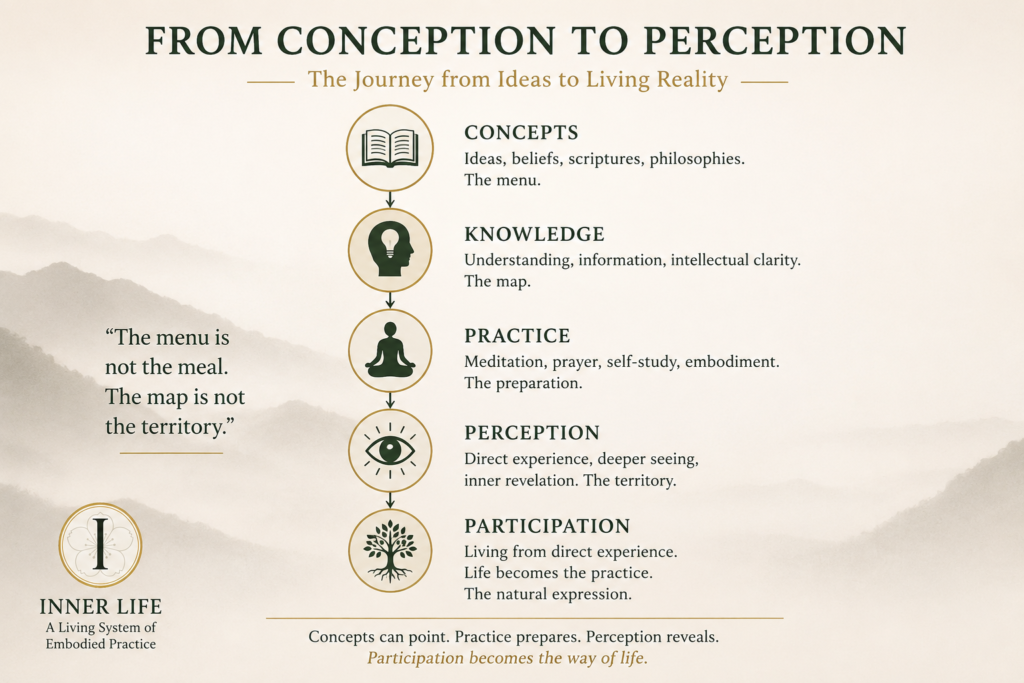
participation, and embodied transformation.
Attention, Awareness, and Consciousness
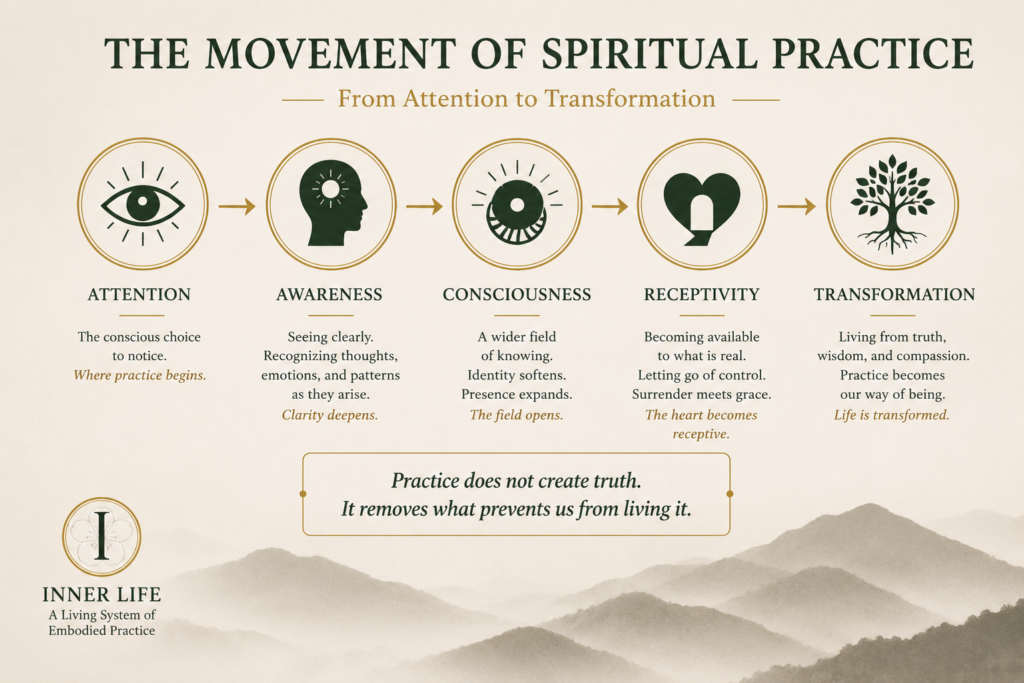
One of the most illuminating moments in the conversation comes when Ravi Ravindra carefully distinguishes between three words that are often used interchangeably: attention, awareness, and consciousness. Although they appear similar, he suggests they describe progressively deeper ways of relating to reality. This relationship between attention, awareness, and consciousness is explored further in the Inner Life Model.
Attention is active. We direct it, focus it, and intentionally place it where we choose. It feels personal, as though it belongs to us. Awareness introduces a different quality altogether. Rather than directing experience, awareness begins receiving it. It is more receptive than assertive, more open than controlling. Instead of attempting to shape reality, awareness learns to be present with it.
Consciousness moves still deeper. Rather than something we possess or produce, consciousness becomes something in which we participate. It is less an achievement of the individual mind than a field of reality into which we gradually awaken. This subtle distinction transforms the meaning of spiritual practice. The path becomes less about controlling experience and more about becoming available to it; less about acquiring extraordinary states than cultivating the receptivity through which deeper perception naturally emerges.
The implications are profound. Spiritual development gradually shifts from control toward participation, from assertion toward receptivity, from accumulation toward openness. We stop trying to manufacture awakening and instead learn to create the inner conditions in which awakening can reveal itself. In Ravindra’s vision, the deepest work is not learning how to grasp reality more firmly, but learning how to receive what has always been present.
The Mind Is a Wonderful Servant
Modern spirituality sometimes portrays the mind as the enemy, as though thinking itself were an obstacle to awakening. Ravi Ravindra offers a far more balanced perspective. The mind is one of humanity’s greatest gifts. Science, medicine, engineering, art, language, and civilization itself all arise through its remarkable capacities. The problem is not the mind. The problem is expecting the mind to comprehend every dimension of reality.
The mind naturally seeks certainty. It categorizes, measures, defines, compares, and predicts. These are precisely the qualities that make it indispensable for navigating the practical world. Yet the deepest dimensions of existence consistently resist being reduced to concepts. Mystery refuses to be measured. Love cannot be fully analyzed. Grace cannot be predicted. The sacred continually exceeds the categories through which the intellect attempts to contain it.
For this reason, contemplative traditions across the world consistently emphasize stillness, silence, prayer, meditation, and contemplation. Their purpose is not to reject the intellect but to place it within a larger field of knowing. The mind remains an extraordinary servant, but it is no longer expected to occupy the highest seat. It learns to participate in something greater than itself.
The Spanish mystic St. John of the Cross expressed this paradox beautifully:
“I came to knowledge by unknowing.” —St. John of the Cross
Knowledge remains essential. Study matters. Reflection matters. Inquiry matters. Yet freedom from attachment to what we think we already know creates space for genuine discovery. As Ravindra reminds us throughout the conversation, spiritual maturity requires not ignorance but humility—a willingness to remain open to realities that continually surpass our understanding.
Astonishment Is a Spiritual Practice
One of Ravi Ravindra’s simplest observations may also be among his most profound.
“When you discover something, you will be astonished.” —Dr. Ravi Ravindra
Real discovery always carries an element of surprise. If we already know exactly what we expect to find, we are usually encountering only our own assumptions reflected back to us. The sacred cannot be manufactured, predicted, or controlled because it is always larger than our expectations. It continually exceeds our concepts and invites us beyond the boundaries of what we thought possible.
This is why the contemplative path requires openness more than certainty. Spiritual practice gradually exchanges conclusions for curiosity, control for receptivity, and explanation for participation. Rather than approaching life armed with ready-made answers, the practitioner learns to meet each moment with fresh eyes. Wonder ceases to be a fleeting emotion and becomes a disciplined way of inhabiting reality. To remain capable of astonishment is, perhaps, one of the clearest signs that the heart has remained alive.
The Courage of Self-Study
If one theme appears more consistently than any other throughout Ravi Ravindra’s work, it is the necessity of self-study. Every authentic contemplative tradition eventually arrives at the same place, even if it uses different language. Self-observation, self-knowledge, mindfulness, self-remembering, and the examination of conscience all point toward the same essential practice: learning to see ourselves honestly. That capacity begins with simple observation, which is exactly what Practice One: Returning to the Soma is designed to cultivate.
Transformation does not begin by analyzing our neighbors, correcting society, or criticizing the world around us. It begins by turning attention inward and asking difficult questions. What do I fear? What continually offends me? What do I seek approval for? What do I defend? What calls me? What interferes? What truly stands in my way? These questions gradually reveal the architecture of the ego—not so that it may be condemned, but so that it may finally be understood.
This work is rarely comfortable. Honest self-observation exposes contradictions we would rather avoid. We discover compassion existing alongside selfishness, courage beside fear, humility beside pride, generosity beside the desire for recognition. Spiritual maturity is not pretending these contradictions do not exist; it is becoming willing to encounter them without turning away.
To illustrate this necessity, Ravindra quotes the great Sufi poet Rumi with characteristic directness:
“If you have not yet seen the devil, go look in the mirror.” —Rumi
The statement is intentionally unsettling. Its purpose is not to produce guilt or self-condemnation, but honesty. Ravindra reminds us that every human being contains conflicting possibilities. The same person who is capable of great kindness is also capable of fear, ambition, vanity, and self-deception. To acknowledge this is not pessimism. It is the beginning of wisdom.
Authentic spirituality never begins with the assumption that we are already awake. It begins with the courage to see ourselves as we are. Only then can the gradual work of transformation truly begin.
Ego Is a Good Servant
Contemporary spiritual culture often speaks about eliminating the ego, as though the self itself were the obstacle to awakening. Ravi Ravindra offers a far more nuanced understanding. The ego is not the enemy. Like the mind, it has an important role to play in human life. Without a healthy sense of self, we could not work, raise families, create, serve, love, make decisions, or fulfill our responsibilities in the world.
As one of Ravindra’s teachers reminded him:
“Ego is a good servant but a bad master.” —Dr. Ravi Ravindra
The problem arises only when the ego occupies a position it was never meant to hold. When status replaces service, achievement becomes more important than meaning, recognition outweighs truth, and personal importance overshadows humility, the servant quietly assumes the throne. Life gradually becomes organized around protecting and expanding the self rather than participating in something greater than ourselves.
The goal of spiritual practice, therefore, is not the destruction of the ego but its proper ordering. The self remains present, yet it learns to serve rather than dominate. Like the mind, the ego is not rejected but integrated into a larger vision of life. As it gradually finds its rightful place, compassion begins to replace self-importance, service becomes more natural than recognition, and the individual discovers that genuine freedom comes not from exalting the self, but from no longer being governed by it.
Religion Organizes Belief. Practice Changes Perception.
Running quietly beneath the entire conversation is an important distinction between religion and spirituality. Ravi Ravindra speaks with deep respect for the world’s religious traditions, yet he continually reminds us that preserving a tradition is not the same as embodying it. Religions preserve teachings, communities, languages, rituals, symbols, and history. They provide continuity across generations and offer invaluable maps for those beginning the journey.
Yet maps alone do not transform the traveler.
One may memorize scripture without becoming more compassionate. One may defend doctrine with great conviction while never encountering the silence from which those teachings originally emerged. It is possible to debate theology for decades without once observing the movements of one’s own mind or recognizing the subtle ways the ego shapes perception. Information, however valuable, is not the same as transformation.
This is why every authentic wisdom tradition ultimately returns to practice. Meditation, prayer, contemplation, embodied awareness, conscious breathing, and self-study are not merely religious activities or intellectual exercises. They are disciplines designed to refine perception itself. They gradually quiet the habitual movements of the mind, soften the grip of the ego, and cultivate the receptivity through which deeper understanding becomes possible.
In this light, the purpose of spiritual practice is not simply to accumulate more beliefs or acquire greater knowledge. It is to learn to see differently. As perception changes, our relationship with ourselves, with others, and with reality itself begins to change as well. What starts as an effort to understand the teachings gradually becomes the lived experience to which the teachings have always pointed.
Becoming Available
Perhaps the deepest insight emerging from Ravi Ravindra’s conversation is also the simplest. Reality is not absent. Truth is not hiding. The sacred is not withholding itself from sincere seekers. What is often missing is not the presence of the divine, but our readiness to receive it. We spend much of our lives looking outward for what the contemplative traditions insist has always been quietly present, waiting for our attention.
This understanding transforms the purpose of spiritual practice. Practice is no longer an attempt to manufacture enlightenment or accumulate extraordinary experiences. Instead, it becomes a gradual process of preparation. Through breath, awareness, stillness, self-study, prayer, contemplation, and embodied presence, we slowly cultivate the receptivity that allows a deeper participation in reality. These disciplines do not create truth. They prepare us to recognize it.
Over time, something almost imperceptible begins to change. The practitioner becomes less concerned with dramatic spiritual experiences and more attentive to the quality of ordinary moments. The search for peak experiences gradually gives way to a quieter capacity for presence. Life itself begins to feel different—not because the world has changed, but because the one experiencing it has changed. The ordinary reveals depths that once went unnoticed.
Perhaps this is why Ravi’s opening observation continues to echo long after the conversation has ended.
“People imagine they are searching for God. It is the other way around. God is searching for them. But I am running away.” —Dr. Ravi Ravindra
If that is true, then the spiritual journey is not primarily about finding what has been missing. It is about becoming available to what has always been present. It is about growing quiet enough, still enough, humble enough, and honest enough to stop running. In the end, perhaps awakening is not the discovery of a distant reality, but the recognition that the One we have been seeking has been patiently seeking us all along.
Watch the Full Conversation With Dr. Ravi Ravindra Below
Or Watch & Listen
on your favorite podcast platform




Continue Exploring This Theme