When the Body Knows Before You Do:
Martial Arts Training Beyond Technique
What an unexpected sword strike in a Tokyo dojo taught me about how martial arts training becomes embodied skill
by Mark V. Wiley
In 1995, I was living in Tokyo and working as the martial arts editor for Tuttle Publishing, the oldest publisher of books on the East for readers in the West. It was an unusual position for someone still in his min-twenties. My work brought me into contact with accomplished martial artists, researchers, translators, and teachers, while giving me opportunities to encounter traditions very different from my own martial arts training.
By that time, I was already deeply immersed in martial arts. I was a certified master in Filipino Eskrima, held a black belt in jujitsu, and taught Wing Chun. Much of my weapons experience came from the Filipino arts, where I was accustomed to shorter weapons generally manipulated with one hand. Japanese swordsmanship presented a different physical problem. The katana was longer, held with two hands, and moved according to principles and technical conventions I had not spent years developing.
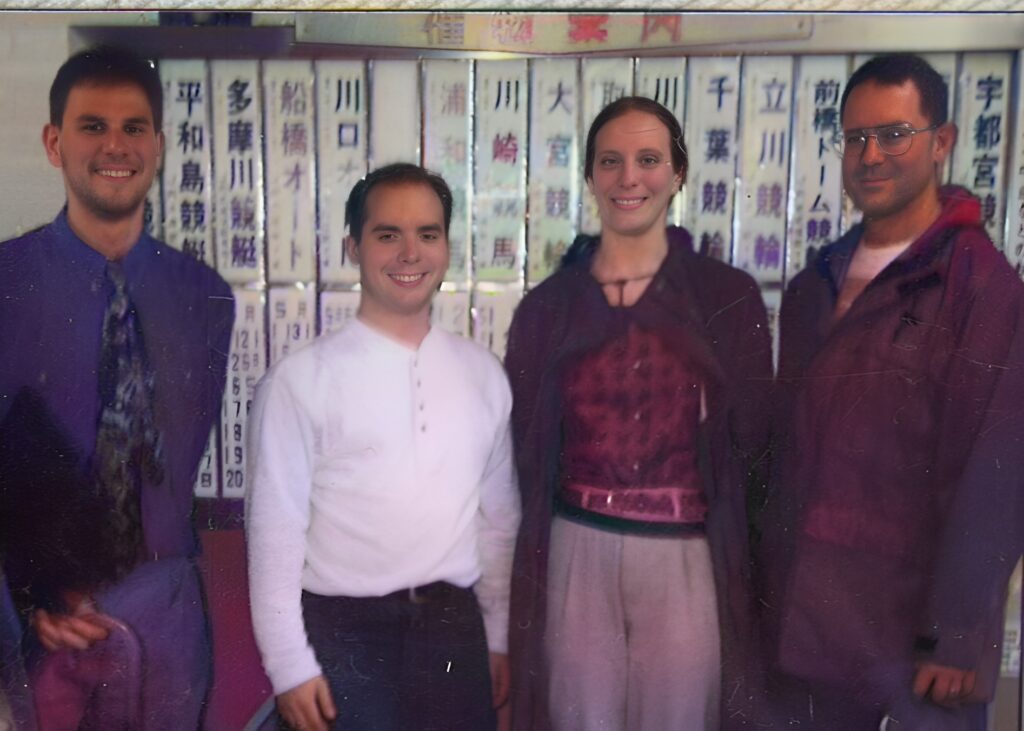
Through my work in Tokyo, I became friends with Meik and Diane Skoss, both serious practitioners of the Japanese martial traditions and students of Donn F. Draeger, whose research and writing had done much to introduce classical Japanese martial arts to Western readers.
One day I asked Meik to teach me the fundamentals of Kenjutsu. Meik took me to a dojo, a traditional placer where Japanese martial arts are trained. I didn’t realize it at the time, but something that happened there would eventually change the way I understood what martial arts training actually develops.
Learning an Unfamiliar Weapon
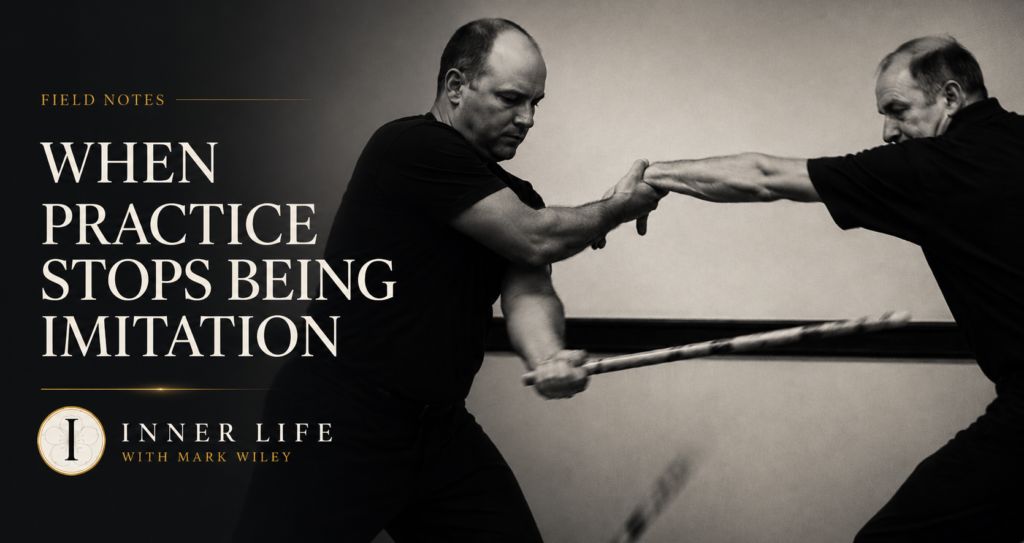
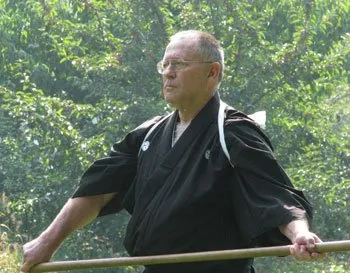
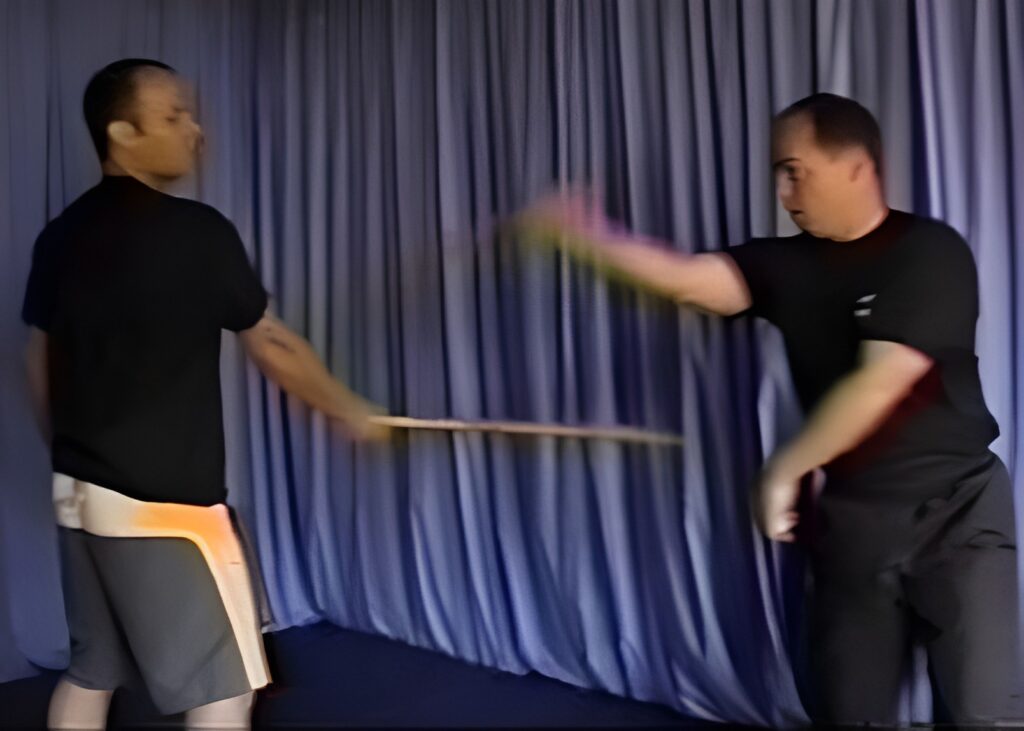
Meik handed me a wooden sword—a bokken—and took one himself. He began methodically showing me several fundamental movements: how the weapon was held, how particular cuts were organized, and how I might receive or deflect an incoming strike. We practiced the movements in the air. I followed as carefully as I could, trying to reproduce what he demonstrated.
The movements themselves were not difficult to understand. But understanding a movement and possessing it are very different things. I had only just been shown them. I had none of the thousands of repetitions that allow a practitioner of Japanese swordsmanship to refine grip, posture, angle, distance, timing, and coordination until they operate as a unified action.
After some time, Meik asked me to face him. He positioned me in a particular guard and explained that he was going to strike. My task was simple: recognize the attack, use one of the defenses I had just learned, and try not to get hit.
We stood facing one another. I concentrated.
Waiting for the Attack
One thing years of martial arts training had already taught me was not to become fixated on the weapon. If I stared at Meik’s hands or the bokken, my awareness would narrow. Instead, I deliberately widened my gaze so that I could take in more of his body at once. I was watching without trying to look at any one thing in particular.
I hoped I might catch something before the attack itself—a shift of weight, a tightening of the shoulders, a change in posture, some small preparatory movement that would tell me what was coming. For several moments, nothing happened.
Then Meik suddenly turned his head to his right and called hello to someone at the far end of the dojo. I looked.
At that exact moment, he attacked.
His bokken was already descending toward me with speed and power. I moved left, deflected his sword with mine, and immediately countered. Meik laughed. I exhaled. I hadn’t been hit.
More importantly, I hadn’t thought about what I had just done.
There had been no time to remember the technique. Something else had responded.
The Technique Was New. The Capacity Wasn’t.
It would have been easy to interpret what happened as evidence that I had quickly learned the Japanese sword defense Meik had shown me. But that isn’t what happened. I couldn’t have been proficient in a method I had practiced for only a short time, and I certainly hadn’t embodied Japanese swordsmanship in an afternoon.
What I did have were years of experience developed through other martial arts and, especially, through weapons training. I knew something about distance and timing. My body understood what it meant for a weapon to enter my space. I had developed coordination between perception and movement, some ability to recognize an incoming line of force, and enough familiarity with combative interaction to respond rather than freeze when something suddenly came toward me.
None of those capacities belonged exclusively to Eskrima, jujitsu, Wing Chun, or Japanese swordsmanship. The outward technique had changed, but something underneath it had transferred.
That distinction became increasingly important to me as my training continued.
What Actually Transfers Between Practices?
Martial arts are often taught through techniques. We learn where to place the hand, how to step, where to turn, what angle to use, how to hold a weapon, and what response corresponds to a particular attack. We need those forms. They provide a structure through which learning can begin.
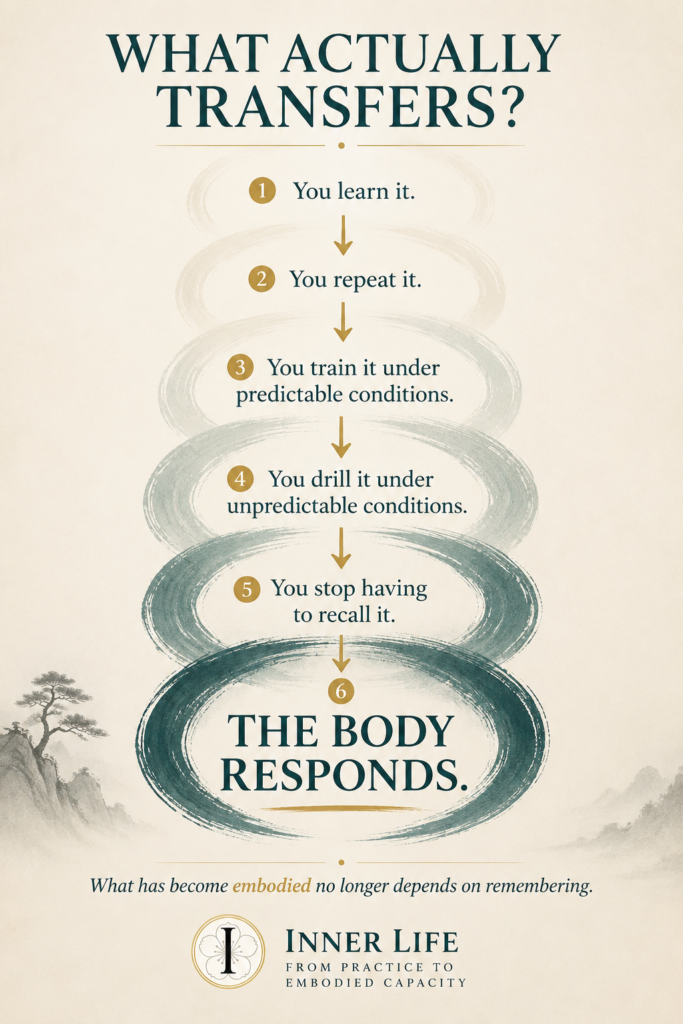
But if development remains attached to the form, our ability may remain attached to the circumstances in which we learned it. Change the weapon. Change the distance. Change the timing. Change the opponent. Remove the preparation. Introduce surprise.
What remains?
This is one reason I have become increasingly interested in the capacities beneath techniques. A particular drill may cultivate sensitivity. Another develops stability. Another teaches distance, timing, structural organization, spatial awareness, or the ability to remain responsive under pressure. Initially, we experience these capacities through the exercise that develops them. Eventually, however, something interesting can happen: the capacity becomes less dependent upon the exercise.
The deeper purpose of a technique may not be the technique itself, but what practicing it teaches the body to recognize and do.
When There Is No Time to Remember
The element that made the encounter with Meik so revealing was the distraction. Had he simply announced the attack and then struck while I stood prepared, I might have consciously attempted the defense he had just taught me. Success would have told me relatively little. I would have been performing a recently learned response under anticipated conditions.
Instead, he deliberately pulled my attention elsewhere. The moment I looked away, the conditions changed. There was no time for me to think: Here comes the strike. Which defense did he show me? Where does my hand go? How should I step? By the time such thoughts could have occurred, the bokken would already have hit me.
The response had to emerge before deliberate thought could organize it.
This does not mean thought is unimportant, nor does it suggest that conscious learning can be bypassed. Quite the opposite. Years of conscious repetition, correction, failure, attention, and experience helped create the conditions from which that spontaneous response became possible.
But eventually the relationship changes. Something we once had to remember becomes something we can do. Something we once had to do deliberately begins to organize itself. And sometimes something learned in one context becomes available in another.
From Technique to Embodied Capacity
This experience has implications far beyond martial arts. We can learn a breathing method and become calm while performing it, but what happens when a difficult conversation begins before we have time to regulate our breathing? We can cultivate awareness during meditation, but is that awareness available when someone insults us? We can practice stability while standing quietly, but does that organization remain when another person pushes us, circumstances change unexpectedly, or we become frightened?
We can understand patience, compassion, presence, or non-reactivity as principles. But what happens before we have time to remind ourselves to be patient, compassionate, present, or non-reactive?
These are different versions of the same developmental question:
while also controlling range and gate.
What remains available when we can no longer depend upon the practice that originally cultivated it?
This is where I think embodiment becomes a useful distinction. Embodiment is not simply being able to perform something extremely well. Nor is it accumulating enough repetitions that a technique becomes automatic. Something deeper has happened when the underlying capacity begins to reorganize how we meet circumstances beyond the original practice.
What Practice Leaves Behind
Looking back, I don’t remember every Japanese sword movement Meik showed me that day. That may be the most interesting part of the story. The particular movements were not what endured.
What endured was the recognition that years of martial arts training had changed something more fundamental than my collection of techniques. Certain relationships among perception, distance, timing, movement, and response had become sufficiently integrated that they could appear in a situation for which I had not specifically prepared.
I had entered that dojo thinking I was learning how to use a different weapon. Instead, for a few seconds, the unfamiliar weapon revealed something about what all those previous years of training had actually left behind.
Perhaps this is one of the most useful questions we can bring to any serious practice:
If the method disappeared tomorrow, what would remain?
The answer may tell us more about our development than everything we have learned to perform.
Continue Exploring