When Practice Becomes Shared
Entering Practice Field Training
by Mark V. Wiley
This reflection explores the lived experience of what Inner Life calls the Practice Field—a condition that emerges when systems begin to align and function together.
→ Read the full framework: The Practice Field
There is a point in practice where things begins to emerge—whether in meditation, qigong, or martial training—where something begins to shift. The effort required to settle decreases. Awareness stabilizes more quickly. Sensitivity increases without strain. And often, this shift becomes most noticeable not when practicing alone, but when practicing with others.
Something emerges—not as an idea, and not as belief, but as direct experience. A condition. A field. The Practice Field.
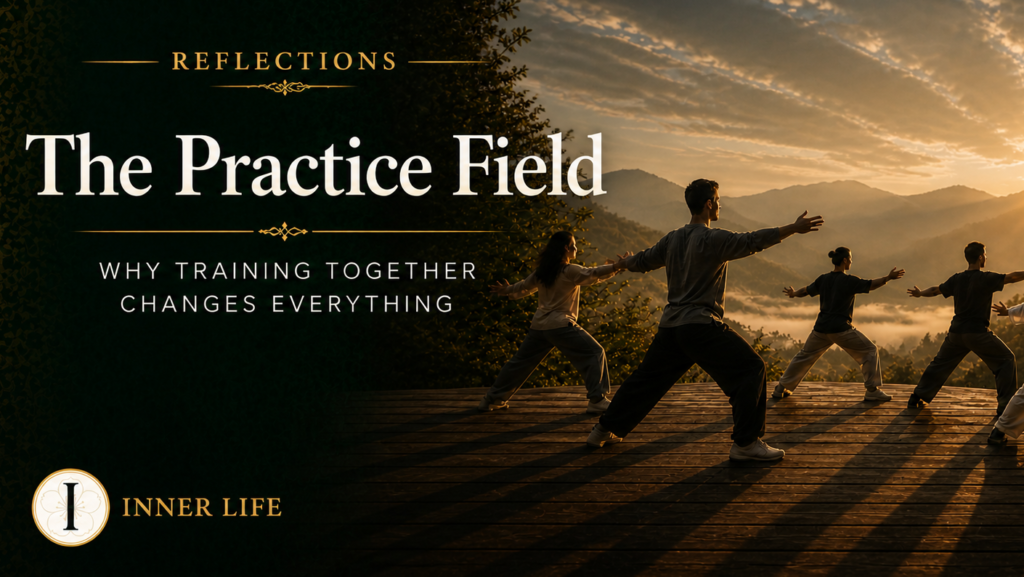
Within the Inner Life framework, the Practice Field is not treated as mystical by default. It is understood as the natural result of coherence across systems. When practitioners align body, breath, attention, and intention, these processes do not remain isolated within individuals. They begin to interact, reinforce, and synchronize. What arises from this is what can be called the Practice Field—a condition that is shared, not owned.
“The Practice Field is not a place—it is a condition that emerges when coherence is shared.” —Mark V. Wiley
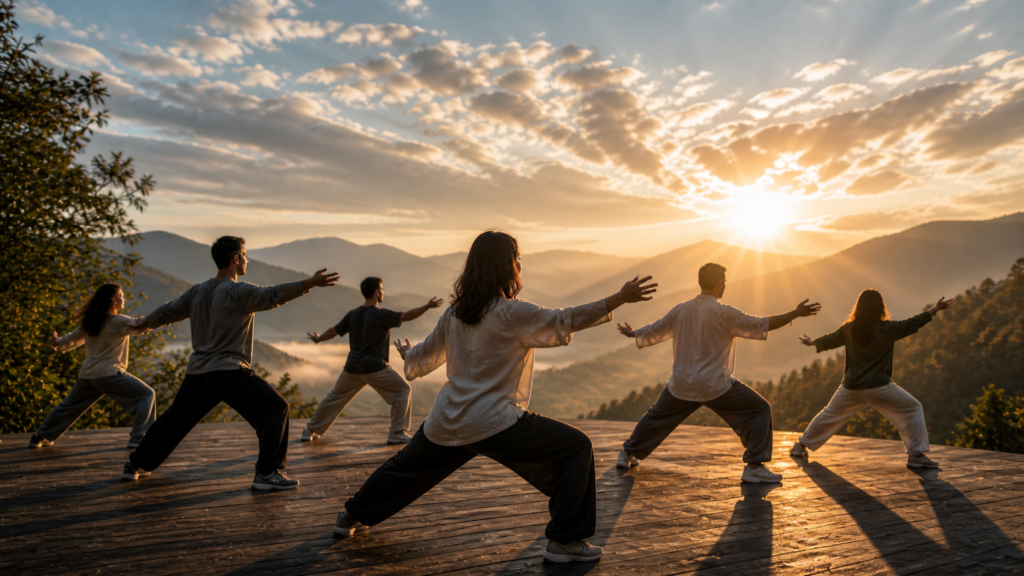
The Practice Field is not something one enters as if stepping into a location. Nor is it something that exists independently of those practicing. It is a condition that arises through alignment. In this condition, internal noise decreases, perception becomes more refined, stability requires less effort, and depth becomes more accessible. Practitioners often describe it simply: it feels as though the space itself is supporting the work.
This is where the field becomes palpable—not as something mystical, but as something functional.
Why Group Practice Changes Everything
This coherence is what allows group practice to function differently from solo training. In solo practice, one must stabilize breath, attention, and structure alone. In group practice, these same processes are mutually reinforced.
Instead of building stability in isolation, one enters a condition where stability is already present and can be participated in. This is why meditation deepens in retreats, qigong becomes more tangible in groups, and martial timing sharpens through partner training.
It is not that something is being added from outside. It is that conditions are being created in which coherence becomes more accessible.
Two Directions of Practice
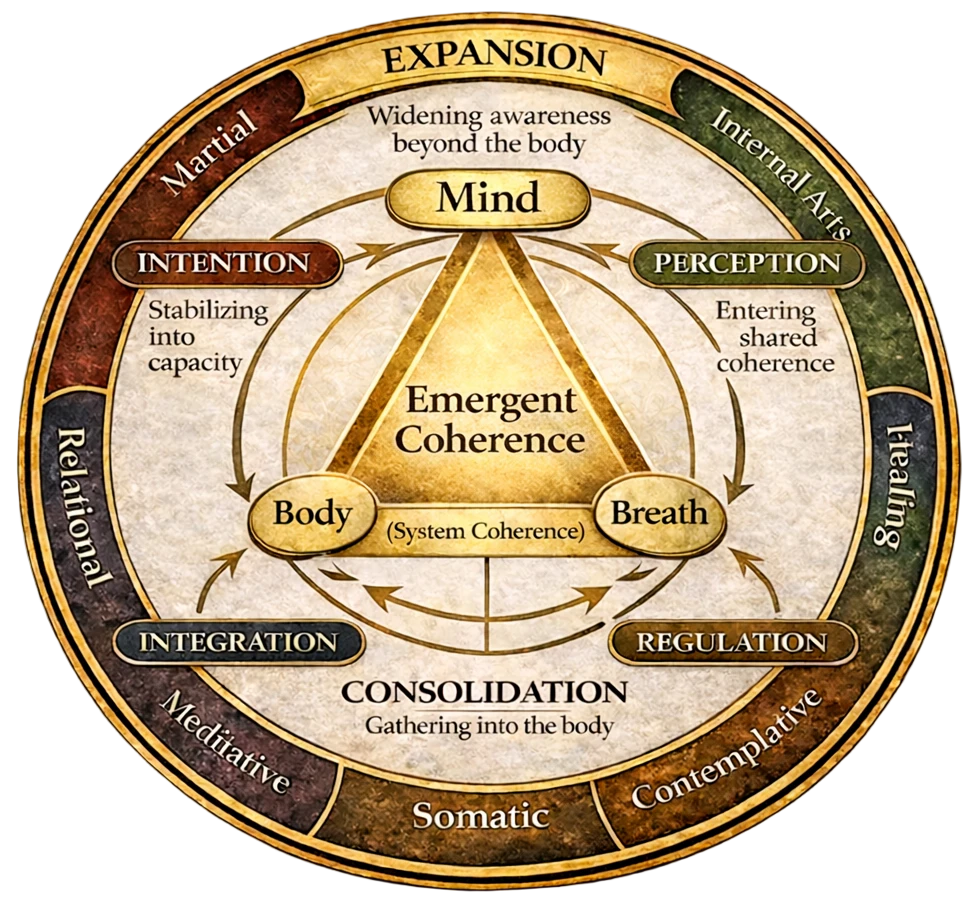
Within this process, two complementary directions of practice emerge: expansion and consolidation.
Expansion is the widening of awareness beyond the body. Perception begins to include space, others, and environment. Sensitivity increases, and the practitioner becomes capable of perceiving relational dynamics more clearly. This allows entry into the Practice Field.
Consolidation is the gathering of awareness into the body. Breath becomes internal and continuous. Sensation becomes unified and dense. Attention stabilizes within the body. This allows what has been accessed to become embodied and stable.
“Expand to connect. Consolidate to embody.” —Mark V. Wiley
These are not opposing movements. They are a cycle. Expansion without consolidation leads to dispersion. Consolidation without expansion leads to stagnation. Real development requires the ability to move between both—fluidly and without loss of coherence.
Over time, this cycle becomes more refined. Less effort is required. The boundary between inner and outer becomes less rigid.
From Group Field to Lived Capacity
The deeper implication is simple, but often overlooked: human development is not only individual. It is relational.
We do not practice in isolation, even when alone. We are always practicing within conditions—internal, environmental, and collective—that shape what becomes possible.
At a certain level of practice, the field itself becomes part of the training—not as something abstract, but as something functional. Something that can be entered, stabilized, and embodied. And in time, something that is no longer dependent on the presence of others.
“At a certain level, the field stops being something you enter—and becomes something you carry.” —Mark V. Wiley
About Reflections
Reflections are explorations of practice, insight, and inquiry along the path of inner development. They are writings shaped through ongoing practice, study, and lived experience. Some are developed essays exploring principles across martial, contemplative, and philosophical traditions, while others are brief notes—observations and insights that arise within the unfolding of practice itself. Across cultures, reflection has long been part of real cultivation, allowing experience to be examined, patterns to be recognized, and understanding to deepen over time. These writings do not offer final conclusions, but follow a process in motion—where ideas are tested, refined, and sometimes dissolved. Each entry marks a moment where practice and insight begin to come into alignment.
Continue Exploring Transformative Practice