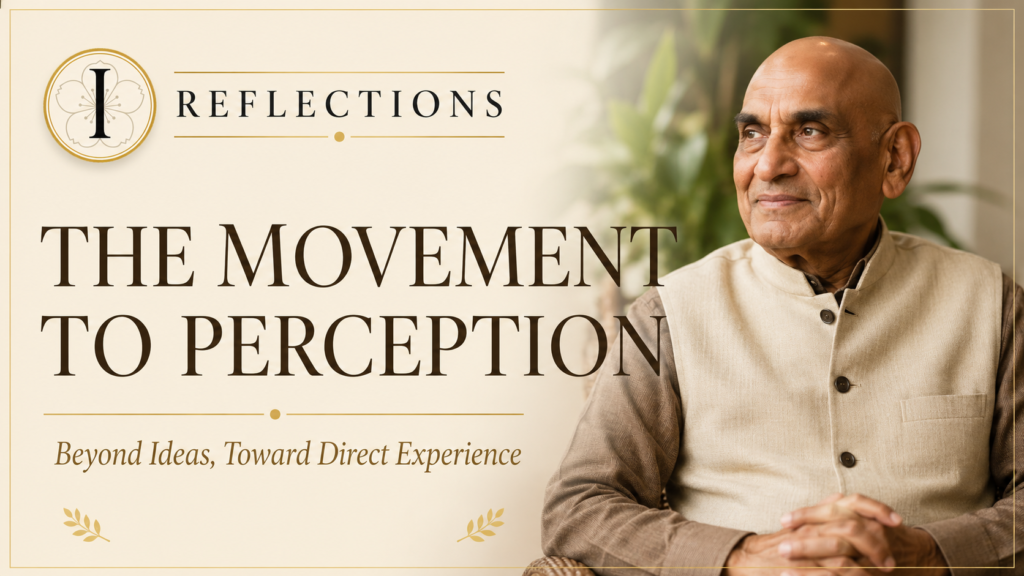
Embodiment and Human Transformation
with Dr. Baffour Jan
Embodiment, perception, and the relationship between balance, awareness, and transformation
Dr. Baffour Jan on Gaining Balance and Insight in Life
Rather than approaching change through thought, belief, or analysis, in this conversation, Dr. Baffour Jan describes a bottom-up process: when the body comes into balance, the breath follows; when the breath stabilizes, the mind settles; and when the mind becomes quiet, awareness reveals itself.
“Transformation does not begin in the mind. It begins in balance.” —Dr. Baffour Jan
At the center of this Dr. Baffour Jan emphasizes a profound claim: suffering is not something to be fought directly. It is a consequence of imbalance and the false sense of separateness that arises from it.
As balance deepens, identity itself begins to shift. What once felt like a fixed, separate self is revealed as partial—constructed through perception and sustained by imbalance. What emerges in its place is not a new identity, but a return to wholeness: a state of inclusion, clarity, and natural coherence.
“Suffering is not something to be solved—it is something that resolves as balance returns.” —Dr. Baffour Jan
The conversation moves beyond philosophy into lived reality—touching on the physiology of emotion, the mechanics of breath, the nature of consciousness, and the subtle distinction between genuine realization and the many experiences that can distract from it. This is not a path of accumulation. It is a process of alignment.
“Experience is not realization. It is still within the field of illusion.” —Dr. Baffour Jan
Key Themes
- Why transformation begins with the body, not the mind
- The relationship between hormones, breath, and mental states
- Balance as the foundation of clarity, peace, and perception
- The emergence and dissolution of false identity
- Why suffering cannot be solved directly
- The difference between realization and psychic or spiritual experiences
- Returning from fragmentation to wholeness
What This Conversation Reveals
This conversation points to a shift in how transformation is understood. Rather than beginning with thought, belief, or analysis, it begins with regulation—bringing the body, breath, and nervous system into balance.
From this foundation, perception changes. The mind quiets not through effort, but because the conditions that sustain agitation are no longer present. What emerges is not a new identity, but a loosening of the structures that create fragmentation. In this sense, transformation is not something imposed. It is something that unfolds when the system returns to coherence.
What this ultimately suggests is a reversal of how practice is commonly approached. Rather than beginning with effort directed at the mind—trying to think more clearly, control attention, or impose stillness—the emphasis shifts to the conditions that give rise to those states.
In this view, the mind is not the primary actor. It is the surface expression of deeper processes—physiological, rhythmic, and systemic. When those processes are brought into balance, the mind does not need to be forced into clarity. It settles on its own.
This has practical implications. It reframes what practice is and where it begins. Not with interpretation, but with regulation. Not with control, but with alignment. From there, what emerges is not something added, but something revealed—an awareness that was never absent, only obscured by imbalance.
About the Guest

Human Development, Inner Stability, and Transformation Beyond Reactivity
Dr. Baffour Jan is a mystic and teacher whose work explores human development, contemplative psychology, and the dynamics of inner transformation. His approach integrates philosophical rigor with practical insight, emphasizing the stabilization of the human system beyond reactive patterns and polarity.
Visit Visit Dr. Baffour Jan‘s Website
Visit Dr. Baffour Jan’s YouTube Channel
Continue Exploring