
INNER LIFE ECOSYSTEM
The living environment in which embodied human development is cultivated
What Is the Inner Life Ecosystem?
The Inner Life Ecosystem brings together distinct domains of practice—martial, contemplative, internal, somatic, healing, and relational—within a living process of development.
Each domain offers a different way of working with human experience. Some cultivate awareness and perception. Others develop structure, movement, regulation, or responsiveness. Each reveals something important, but none operates entirely independently of the others.
What makes this an ecosystem is not simply the presence of different practices, but the relationships among them.
What develops through stillness may change how we move. What we discover through movement may reveal patterns of tension or attention. Interaction may expose limitations that were not apparent during solitary practice. These discoveries, in turn, inform how we return to stillness, movement, or contemplation.
Development becomes a process of continuous interaction, refinement, and integration.
Rather than treating different disciplines as separate paths, Inner Life explores how they can inform, challenge, and support one another—and how what develops through practice becomes available in everyday life.
From Domains to Development
Different traditions often begin with different aims. Meditation may emphasize attention and awareness. Martial arts may develop structure, coordination, and responsiveness. Internal practices may explore breath, physiology, and subtle perception. Healing methods may address restriction, imbalance, and recovery.
Although their methods differ, they frequently work with overlapping dimensions of human experience.
A practitioner developing stability through standing practice may recognize the same organizational principles during movement. Greater sensitivity to breath may reveal changes in emotional state. Improved awareness of tension may influence how someone responds during a difficult conversation.
In this way, development in one domain can become a resource for another.
However, transfer is not automatic. A quality available under familiar practice conditions may disappear when circumstances change. Someone may experience calm during meditation yet become reactive under pressure. A person may demonstrate coordinated movement in training but lose that organization during an unexpected interaction.
These differences are useful. They reveal where development is established, where it remains dependent on particular conditions, and where further integration is needed.
Integration does not come from doing more. It comes from how practice begins to connect.
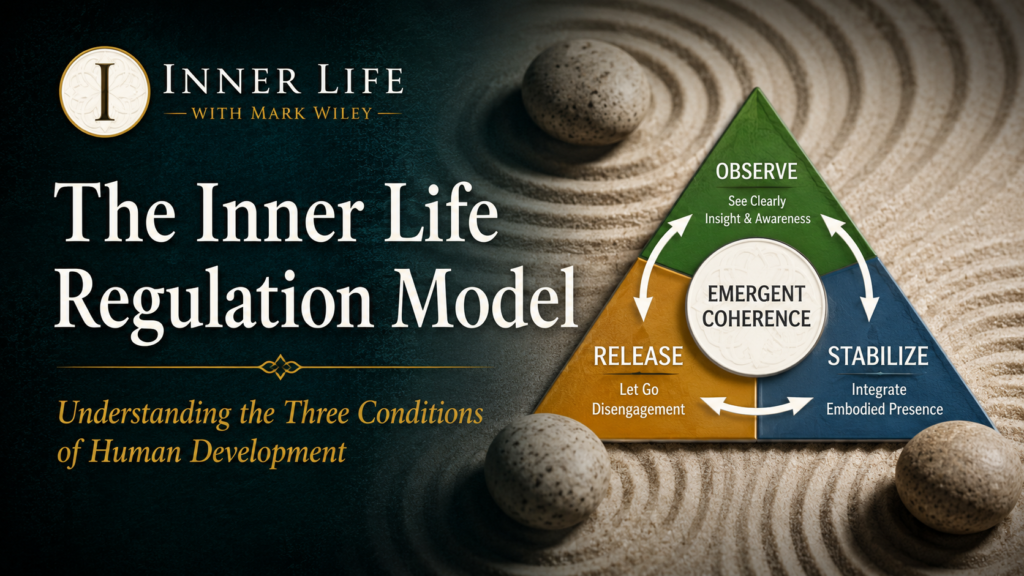
The Regulation Model – Finding Balance
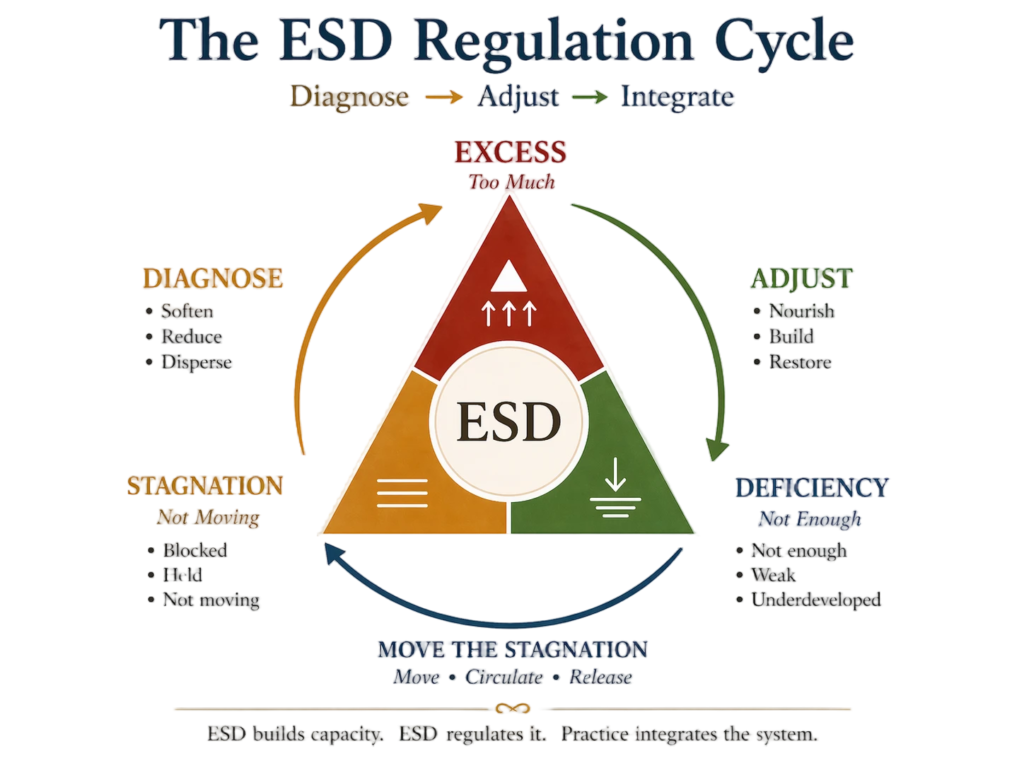
As different domains interact, patterns of organization and imbalance become easier to recognize.Within the Inner Life framework, three recurring conditions provide a practical way of examining these patterns:
- Excess — When effort, tension, stimulation, or activity exceeds what a situation requires.
- Stagnation — When movement, responsiveness, or adaptation becomes restricted or held.
- Deficiency — When the organization, resources, or capacities needed for a situation are insufficiently developed or unavailable.
These conditions are not fixed labels for a person. They describe patterns that may arise within particular activities, circumstances, or states.
For example, someone attempting to maintain stability may use excessive muscular effort. Another person may become so fixed in a posture or method that adaptation becomes difficult. In a different situation, a practitioner may lack the coordination or awareness needed to respond effectively.
Recognizing these patterns helps guide how practice is adjusted.
The aim is not to eliminate all variation or maintain an ideal state at every moment. It is to develop greater sensitivity to what is happening and the ability to reorganize as conditions change.
The Inner Life Regulation Model explores these patterns in greater detail, including how regulation, stability, and responsiveness relate to embodied development.
The Logic of Integration
The relationship among practices becomes especially important when we consider how development occurs over time.
Learning a method is one thing. Developing the ability to use what it cultivates across different conditions is another.
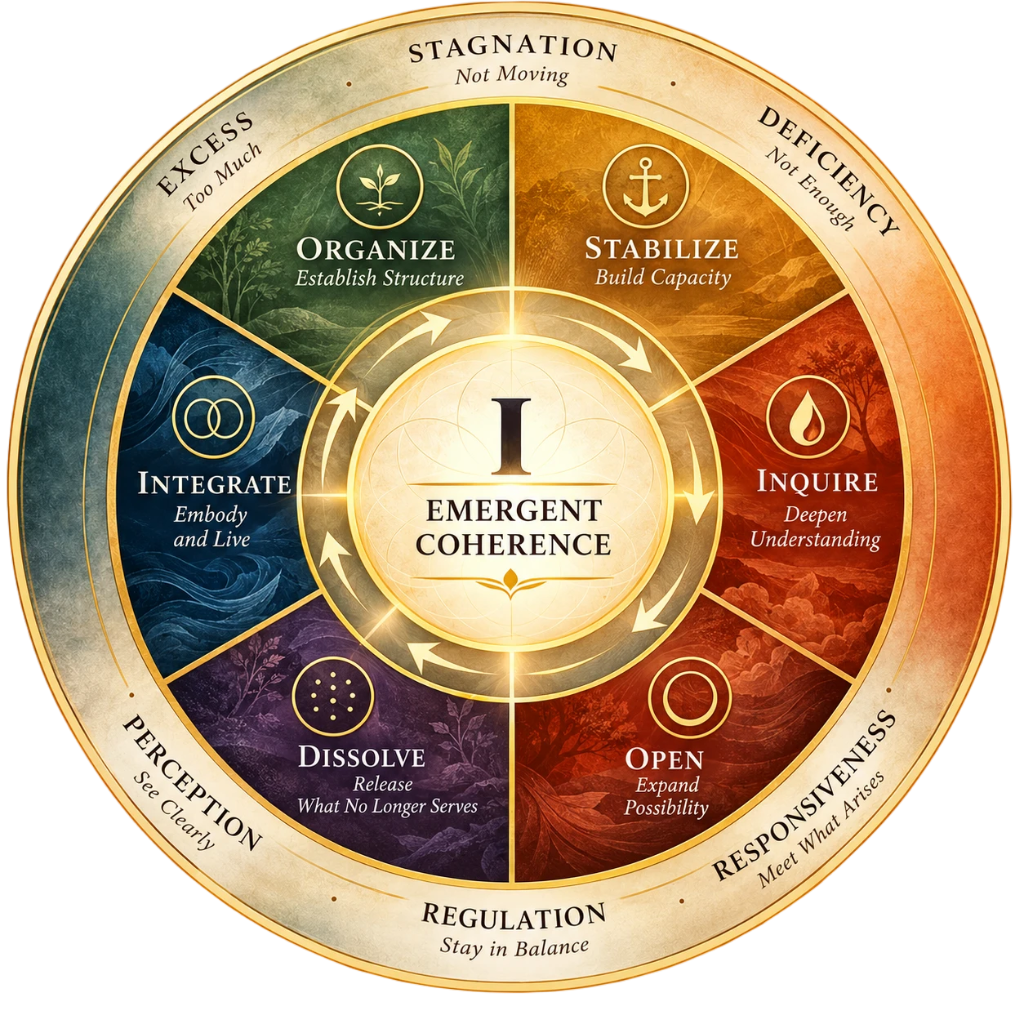
A practitioner may first learn to recognize unnecessary tension through standing practice. Movement then reveals whether that awareness remains available during transitions. Variation introduces unfamiliar rhythms, directions, or demands. Interaction adds feedback that cannot be completely anticipated or controlled.
Each context reveals something different about the same developing organization.
The purpose is not to abandon individual methods or combine them indiscriminately. Each practice has its own principles, functions, and developmental value. Integration requires understanding these distinctions while exploring where meaningful connections exist.
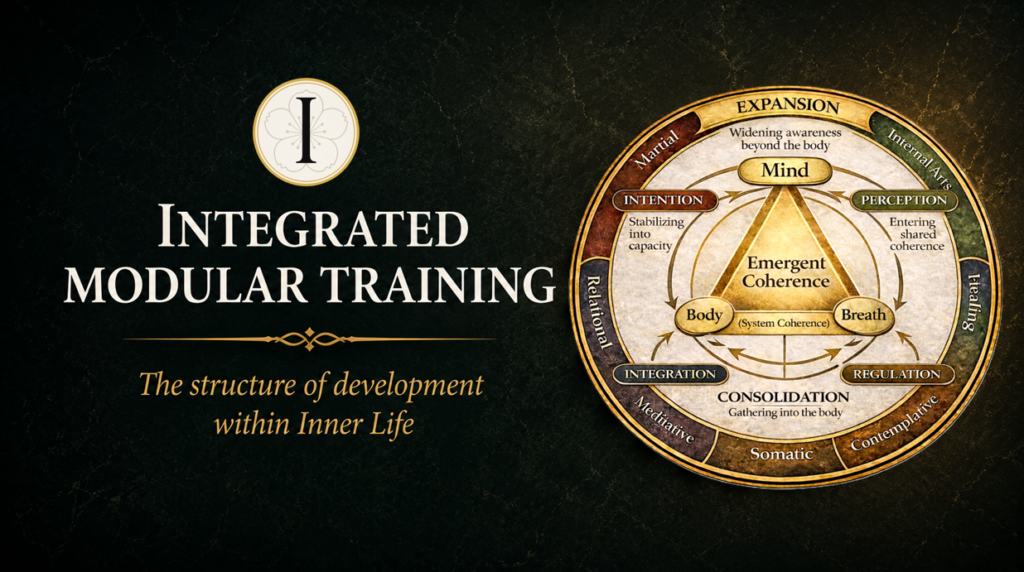
This understanding contributed to the development of Integrated Modular Training (IMT).
IMT provides a way to select, organize, combine, vary, and test practices according to what is being developed. Rather than treating methods as isolated routines, it examines their functions and relationships.
Within the Ecosystem, IMT serves as a practical methodology for working across domains. The Ecosystem describes the relationships. IMT provides a way of working deliberately with them.
An Ecosystem of Practice
The Inner Life Ecosystem includes seven interconnected domains. Each offers a distinct perspective on development, while sharing important relationships with the others.

Internal Arts — Practices such as qigong, neigong, and related internal disciplines explore breath, internal organization, movement, and perception. They can develop sensitivity to processes that are often overlooked during ordinary activity.
Their relationship with somatic, meditative, martial, and healing practices helps clarify how internal experience connects with movement, function, and everyday life.
Meditative Practice — Meditation cultivates attention, awareness, and the ability to recognize experience as it unfolds.
Its relationship with movement and interaction helps explore whether qualities developed in stillness remain available when attention is divided or circumstances become demanding.
Martial Practice — Martial disciplines develop structure, coordination, timing, adaptability, and responsiveness through movement and interaction.
They provide opportunities to examine how awareness, regulation, and organization function when conditions become less predictable.
Contemplative Traditions — Contemplative inquiry and wisdom traditions explore questions of meaning, identity, consciousness, and our relationship with existence.
They offer perspectives that can deepen the significance of direct experience while inviting examination of whether understanding has become embodied.
Somatic Practice — Somatic methods develop sensitivity to bodily experience, patterns of tension, movement, and internal organization.
They help reveal how habitual responses influence perception and action, while providing opportunities for greater differentiation, regulation, and coordination.
Healing Practice — Healing approaches address conditions that may limit comfort, function, recovery, or participation in practice.
They can support the conditions necessary for development while remaining distinct from the broader process of cultivation and integration.
Relational Practice —Relationships introduce forms of feedback that solitary practice cannot fully reproduce.
Listening, communication, cooperation, disagreement, and shared activity reveal how presence, awareness, and responsiveness operate with other people.
Across these domains, the aim is not to become equally proficient in every discipline.
It is to recognize what each can contribute, how their relationships can support development, and where experience reveals the need for further refinement.
Each domain offers a different entrance. Their interaction reveals a larger field of development.
Integrative / Bridge Practices
Some practices naturally engage several domains at once. These can serve as bridges, helping practitioners recognize and explore relationships that might otherwise remain unnoticed.
Different forms of practice bring these connections into experience:
- Standing Practice — brings together postural organization, breath regulation, somatic awareness, and sustained attention.
- Movement Practices — carry these qualities into changing positions, rhythms, and patterns of coordination.
- Interaction Practices — introduce external feedback, requiring perception, movement, and responsiveness to remain coordinated.
- Contemplative & Devotional Practices — including dhikr, chanting, and repeated remembrance, may engage attention, breath, rhythm, emotion, and embodied awareness.
- Internal Cultivation Practices — including qigong, neigong, and internal martial training, connect physiological awareness with movement, structure, and coordinated expression.
The value of these practices is not that they erase distinctions among disciplines. Rather, they allow relationships between different aspects of development to be explored directly.
Through practice, we may begin to recognize how:
- Changes in breathing influence muscular tension and effort.
- Reorganizing posture affects stability, movement, and perception.
- Greater attentional stability influences responsiveness during interaction.
- Changes in rhythm or movement reveal patterns of tension, coordination, or adaptation.
- Qualities developed in one practice become available in another.
These relationships can then be explored, refined, and tested under different conditions, helping what develops through practice become increasingly available in everyday life.
A bridge practice is valuable not simply because it involves several elements, but because it helps reveal how those elements influence one another.
Note: Physiological signals such as heart rate variability may reflect this process—but they do not produce it.
Embodiment: The Thread That Holds It Together
The Inner Life Ecosystem is ultimately concerned with what becomes available through practice.
Understanding a principle does not necessarily mean we can express it. Experiencing stability in one setting does not guarantee that it will remain available in another. Recognizing a pattern is not the same as being able to respond differently when that pattern arises.
Embodiment is the ongoing process through which cultivated qualities become increasingly integrated into perception, physiology, movement, attention, and action.
It can be explored through questions such as:
- Does awareness developed in stillness remain available during movement?
- Can stability be maintained without unnecessary rigidity?
- Does greater sensitivity lead to more appropriate responses?
- Can we recognize disruption, reorganize, and return to continuity?
- Do qualities cultivated through practice become available in relationships, work, and everyday circumstances?
These questions shift attention from what a practitioner knows or can demonstrate under familiar conditions toward what has become part of how they actually live.
Physiological measurements and other observations may provide useful information about particular aspects of this process. However, no single measurement establishes the degree to which a person has become integrated or embodied.
What matters is the developing relationship among experience, organization, responsiveness, and lived expression.
The Inner Life Ecosystem is therefore not a collection of methods to accumulate or a fixed sequence everyone must follow. It is a living field of practice in which different disciplines reveal, inform, challenge, and refine one another.
Over time, what begins as something deliberately practiced may become increasingly available without requiring the same familiar conditions.
The measure of development is not simply what happens during practice, but what becomes available when life asks for it.
This is how the Ecosystem becomes lived.
This is where practice becomes life.
Explore the Inner Life Framework