

THE INNER LIFE MODEL
A unified system of embodied development
This is not a model to study.
It is a system you enter through practice.
What is described here is drawn from lived experience—and becomes clear only through engagement.
The Inner Life model presents a unified view of human development—integrating contemplative, internal, martial, somatic, and healing traditions into a single coherent system.
What appears as different methods becomes, over time, a shared process of development—one that is lived in the body, expressed in action, and stabilized through experience.
When the system is integrated, coherence emerges.
Measurement reflects this—but does not produce it.
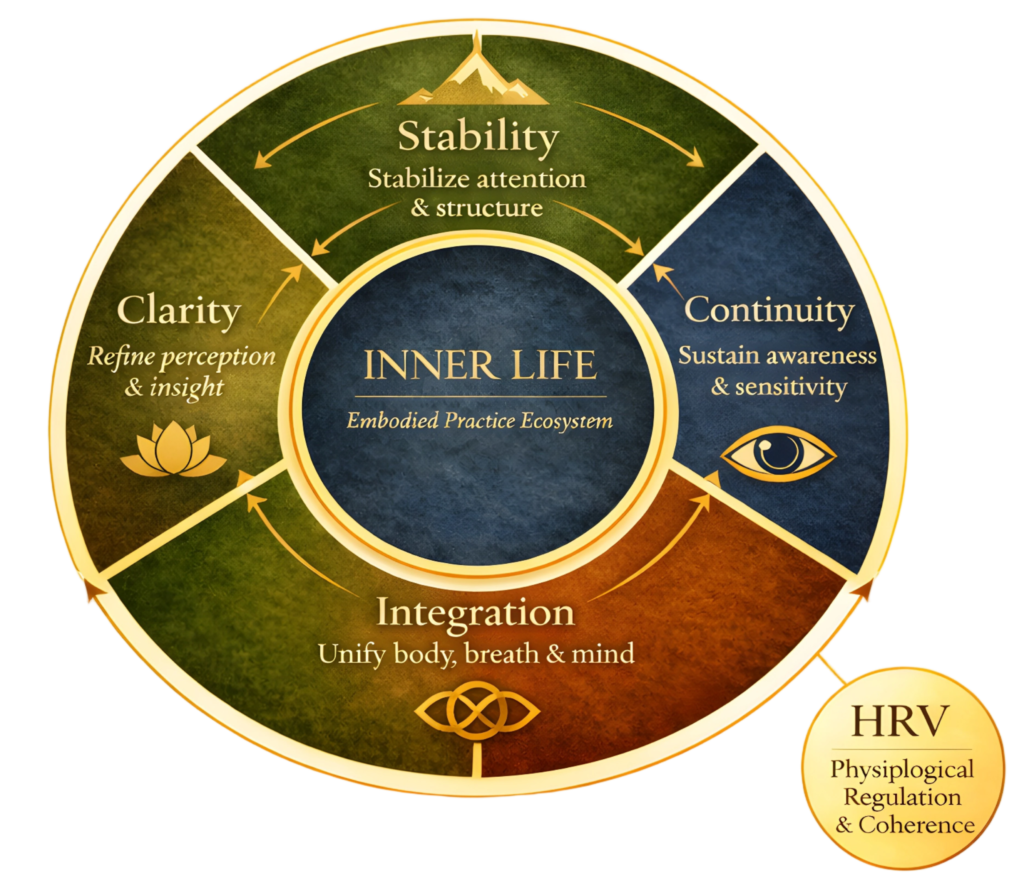
A system of integration, not accumulation.
What is trained separately becomes unified through practice.
The Structure of the System
The Ecosystem
What is being cultivated
The Inner Life ecosystem is the field of practice itself—the living system in which different traditions refine and stabilize one another.
No single domain is complete. It is through their interaction that coherence begins to emerge.
Over time, what begins as separate practices becomes integrated. Attention, breath, structure, perception, and action begin to align into a unified way of being. The ecosystem is not defined by its parts, but by what emerges through their integration.
IMT (Integrated Modular Training)
How it is developed
Integrated Modular Training organizes development around core human capacities—stability, continuity, clarity, and integration. Rather than training techniques, it develops what allows all techniques to function.
Each capacity can be developed through multiple entry points, but all must ultimately be brought into relationship. As these capacities begin to synchronize, the system organizes into coherence. This is experienced directly as integration, and traditionally described as the regulation or emergence of qi.
IMT does not replace traditions. It reveals how they function together.
Practices
How it is experienced
Practice is where the system becomes real. Through direct engagement—standing, breathing, moving, observing—the relationships described in the model take form in the body.
What is learned in stillness appears in movement. What is trained in movement clarifies perception. What is seen in perception reshapes how the body is inhabited.
Practice is not the repetition of techniques. It is the gradual organization of the human system into a coherent, responsive, and embodied state.
ESD (Excesses, Stagnations, Deficiencies)
How it is regulated
Development requires regulation. The system reveals imbalance through three patterns: excess, stagnation, and deficiency.
These are not separate conditions, but ways the system expresses imbalance when capacity is uneven or misapplied.
Integrated Modular Training builds the underlying capacities of stability, continuity, clarity, and integration. The ESD model provides the feedback through which those capacities are regulated. Practice is where both are brought into relationship.
When the System Organizes
As these elements come into relationship, something shifts.
Attention stabilizes. Breath deepens.
Perception refines. Action becomes coordinated.
What begins as method becomes experience.
What begins as practice becomes a way of being.
Inner Life is not a collection of practices.
It is the system through which practice becomes lived transformation.
Enter the System
This is not something understood all at once.
It is entered through practice.
Begin simply. Refine over time.