
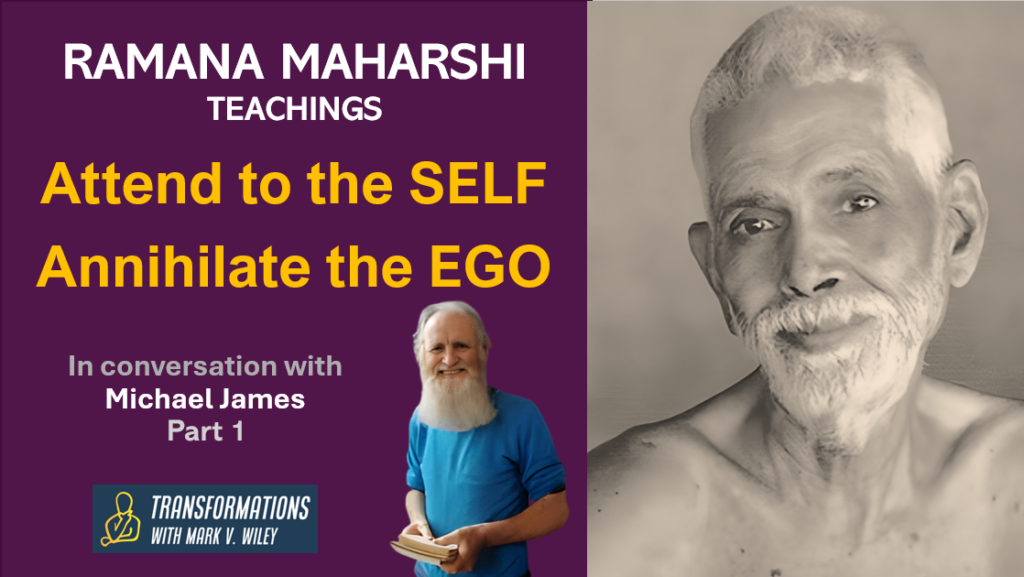
In this episode, we explore Ramana Maharshi Self Inquiry, examining suffering, illness, and death, and why so many sincere seekers struggle to live what he pointed to.
Joined by Ramana scholar and practitioner Michael James, we examine common misunderstandings surrounding Self-inquiry and non-duality. We also explore how these teachings relate to lived human pain. However, rather than merely repeating Ramana’s words, this conversation asks a deeper question: Why is this teaching so difficult to live? And what does it truly demand of us?
Ramana Maharshi (1879–1950), born Venkataraman Iyer in Tamil Nadu, underwent a spontaneous awakening at age sixteen—a direct realization that his true nature was beyond body and mind. He later settled at Arunachala in Tiruvannamalai, where seekers gathered around him, and the Sri Ramana Ashram formed.
His central teaching was simple yet radical: the Self (Ātman) is not separate from absolute reality (Brahman). Through the method of Self-inquiry — “Who am I?” — he invited seekers to trace the sense of “I” back to its source. There, the false ego dissolves and pure awareness remains. Ramana Maharshi Self Inquiry is not a philosophy but a direct turning inward toward the source of awareness.
In this conversation, we explore what that actually means for real human experience.
Explore more conversations on consciousness and integration on the Podcast page.
Learn more about Ramana Maharshi at the official Sri Ramanasramam site.