
THE INNER LIFE ECOSYSTEM
A Living System of Embodied Practice
A coherent, experience-derived model of human development.
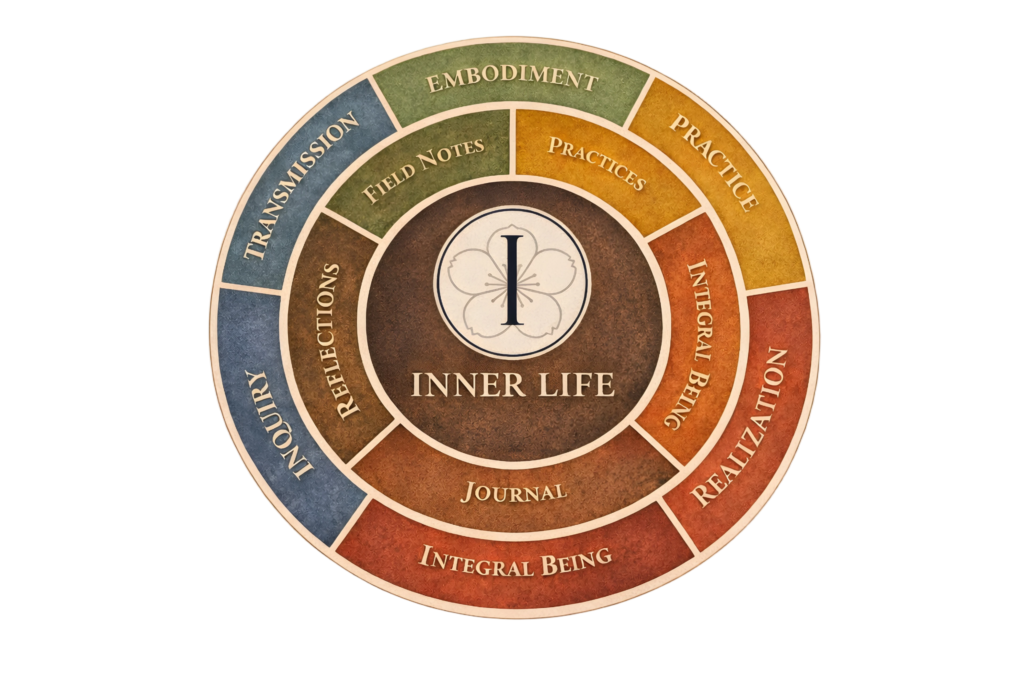
The Inner Life ecosystem is a living system of embodied practice—an environment in which different disciplines refine, inform, and stabilize one another over time. It is not built around a single method or tradition. Instead, it brings together martial, contemplative, internal, somatic, and healing practices as interconnected domains of development. Each begins from a different entry point. Each reveals something essential. But none are complete on their own.
What emerges through their interaction is integration.
Across traditions, different methods appear to cultivate different skills—stillness, movement, awareness, structure. Over time, a deeper pattern becomes visible: what is being developed are underlying capacities that shape how we perceive, respond, and inhabit the world. As these capacities begin to align, the system organizes into coherence. What was once practiced in parts becomes lived as a unified process.
This is the Inner Life ecosystem—not a collection of paths, but a field of integration shaped through practice.
What Inner Life points toward is not a set of methods arranged side by side, but a field of practice in which each domain both reveals and corrects the others. No single discipline is sufficient on its own. Each opens a doorway, but each also carries limitations. It is through their interaction that coherence begins to emerge—something deeper than technique, something lived.
Within this ecosystem, practices do not remain fixed in function. What begins as method becomes perception. What begins as regulation becomes realization. Over time, disciplines begin to overlap, inform one another, and integrate.
As these domains interact, imbalance becomes visible. At times there is too much—effort becomes force. At times something does not move—practice becomes held or stagnant. At times something is missing—capacity has not yet developed. Within Inner Life, these are understood as excess, stagnation, and deficiency—patterns that guide how practice is adjusted as the system moves toward coherence.
This is not a progression from one practice to another, but a deepening through them.
Inner Life is not a single path or method. It is an ecosystem of embodied practices drawn from martial, contemplative, internal, somatic, healing, and relational traditions. At its deepest level, this ecosystem is not defined by its parts, but by what emerges through their integration: a stable, coherent, and embodied way of being.
The Logic of Integration
Inner Life is not only an ecosystem in principle. It is also a way of training.
The question is not simply what practices are included, but how they are brought into relationship—how they are learned, combined, and embodied over time. Across years of training in different disciplines, a consistent pattern began to emerge.
Transformation did not come from exposure to more methods, but from how those methods began to connect and operate together. Practices had to be understood within their own domain—but more importantly, they had to be linked and integrated across domains until they formed a coherent whole.
This understanding led to the development of an integrated approach to training—what I have called Integrated Modular Training.
Integrated Modular Training did not begin as a generalized model. It first emerged in 2007 through Wiley’s work in Filipino Martial Arts, where he began organizing training around core functional capacities rather than isolated techniques. This approach allowed skills developed in one area—timing, structure, responsiveness—to transfer more directly across contexts.
Over time, this pattern proved not only effective, but foundational. Beginning around 2020, Wiley expanded this framework beyond martial training, applying it across his broader work in internal cultivation, healing practices, and contemplative disciplines. What had begun as a method within a specific art revealed itself as a more universal pattern of development.
From this expansion, Integrated Modular Training became the underlying structure through which the Inner Life ecosystem is now articulated—a unifying approach to how practice organizes, stabilizes, and becomes lived.
What began as a training method became a structuring principle for a life of practice.
Within this framework, each domain of practice can be understood as a module. Each develops specific capacities, but none are complete in isolation. It is through their interaction—through linking within domains and integration across them—that deeper stability, adaptability, and embodiment emerge.
In this way, the Inner Life ecosystem is not a collection of parallel paths, but a structured field of cultivation—one in which distinct practices gradually converge into a unified way of being.
An Ecosystem of Practice
Internal Arts
Refining the inner processes of the body
Practices such as qigong, neigong, neidan, and xiu dao develop awareness of breath, energy, and internal organization. Through sustained training, they refine perception from within the body and support the gradual transformation of the human system at a subtle level.
On their own, however, internal processes can become abstract or ungrounded. Their development is stabilized and clarified when integrated with structure, movement, and lived experience.
Meditative Practice
Stabilizing attention and awareness
Vipassana, insight meditation, Daoist quiet sitting (jing zuo, zuowang), and related methods cultivate stillness, clarity, and sustained attention. These practices reveal how perception is shaped and how experience arises moment to moment.
Yet stability alone is not completion. What is seen must be embodied, tested, and lived.
Martial Practice
Developing structure and responsiveness under pressure
Disciplines such as Ngo Cho Kun and Integrated Eskrima cultivate coordination, adaptability, and responsiveness within dynamic environments. They bring awareness into movement, interaction, and real-time decision-making.
Without internal refinement and contemplative depth, however, martial skill can remain mechanical. Its full development emerges when structure, perception, and internal awareness converge.
Contemplative and Wisdom Traditions
Orienting toward reality and meaning
Non-dual traditions—including Advaita, Zen/Chan, Daoism, Sufi metaphysics, and Christian mysticism—provide frameworks for understanding reality, self, and transformation. They clarify what is being cultivated and why.
But orientation alone is not realization. Insight must be embodied to become stable and lived.
Somatic Practice
Restoring sensitivity and structure
Pandiculation, hyperbolic stretching, PNF, standing practices (zhan zhuang), and traditional forms such as Sanzhan, Ba Duan Jin, and Daooyin reorganize the body, improve regulation, and develop structural awareness.
Without deeper integration, however, somatic work can remain therapeutic rather than transformative. Its potential is realized when it connects with breath, attention, and internal development.
Healing and Therapeutic Practice
Rebalancing and sustaining the system
Manual therapies, Muscle Energy Technique, acupressure, diet and nutrition, and Chinese medical frameworks address dysfunction, restore balance, and support long-term sustainability of practice.
Healing creates the conditions for development—but does not replace it. It prepares the ground for deeper cultivation.
Dialogical and Relational Practice
Refining through relationship
Conversation, teacher-student exchange, inquiry, and shared exploration—such as those found in Integral Being—ensure that practice remains open, grounded, and real. Relationship introduces feedback, correction, and perspective.
Without relational testing, development can become isolated or distorted. Dialogue brings practice back into alignment.
Integrative / Bridge Practices
These integrative or bridge practices are the primary means through which this process of linking and integration takes place.
Within the Inner Life ecosystem, not all practices remain confined to a single domain. Some begin as methods of regulation or training, but over time open into deeper perception and realization. These are integrative or bridge practices—methods through which distinct domains begin to inform and transform one another.
Practices such as Sufi dhikr, Buddhist chanting, and internal sound work in Daoist traditions often begin as meditative disciplines. They regulate attention, synchronize breath, and stabilize the nervous system. Yet with sustained engagement, they begin to shift in function. Repetition becomes absorption. Technique becomes perception. The practitioner no longer performs the practice but enters into it.
Other practices connect somatic, internal, and healing processes. Methods such as qigong, neigong, and the Six Healing Sounds regulate physiology, refine internal awareness, and restore systemic balance, while simultaneously deepening perception from within the body.
Some unify martial and meditative development. Forms, Sanzhan, and standing practices stabilize attention within movement, cultivating presence under pressure and coordination within dynamic conditions.
Still others bridge internal, martial, and somatic domains simultaneously. Internal training methods, standing practice, structural conditioning, and systems such as Tian Te Lin Chien integrate breath, structure, and internal force into a unified field of embodied action.
These practices are not secondary or supplemental. They are transitional gateways within the ecosystem—places where development becomes integrated. They reveal that practice is not linear or compartmentalized, but relational, with each domain refining and completing the others.
They also do not remain what they first appear to be. As the practitioner deepens, their function evolves.
In practices such as Sanzhan, what begins as external structure gradually becomes breath, then intention, then internal awareness, then rooting, then perception, then power—eventually expressing as jin, an integrated force arising from the whole body.
At a structural level, these relationships can be seen in how practices begin in one domain and open into others:
• Meditative ↔ Contemplative
Practices that begin with stabilizing attention and open into direct insight and realization
(Dhikr · chanting · self-inquiry · insight meditation)
• Somatic ↔ Internal ↔ Healing
Practices that regulate the body, refine internal processes, and restore systemic balance
(Six Healing Sounds, qigong, neigong)
• Martial ↔ Meditative
Practices that stabilize attention within movement, pressure, and coordination
(Forms, Sanzhan, standing practice / zhan zhuang)
• Internal ↔ Martial ↔ Somatic
Practices that unify structure, breath, and internal force within dynamic conditions
(Neigong, standing, structural training, Tian Te Lin Chien)
Through these integrative practices, the deeper logic of the ecosystem becomes visible.
Practice is not a collection of methods. It is a process of convergence—where attention, structure, breath, perception, and action are gradually brought into alignment and lived as a single, coherent expression.
The Inner Life model is not built around what can be measured, but around what reflects integration across the system. As the system begins to organize coherently, the body expresses this through increasingly stable and coordinated rhythms—what traditional systems describe as the regulation of qi. Modern physiology may observe aspects of this through signals such as heart rate variability, but these remain reflections of the process, not its cause or its completion.
Embodiment: The Thread That Holds It Together
Inner Life is not defined by its categories. It is a field of integration.
Integral Being opens dialogue—but dialogue becomes meaningful only when it changes how we inhabit ourselves. Practices refine attention—but attention matures only when it stabilizes in the body. Field Notes preserve encounters—but encounters transform only when metabolized through lived experience. Reflections articulate insight—but insight remains incomplete until it is felt, breathed, and carried. Learning offers structure—but structure without embodiment becomes information rather than formation.
Embodiment is where conversation becomes character. Where memory becomes capacity. Where reflection becomes posture. Where discipline becomes presence. It is not something added. It is what allows all the rest to take root.
Practice, in this sense, is not a collection of methods but a process of convergence. Distinct disciplines—movement, stillness, inquiry, healing, and relationship—gradually come into alignment, each refining and completing the others.
Over time, what begins as practice becomes a way of being. Not something performed, but something lived. Not something added, but something integrated.
This is the nature of an inner life—not constructed from parts, but cultivated through their integration.
What begins as practice becomes a way of being. This is how the ecosystem becomes lived.
This is where practice becomes life.