
MARK V. WILEY
Practitioner, Teacher, and Field Archivist of Embodied Wisdom Traditions
Origin → Training → Expansion → Documentation → Transmission
For more than four decades, Mark V. Wiley has walked a path through martial, healing, and contemplative traditions—studying not only their techniques, but the deeper principles through which they transform the human body and mind.
His work is not rooted in theory, but in practice.
In time, repetition, correction, and lived experience.
The path began early.
Born three months premature and shaped by years of chronic pain, daily headaches, and recurring
migraines, his first encounter with the body was not through strength—but through limitation.
At the same time, experiences of social pressure and bullying led him toward martial arts—not as sport, but as a means of finding structure, resilience, and self-possession.
What began as a search for relief gradually became a deeper inquiry:
How does the body change through practice?
How does perception shift?
What does it mean to develop—not just skill—but stability?
Beginning his martial arts training in 1979, Wiley immersed himself in traditional systems, eventually training across multiple disciplines and lineages.
He is a grandmaster of Filipino Martial Arts and founder of Integrated Eskrima, and a lineage holder in Ngo Cho Kun (Five Ancestor Fist) kung fu.
But beyond rank or system, his focus has remained consistent:
to understand how training reorganizes the body how structure, timing, and responsiveness emerge how intelligence is built through doing—not explanation
Over time, this inquiry expanded beyond martial systems into the healing and internal traditions that support deeper development.
His work includes extensive training in Chinese medicine, manual therapies, qigong, neigong, meditation, and multiple systems of therapeutic bodywork.
Here, the emphasis shifted:
Here, the emphasis shifted:
from movement to regulation
from technique to integration
from performance to perception
Practice revealed itself not simply as a means of building capacity—but as a process that refines sensitivity, reorganizes the nervous system, and alters how one experiences both body and world.
For more than three decades, Wiley has worked directly with masters, healers, and lineage holders across cultures.
Rather than studying from a distance, he pursued apprenticeship—learning through correction, repetition, and long-term immersion in living traditions.
Since the mid-1990s, his field research has taken him throughout the United States and Asia, documenting systems of knowledge that are rarely written down and often transmitted only through direct
experience.
This work led to his role as a field archivist of embodied wisdom—preserving not only information, but ways of training, ways of seeing, and ways of being.
Alongside this work, he has written, edited, and published extensively.
He holds a Master’s degree in Healthcare Management and doctorates in Oriental Medicine and Alternative Medicine, and is the author of sixteen books and several hundred articles.
Through Tambuli Media, he has contributed to the preservation and
transmission of traditional martial and healing knowledge across generations.
Today, this work continues through Inner Life and Integral Being. Inner Life explores how practice shapes the body, refines perception, and supports human development over time.
Integral Being extends this inquiry through conversations with practitioners, scholars, and teachers—those who speak not from theory, but from lived experience.
Together, these form not a system—but a field of inquiry
into embodiment
into awareness
into what it means to live in alignment with what is real
Across all traditions, a simple orientation remains:
Embodiment over abstraction
Lived insight over theory
Integration over accumulation
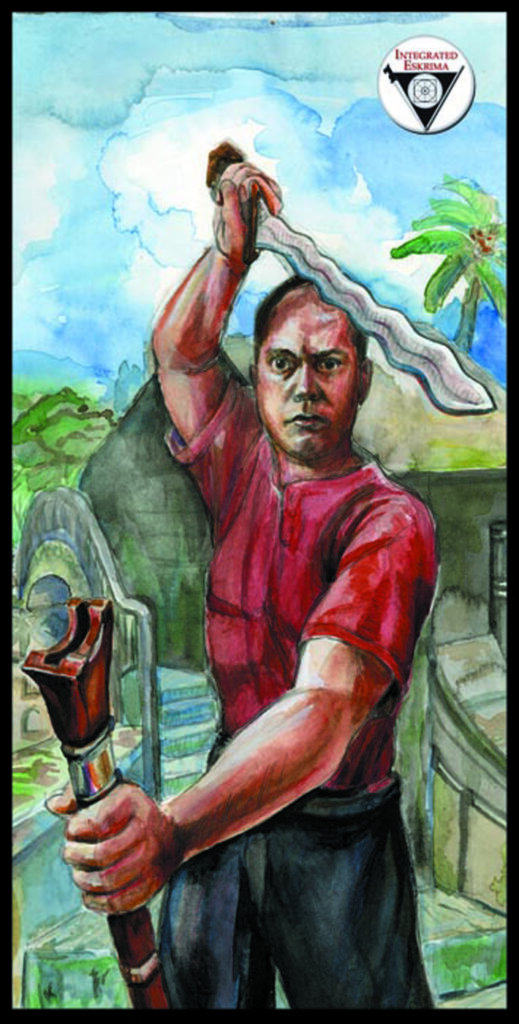

After more than four decades, Wiley continues the work as both practitioner
and student.
Not as someone who has arrived—but as someone still refining.
Still testing.
Still learning.
The path remains what it has always been:
a process of returning—again and again— to what can be felt, verified, and lived
A path walked, as always, as a fellow traveler.